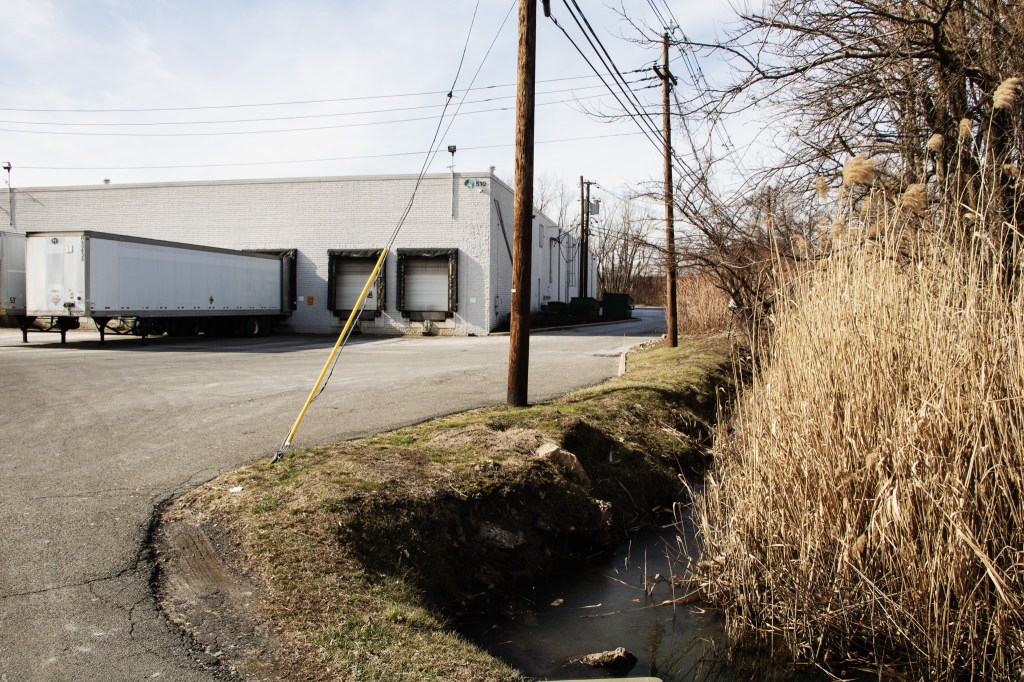
A warehouse at the edge of the marshes in Moonachie, New Jersey. Nate Rosenfield
For centuries, people have tried to control the water in New Jersey’s Meadowlands. But the water has always prevailed.
Nate Rosenfield
It was late. The worst of the rain had passed. Don Torino and his wife, Pat, took turns looking out the window to make sure the flooding in the street hadn’t risen. As the night wore on, they settled down on the couch to watch the news. Their dogs nestled beside them as the rain pattered on the roof of their mobile home.
The Torinos live in Moonachie, a small town in New Jersey’s Meadowlands that sits along the shores of the Hackensack River estuary. Midnight was approaching when the tide came in—the winds of Hurricane Sandy driving the water inland. The river surged into the tributaries that snaked through Moonachie, spilling over onto yards and roads until the town’s tide gates began to fail.
By the time Torino realized what was happening, a river was bubbling through the floor. “It just came up like nothing I’ve ever seen,” he said. Torino panicked. He tried to call 911, but the fire department was overwhelmed.
“Nobody would come in to rescue you,” Torino said. “You had to get yourself out of there.” Torino and his wife picked up their two dogs and walked out into the rain. The freezing water rose to their chests. Dozens of fish swam alongside them as they waded down the river that had once been their street—the same street Torino grew up on.
Flooding was normal in this part of the Meadowlands. Every few years a storm would bring water up the first few steps of the Torino’s trailer. Several years earlier, Torino had to use his aluminum bass boat to help some older neighbors get to high ground during a bad nor’easter. The freezing water gave him trench foot and he had to be hospitalized.
But this time was different; the water just kept rising. As they trudged through the river, Torino found some floating debris for his dogs to stand on. They managed to reach Moonachie Avenue, which sits uphill from the trailer park, and were directed to a recreation center on the corner. The Torinos were freezing and soaked by the time they made it inside. There was no power or heat. Dozens of their neighbors were huddled in the dark, trying to stay warm.
At dawn, Pat’s sister arrived and drove them to Oakland, New Jersey, where Pat’s mother lived. Torino came back to Moonachie the next day to see whether their home was still there. He waded into knee-high water that still filled the trailer park. It smelled of swirling sewage and gas that had leaked from the neighboring houses. The back of his trailer had fallen off its cement blocks, crushing the bathroom. The windows were damaged. And the back of the house was filled with water.

Don Torino outside of his home in Moonachie. Nate Rosenfield
In the following weeks, Torino traveled between Oakland and Moonachie to clean up the wreckage. He scrubbed the walls and surfaces with bleach. He dragged out the putrid carpet, the swollen dresser, the wet mattress. It took five days for the flood water to drain from the area. $24.1 million in damages were suffered by homeowners in the Meadowlands, mostly concentrated around Moonachie and a neighboring town. The Torinos got around $5,000 in state grants to repair their bathroom and $10,000 from FEMA to raise their home by four feet. They hoped it would be enough to stave off the next storm. Without this funding, Torino said, they would have been unable to stay.
“The neighborhood was devastated,” he said. The south end of the trailer park is at an even lower elevation, so the homes there were hit harder. “There’s some people that disappeared after Sandy, that never came back.” He was sad to see his neighbors give up their homes. “I think people just said, ‘I’m not having any more of this.’” In the face of climate change, Torino said that he and his neighbors had few options to protect themselves. Raising their homes was hardly a guarantee. “There’s only so much we’re going to be able to do in the community to get ready for it. You’re trying to get working class people to think about the future of climate change. What are they supposed to do?”
Torino himself never thought of leaving. He had grown up here and he was determined to stay. In any case, there wasn’t a lot of time to think. “We had a lot of work to do,” Torino said.
The Meadowlands is an area of wetlands about the size of Manhattan that rests in a floodplain where the Hackensack River flows into Newark Bay. For decades, people have looked out their car windows in disgust at these trash strewn reeds below the highway. In 1967, the New York Times described it as the “mean and inhospitable land across the Hudson River” filled with miles of “auto graveyards, ponds of sludge and hills of industrial waste.” And yet, in the same breath, the Times called this polluted landscape “the most valuable undeveloped real estate in the United States.” Because of its proximity to one of the most powerful cities in the world, the Meadowlands has been attractive real estate for centuries. As the surrounding landscape was gradually overtaken by industry, this wide tract of land became all the more desirable.
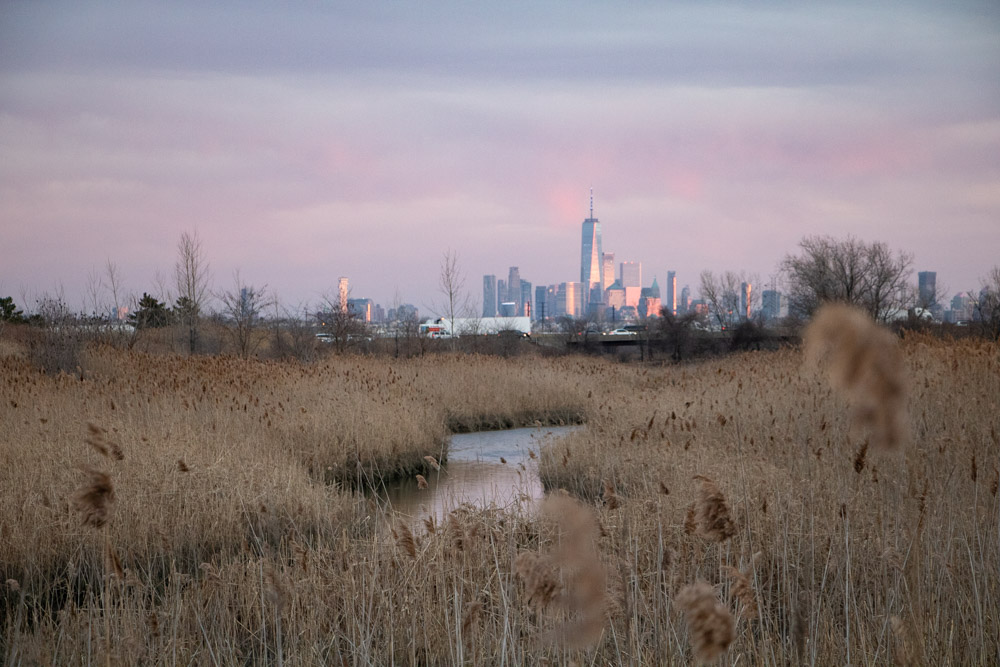
The Meadowlands is a vast area of wetlands less than ten miles from Manhattan. Nate Rosenfield
The pollution of the Meadowlands and its relative lack of development can be traced to one source, which has perennially shaped its history: the relentlessness of its waters.
Its briny waterways once flowed between tangled Spartina grasses and white cedar forests, where hundreds of thousands of birds nested along their migratory path down the coast. “Nothing is wanted but good marksmen with powder and shot,” wrote one Dutch settler about the area in the 1640s.
By the 19th century, when the region was beginning to industrialize, wetlands were commonly viewed as wastelands. What made these wetlands a wealth of biodiversity—the salinity of the water, which allowed fresh and saltwater fish to coalesce; the thick tangles of marsh grass, whose roots sheltered spawning fish; and its tides, which brought fresh nutrients from the river out to sea—made it unsuitable for growing crops. Many thought that unless it could be drained, the land was useless.
But this was no simple task. “Occasionally,” according to the first major geological survey of the region, “an unusual high tide submerges the whole area, and it is always in a saturated condition.” Parts of the meadows did not reach bedrock for over 100 feet. In the 1820s, a group of investors spent what today would be $13 million to drain 1,300 acres of wetlands with miles of dikes and ditches. Within a few years, the muskrats living in the marshes had burrowed holes into the dikes. They breached—drowning the investors’ cattle and killing their crops. A generation later, an engineer named Spenser B. Driggs designed a system of dikes supported with six-foot-long interlocking iron plates, which no muskrat could sabotage. But over the years, the iron plates sunk into the muddy soil, and the land flooded once more.
By the late 19th century, a network of roads and railway lines began to spread across the Hackensack meadows, connecting the region with New York City’s bustling ports, and a local industry of brickyards began to develop. But the area was still largely viewed as a wasteland. The first Geological Survey, from 1897, described a landscape covered by “offensive manufacturing industries, manure piles [and] other nuisances.” But it noted that despite the blight of the wetlands, the area held enormous potential as “the most rapidly growing and desirable residence district in the vicinity of New York.” According to the report, if some single governing body was established to pool the resources of the local municipalities, the land could be reclaimed from the water.
However, no such governing body appeared. Instead, at the turn of the 20th century, the local towns pursued a simpler method for filling in the meadows. Trash, easily delivered through the new network of highways, was dumped directly into the marshes as “fill.” But these small-scale efforts lacked the grandeur this massive tract of undeveloped land had inspired for over half a century.
In 1930, a prominent advocacy group called the Regional Plan Association (RPA) wrote a report on the area. “Within metropolitan New Jersey,” the RPA reported, “there is no more dramatic opportunity than that presented by the great area known as the Hackensack Meadows.” It imagined the creation of “a great industrial city, in which the application of the latest knowledge of city building would be unhampered by any development already in existence.” The land would be raised by 10 feet using the refuse of the surrounding area, making room for a city that could rival Manhattan in scale, according to the RPA.
This dream loomed large over the region, but without sweeping government action, it remained impossible. Instead, the attempts of private investors to drain sections of the meadows created large pools of stagnant water that became massive breeding grounds for mosquitos. And, unbeknownst to the towns that had allowed unfettered dumping in their vicinity, most of the construction that occurred atop these truckloads of waste would suffer from structural problems as the garbage began to settle unevenly. Furthermore, most of this new construction was built only a few feet above sea level and was highly vulnerable to flooding.
Throughout the post-war period, raw sewage from the neighboring cities and hazardous chemicals from the factories upstream were pumped directly into the area’s waterways. The bodies of fish would be seen belly up in the marshes. Birds would die after landing in the water. And trash fires lit by landfill owners to make room for more garbage would burn for months at a time. A hazy, noxious smoke drifted over the meadows, limiting the visibility of the cars rushing past on the New Jersey Turnpike.
By the late 1960s, as the environmental movement began to emerge, the state created a commission, given unprecedented powers over local zoning, to develop the region, control the dumping, and protect what their legislature referred to as “the delicate balance of nature.”
Throughout the 70s and 80s, the commission slowly tapered off the dumping, eventually capping the landfills to prevent the further contamination of the local waterways. And with the help of the newly formed Environmental Protection Agency (EPA), the commission diverted the runoff from neighboring factories and sewer systems into treatment plants and turned large tracts of land into parks, investing in ecological restoration projects to bring back species that had left or died off. Eventually, bald eagles and peregrine falcons were spotted soaring above the meadows.
At the same time, the commission paved over contaminated wetlands to make room for a sprawling warehousing industry that provided jobs and increased the tax base of the neighboring towns. The Meadowlands Sports Complex, a massive arena which would host the New York Giants and major musical performances, was built in an open field of marsh grass. Almost half of the wetlands that remained in the 1960s would be destroyed.
The balance the commission attempted to create between nature and development did not anticipate the threat of climate change. The wetlands the commission destroyed had provided a valuable source of floodwater drainage, and although the commission had forced new buildings to be raised at least ten feet above sea level to deal with the chronic flooding in the area, they did not plan for the area’s waters to rise by approximately three feet by the end of the 21st century. As the intensity of storms increases, the threat of flooding is once again reshaping policymakers’ visions of the Meadowlands.
The Regional Plan Association, which two generations ago had called for the Meadowlands to be filled in and converted into a great metropolis, released a new report in 2017 calling for a state park to be created in the Meadowlands that would gradually expand over the course of the century. It would overtake the areas most vulnerable to flooding like Moonachie, whose residents, the plan proposed, would be allowed to participate in a buyout program.
“As sea levels rise and land becomes permanently inundated,” RPA’s report states, “retreat is inevitable.”
On a December afternoon, I met Don Torino in DeKort Park, a wildlife preserve between the warehouses and freeways just a few miles from Moonachie. Torino spends a lot of his time walking through what remains of the marshlands here, watching the birds that still return to rest during their migration along the coast.
Across the water, the heads of the phragmites swayed in the wind along the shore, and Manhattan’s skyline glinted in the winter sun. Large transmission cables cut across the sky, running parallel to the New Jersey Turnpike, which runs high above the water extending into the distance toward the city.
Torino wore a blue parka and a wool hat. His gray beard was trimmed, and you could see the faded blotches of a chest tattoo peeking out below his collar. He was quiet and composed, easily falling into silence as he looked out over the landscape. As the president of the Bergen County Audubon Society, it was easy for him to recite the story of the land constantly circling through his mind—the destruction caused by the waste industry, the environmental restoration projects the state has conducted around DeKort Park, the wildlife that has reappeared here, and the threats they face.
“There are no mountains in the Meadowlands,” Torino told me, pointing to hillsides that border the park. All those hills, he said, were landfills. They have remained fallow ever since the state capped them, unable to be developed without contaminating the area. The piles of soil dumped over the sealed waste eventually sprouted switchgrasses and wildflowers. Northern Harriers and Red Tail Hawks began to hover over the hills, searching for field mice hiding in the brush.
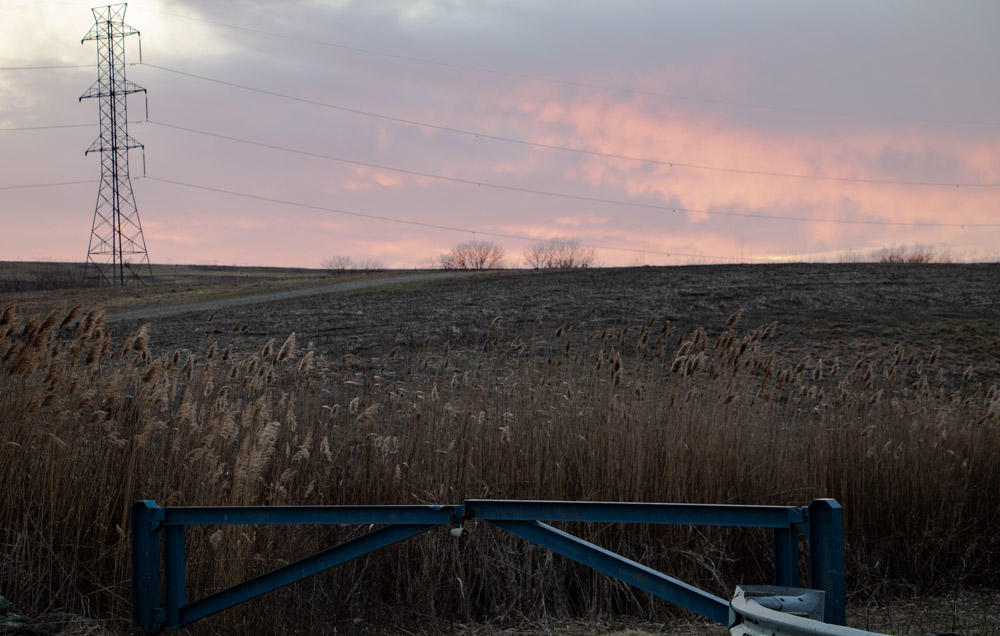
A capped landfill outside of Dekort Park that is now covered in wild grasses. Nate Rosenfield
This place used to be known as “Garbage Island,” Torino told me. His earliest memories of the Meadowlands were riding out to this spot with his father, who owned a garbage business and a small home in Hackensack, to dump garbage into the meadows. Waste was good business back then.
If things turned out differently, Torino said, he might have taken over his father’s business and lived off the garbage that filled the meadows.
“But that didn’t happen,” he said. When Torino was around ten, his father had a heart attack and was diagnosed with emphysema. Disabled, he had to sell his business and move the family from their home in Hackensack to a trailer park in Moonachie, the same trailer park Torino lives in today.
Moonachie was only a few miles from Hackensack, but the two towns felt worlds apart. In Hackensack, Torino played football with his friends and walked to school along tree-lined streets. In Moonachie, goats would run along the dirt roads outside of town and the neighborhood boys had little to do but wander in the meadows, hunting muskrats for money in the winter and fishing during summertime.
It was strange at first, but he took to his new home. He and his friends would catch garter snakes in the grasses near East Riser Ditch and wander around the old clay pits—ponds that were formed from clay mines dug out of the marshes by the local brickyards before the industry fell into decline and the pits were left to fill with rain.
“We did what we wanted, went where we wanted, and didn’t really answer to anybody,” Torino said. “We didn’t have the best families. They didn’t follow us out there, so it didn’t matter.”
One day, when Torino was wandering with his friends, he saw something passing over him. “I remember standing at a corner and seeing four great egrets fly over,” he said. Their pure white plumes, long thin legs, and snaking necks seemed commonplace to his friends, who hardly noticed. “But that’s a sight I didn’t forget.”
He kept lists in his head of the birds he found—barred owls, rough legged hawks, northern harriers. He studied the intonation of their songs to recognize them as they hid in the reeds of the tall grass. But as his connection to birds began to grow, he started to notice the threats encroaching all around them.
By the late 1960s, around 50,000 tons of garbage were poured into the Meadowlands each week, enough to fill Giants stadium from the field to the brim every six weeks. And once the Meadowlands Commission started to restrict the dumping, warehouses and housing developments started to fill the meadows. Torino saw silver sludge floating into the water from the local factories and bulldozers filling in the shores of the old clay pits where he and his friends used to wander. He was enraged by the sight. One of Torino’s friends used to sneak into the construction sites and use a knife to destroy the pumps they used to drain the pits.
“He thought he was going to save ’em somehow,” Torino said.
Torino dropped out of high school and got his GED. He was hired as a forklift operator at a warehouse less than a mile from his home and was eventually elected to be a shop steward for his union, Teamsters Local 560. He believed in the union and learned how to organize and negotiate, but the struggle wore him down. His kids used to tell him that they didn’t know who he was. “‘We thought it was some guy that was sleeping in the back,’” Torino recalls them saying. “It was a horrible existence.” He always dreamed of finding a way back to the meadows. In the mid-1990s, Torino quit. He found a job at a local birding store called Wild Birds Unlimited and got involved with the local chapter of the Audubon Society, eventually becoming its president.
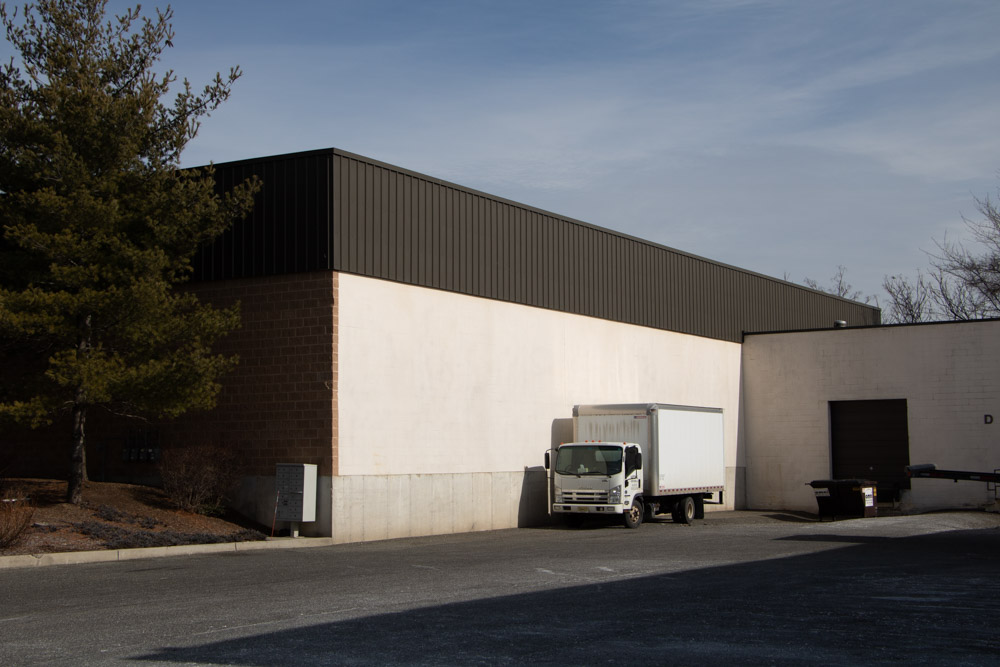
A large warehousing industry has developed in the Meadowlands since the 1970s. Nate Rosenfield
When Torino took over the Bergen County Audubon Society, it was mostly a club for bird enthusiasts; its members were interested in spotting rare species and organizing nature walks. Torino wanted to shape it into an organization that could protect the wild places that remained in the Meadowlands. He led outreach efforts that brought in over 2,000 members and started to mobilize them to protect wildlife habitats in the area.
Species were beginning to return because of the state’s ecological restoration projects. In 2010, a bald eagle’s nest appeared in the Meadowlands for the first time in over a century, according to the U.S. Fish and Wildlife Service. The nest was in the branches of a cottonwood tree that stood in the remains of a dump site by an abandoned paper recycling plant. A developing company called SkyMark had gotten municipal support to build a sprawling $1 billion retail and residential development in the same location. Torino mobilized his contacts to keep this from happening. “We got everybody involved,” Torino said. “We took them to task publicly, and we strung it out so long that they just threw in the towel.” In 2014, the U.S. Fish and Wildlife Service denied Skyline’s plan because of the damage it would cause to the nest. “They’ve had 13 baby eagles since we saved that nest,” Torino said.
Torino successfully fought an amusement park that developers were trying to build in the meadows and pushed for the managers of a former landfill to cover its methane pipe because birds were being scorched by the exhaust. He helps manage a land preservation fund for Bergen County and helps build wildlife habitats along the edges of homes and parks.
Fighting to save the bird habitats that remain in the Meadowlands has often been a disheartening task for Torino, who has watched nearly half of the wetlands he roamed in as a child be destroyed. Sometimes he thinks about what it would be like to live in a place surrounded by nature, rather than in one of the most densely developed regions of the country, where every acre of undeveloped land sparks conflict. “Each one of these battles takes something more out of you,” Torino said. And when Hurricane Sandy hit, a whole new struggle began.
Hurricane Sandy cost New Jersey $36 billion in damages, more than half the cost of the storm for the entire East Coast. The Federal Emergency Management Agency (FEMA) deployed over twenty thousand responders, “one of the largest personnel deployments in FEMA’s history,” according to the agency. Sandy was a wake-up call to the region about the dangers of climate change.
In January 2013, Congress passed the Sandy Recovery Improvement Act, which allotted $1 billion for climate mitigation projects. The Obama Administration’s Department of Housing and Urban Development launched a competition called Rebuild by Design, where interdisciplinary teams of scientists, researchers, and engineers submitted competing proposals for recovery projects. The plans were developed in consultation with the communities affected by Sandy.
Torino attended a meeting about Rebuild by Design’s plan for the Meadowlands at Moonachie’s Borough Hall. The plan’s designers had envisioned what they called a “grand bargain” between the competing needs of development and ecological restoration. The area’s wetland preserves would be surrounded by berms to prevent flooding and a road would be built atop it to allow neighboring towns direct access. The areas zoned for industrial and residential use would be built higher and denser to allow for economic growth, without impeding on the wetlands.
“I’m sitting there listening to this plan and I just lost my temper,” Torino said. He felt the plan was going to invite more development to the area. It wouldn’t help the wetlands and it wouldn’t help homeowners in the community.
Torino wasn’t alone. Rob Freudenberg, who was the director of the Regional Plan Association’s programming for New Jersey at the time, was advising the Rebuild by Design team and attended community outreach meetings. He said that the message he often heard from community members was, “Why do we need more development in the Meadowlands? We just want our communities to be safe.”
Torino decided to join Rebuild by Design’s citizen advisory group, a committee of residents who would advise the design team about local concerns. Torino felt like the input was helping at first. The designers narrowed the focus of the plan to developing green spaces and increasing local flood protection. They were going to create parks and plant greenery with native plants to help catch stormwater and improve some of the area’s pump stations and drainage ditches.
Torino spent two years attending these meetings. He talked with representatives from the Port Authority and Teterboro Airport. He deliberated with residents who worried that wetlands in their backyards would increase their risk of flooding, when really, Torino told them, it would help prevent it. But these two years of effort were “basically wasted,” Torino said. “They didn’t have enough money to do any of it.”
The state ended up shrinking the plan’s allotted funding to the smallest amount in the range they had set aside. The plan was whittled down to improvements to two local pump stations and a drainage ditch. The greening projects were delayed until more funds could be secured.
According to New Jersey’s State Report on Climate Change, the Meadowlands are expected to see two to three feet of sea level rise by the end of the century. Francesco Artigas, the lead scientist at the Meadowlands Research and Restoration Institute, who monitors sea level rise in the area, said that the local tide gates are projected to protect the area from flooding at five feet of sea level rise. The problem, Artigas said, is the storms.
During Sandy, the area saw storm surges over eight feet high, overwhelming the tide gates and inundating Moonachie and large swaths of neighboring towns. Rebuild by Design’s improvements will not address that level of flooding.
According to a report by the New Jersey Department of Environmental Protection, failing to provide additional flood protection “may lead to increased and more frequent damage to local infrastructure and property, direct harm to economic activity, and increased potential for loss of life.”
Torino is aware of all this, as well as of the RPA’s belief that the area should be turned into a park and the residents removed. To him, that may have been a good idea back when he was a kid. But now, he thinks a buyout plan would only hurt the residents who live there. Torino believes that if Moonachie were wealthier, “we probably wouldn’t be talking about that.”
But he understands that staying won’t be easy. “We put things in bad places,” Torino said. “And now we’re paying for it.”
On a bright March morning, Don Torino led a group of birdwatchers through Teaneck Creek Conservancy, a former dump site for construction debris by Interstate 80, which is now a wetland preserve. The park was recently renovated to improve water flow through the marshes, clear garbage buried under the soil, and restore native plants to the area. Its muddy fields were still laced with tire tracks from the construction. Housing developments and office buildings crowded the edges of the park, visible through the bare trees, and cars rushed past on the highway interchange less than a mile away.
Faces young and old followed Torino along the winding trails. The nearby development receded from focus when the crowd spotted a red shouldered hawk staring down silently from one of the trees towering over the marshes. Everyone whispered, stopped, and looked. Later, as they walked along a footbridge over the creek, a furious flapping sound came from the brush. Torino barked out—“kingfisher”—to alert the others. He looked out in awe as the bird sailed over the creek.

Don Torino leading a bird walk in Teaneck Creek Conservancy. Nate Rosenfield
“The thing about being a naturalist,” Torino once told me, “is it doesn’t take more than five seconds to go back to being a kid.”
Torino didn’t imagine when he was young that there would be any wetlands left in the Meadowlands. “You just took it for granted that everything was going to disappear,” Torino said. “You just thought that it was a matter of time.” The idea that bald eagles would return to these marshlands still astounds him.
But spotting rare species has never been the source of Torino’s fascination for birds. He has always been most interested in their ingenuity and resilience as they struggle to survive in places so full of risk.
“After everything,” he said, “how in the hell are they still here?” ◊

 Planet A Magazine
Leave a comment