
Food scraps in a GrowNYC collection bin await pick up by the DSNY. Jake Bolster
New York City’s curbside organics collection program helps deliver un-fracked natural gas to local residences. Is this the best use of New Yorkers’ food waste?
Jake Bolster
Every Saturday morning in Ridgewood, Queens, four tall green bins sit on the corner of Myrtle and Cypress Avenues, eager to accept all the food waste locals can muster. Usually, someone carrying a small bag (or, in one case, a 12-gallon bucket) full of organic waste will wordlessly dump their contents in the bins, recycle their bag if need be, and go about their business without breaking stride. But when Liz French makes her way to the station—scraps in a bag marked “GIFTS”—something is different: she lingers.
Before unloading her haul, French secures her dog, Screamin’ Nini, a Fox Terrier, within her line of sight, then carries her bag of food scraps over to the bins. French, clad in a forest green knee-length coat and a purple beret, handles her bag with black gloves. In one fluid motion, she picks up the bag by its diagonal corners, empties its contents into the bin in front of her, then walks back over to Screamin’ Nini. When asked how long she has been composting, she turns around, gives me a once-over, and says, “before you were born, probably.”
French has been collecting food scraps to turn them into soil since she was a young girl growing up in Indianapolis. “My parents were kind of hippies,” she told me a few days after I met her at the organics collection site in Ridgewood, run by GrowNYC. She credits them with introducing her to the practice; they explained to her that sending food to compost piles yields nutrient rich soil, wonderful for household plants, sidewalk beds, or city parks. It also keeps food waste out of landfills, where it can simply rot and give off noxious fumes. As she grew older, she became an even more serious composter. When French moved to Bloomington, Indiana, after college, she lived in a house full of “aspirational commune people” who all enjoyed the circular process of turning organics into soil, which they used in their backyard garden to grow vegetables.
In 1989, French left the plains of Bloomington for the skylines of New York City. Initially, she says, she “moved for a man,” but that didn’t last. After they broke up, French decided to stay. She had found a job as an art guard at PS1, at the time an alternative art gallery in Long Island City, and she enjoyed it, even though “sometimes their paychecks were alternative,” she said. In any case, “it was time to get out of Indiana.” Today, French works as an editor for Library Journal and lives in Queens, while most of her family remains in Indiana.
When French landed in Long Island City, it was not yet a trendy place to live. Even for New York, the neighborhood was very much an urban environment. “There just was no opportunity for any sort of gardening or any sort of composting, let alone recycling,” she said. In April of 1989, the year she moved to New York, the city passed Local Law 19, requiring New Yorkers to recycle. But composting efforts remained voluntary and scattershot.
It was five years before French found a way to compost again. While visiting the Union Square Farmers Market in 1994, French met a German woman who had started collecting compost four times a week at the market. Since French lived in Queens, the woman recommended she freeze her food scraps (sans meat and bones), and bring them to the drop-off station at the market whenever she could.
So, that is what she did. For almost a decade, French froze her scraps, rinds, grinds, and peels, put them into a plastic bag or milk carton, tucked that into her backpack, and hopped on the train to work where she stored the scraps under her desk. During her lunch breaks, French would drop the stuff at Union Square, then sit in the park and enjoy her lunch.
Gradually, composting caught on in New York, and French could travel to drop-offs a little closer to home. Then, last fall, New York City rolled out a curbside composting program across all of Queens. “I was overjoyed,” French said. The program was convenient for her (she no longer needed to walk the handful of blocks to the Grow NYC station), and a sign that the city was getting serious about composting. French was right. Earlier this year, Mayor Eric Adams announced the extension of the program to all five boroughs by 2024, touting it as the largest composting program in the country.
But it is unlikely French’s food scraps will be turned into compost. Most of the material collected in Queens will be handled by New York’s Department of Sanitation (DSNY), Department of Environmental Protection (DEP), and WM, a multinational, multibillion-dollar private waste management company. Each plays a role in using food scraps to generate energy.
The process goes like this: the DSNY collects food waste from residents’ personal bins and delivers the scraps to a transfer station, run by WM, formerly Waste Management; at an organics facility in Greenpoint, Brooklyn, WM turns these scraps into a pulpy slurry, which it trucks two miles down the road to the Newtown Creek wastewater treatment plant; in “digester eggs” there, microbes devour the muck: a process called “anaerobic digestion.” A DSNY official said the department will decide this summer how to handle other boroughs’ food waste, but, for now, this is how “much” of the organic material collected in the Queens curbside program will be used.
One byproduct of anaerobic digestion is a solid material called “digestate,” which can be used as fertilizer, or a soil additive. The other is methane, a natural gas the city has contracted utility provider National Grid to collect, clean, and use to help heat the surrounding homes and businesses. This is not what most people think is happening to the food scraps they put in their curbside bins. Composting advocates, like Christine Datz-Romero, the German woman French met in 1994, are disappointed that this is what the citywide program is going to do. On top of that, because of various technical hurdles, the partnership with National Grid only recently began delivering gas to the grid; in the interim, any methane that was not used to power the plant wound up getting burned, or “flared,” into the air.
“Oh no,” said French, upon hearing the fate of her scraps. “That must not amuse the neighbors. And there’s a lot of neighbors around that area.”
There is little consensus about how to handle food waste in the U.S., except that landfilling it should be avoided at all costs. Food rotting in landfills, crushed by the surrounding scraps, suffocates, and decomposes without oxygen. In landfills without gas collection systems, this food emits methane as it breaks down (as opposed to CO2 if it were exposed to oxygen), a potent greenhouse gas at least 28 times more effective at trapping heat in the earth’s atmosphere than CO2. Methane is the U.S.’ second most common human-produced greenhouse gas, accounting for 12% of the country’s emissions in 2021—nearly a fifth of which comes from landfills. The EPA estimates that each year, the U.S. sends 140 million acres worth of food, about the size of California and New York, to landfills, where it is the most common material among the heaps of discards.
In New York, a city that “rarely had a day in its history without a waste problem,” writes Martin V. Melosi in his book Fresh Kills: A History of Consuming and Discarding in New York City, landfills have not always been the solution to waste. In the nineteenth century, waste-collection duties passed between the city inspector, the Metropolitan Board of Health, the Police Department, and private cartmen and scavengers. Dumping garbage in the city’s waterways was the prevailing waste management method.
Collecting trash was difficult in New York. Scrappers and cartmen had to haul stray scraps like ashes, street debris, in addition to residents’ and restaurants’ organic matter, oftentimes without the equipment necessary to do the work on a large scale. By the turn of the century, each citizen in Manhattan and the Bronx produced 60 pounds of garbage, and 1,231 pounds of ashes a year.
At the turn of the century, ashes were everywhere, a byproduct of furnaces in homes and businesses, and the incinerators New York had built to dispose of its waste. Brooklyn Ash Removal, one of the companies with a substantial contract to remove these ashes, created a heap so infamous it featured in F. Scott Fitzgerald’s The Great Gatsby. “A valley of ashes—a fantastic farm where ashes grow like wheat into ridges and hills and grotesque gardens; where ashes take the forms of houses and chimneys and rising smoke and, finally, with a transcendent effort, of men who move dimly and already crumbling through the powdery air,” Fitzgerald wrote.

Incinerating waste meant the city no longer needed to outsource refuse disposal to private companies. New York signed the last of its private contracts in 1933, and it would be 64 years before the city resumed outsourcing waste processing to the private sector.
New York’s waste output continued to climb as the twentieth century wore on. But there were exceptions to this trend. In wartime, wasting food became unseemly, and unpatriotic. During World War II, the U.S. distributed posters showing a clean-picked plate after a meal, captioned “Food is a weapon. Don’t waste it!” spinning food waste as a detriment to the country’s ability to feed Allied troops on the frontlines.
By the second half of the twentieth century, landfilling had caught on in New York. At the time, anything thrown out in New York City likely made its way to Fresh Kills landfill in Staten Island, a contentious behemoth of rotting food and inorganic waste, first opened in 1948. In just a couple of years, Fresh Kills became such a noxious scourge that in a 1950 report, the DSNY recommended the city redouble its efforts to incinerate waste and “terminate all dumping of garbage and combustible material in landfills.”
However, incinerating waste proved unfeasible and, eventually, the city revived its partnership with the private sector to handle its garbage problem. In 1997, the Bronx became the first of the five boroughs to ship its residential waste outside city limits. WM won the bidding war for a three-year contract to transport Bronx refuse to a landfill in Waverly, Virginia. The city paid the company $51.72 for every ton of waste it shipped, in line with what it had cost the city to send scraps to Fresh Kills.
The cost-effectiveness of the public-private partnership didn’t last; exporting waste ended up costing taxpayers $90 million more than the Giuliani administration promised ($323 million a year). In 2017, New York City finalized a 20-year, $3.3 billion contract with WM to export waste from the Hamilton Avenue and Southwest Brooklyn marine transfer stations, the final contract from the Giuliani-era waste export deals.
In the last decade, New York has invested in keeping food out of landfills by trying to capture the energy stored in its discarded organics, and turn them into natural gas. In 2014, WM resubmitted an engineering report in support of a permit modification to their Varick Avenue transfer station, located about two miles from the city’s Newtown Creek Wastewater Treatment plant. They wanted to add an organics processing facility.
On a mild morning in February, I arrived at WM’s organics processing facility in Elizabeth, New Jersey, to see how New York’s organic waste would be turned into slurry. (The facility on Varick Avenue in Brooklyn, which will actually handle food scraps from New York, does not host tours.) The building, a warehouse with sallow beige paneling about the size of a football field, sat at the end of a row of residential homes five minutes from Newark Airport. At the other end of the street was a motel and a church.
Arielle Bernard, a WM sales support manager, and Nick Burreci, the facility manager were the tour guides. We met in Burreci’s office, put on neon safety vests, hard hats, and clear safety glasses, and Burreci gave a short safety lecture. He covered evacuation procedures in case of a fire (there had been one at the neighboring WM waste transfer center last May, which claimed the life of a WM employee), an explosion, or an earthquake, none of which, I was assured, would happen that day. Then, Burreci led us out the door to the “tipping floor,” as it’s called, where all the rotten, old, or unwanted food that local companies contract WM to handle gets dumped.
On the way, we passed a large cube with ducts running into the warehouse ahead of us. The machine, which Burreci said is always on, traps smells from the hangar, and made a loud thrumming noise, similar to the sound of an airplane landing at the nearby Newark airport.
“Do you smell anything?” Burreci asked me.
I inhaled, and said I did not.
“That means it’s working.”
As we headed towards the tipping hangar, Bernard explained that WM is part of New York’s plan to deal with the volume of food waste collected in its curbside program. We reached the door, which she held open. “Be prepared for the smell,” she said, as we stepped through.
Before us sprawled 15,625 square feet of empty space, designed to handle 500 tons of food waste a day. It looked like it could fit about three small airplanes. The place was a cesspool of rotten smells; so many different types of food make their way through here that it was difficult to identify a prevailing odor. Just then, an employee driving a forklift dumped the contents of a green plastic bin onto the floor near the hopper. The bin had come from a nearby church which had contracted with WM to pick up the food it was unable to use. Now, hundreds of onions and cabbages rolled forth, along with clear plastic bags full of cardboard. The haul felt anticlimactically small in the massive space.
Material on the tip floor gets shuffled over to “the hopper,” Burreci said, an industrial-looking shovel the size of Clifford the Big Red Dog that grinds to bits anything it gobbles up. The hopper feeds this material to a separator, which diverts inorganic material from the organic sludge. Those plastic bags full of cardboard would be taken care of by the separator, Burreci said. When members of Burreci’s crew see materials the system cannot accept—large pieces of wood, metal, or glass—they remove them by hand, or with a machine. Otherwise, “if you can eat it, we can take it,” he said with a chuckle.
Once the food has been separated, it gets combined with organic liquids to reach its slurry form, and rushes through pipes below ground into the neighboring tank room, where it is stored. Much of the slurry-making process, like the liquid to solids ratio, can be controlled from a screen on a back wall, and it can take as little as 45 seconds from the moment food touches the tipping floor for it to become slurry, Burreci said. WM does not mandate the food they accept be expired.
The inorganic material captured in this process ends up in a dumpster at the end of the system. Standing next to this dumpster, Bernard estimated that residuals—finely shredded packaging labels and bits of cardboard—make up about eight percent of the entire material this process generates. That unusable eight percent from the Varick facility gets driven over 300 miles to a WM-run landfill in Fairport, New York. “There’s no way for us to separate it out and make that more valuable,” she said. “The struggle we face with any end market is finding a buyer for it.” WM is not working on finding a different solution for this waste.
Before we left for the tank room, I asked if the whole process we’d just walked through uses more energy than the wastewater treatment plants generate. “This process, in general, is energy intensive,” said Bernard. “We’re capturing the energy benefits for the wastewater treatment plants, not necessarily for our facility.” The company does not calculate the energy tradeoffs between the natural gas generated with their slurry at wastewater treatment plants and the power they consume at their facility.
We moved on. As we stepped into the neighboring room, narrower than the tipping room, a large truck with a silver-bullet-shaped container on its bed backed into the room. An employee walked over with an industrial hose, and fitted it to the container. It was about to be loaded up with slurry.
Next to the truck stood three tall, metal tanks shaped like silos. Two of the tanks held 56,000 gallons of slurry, and another 26,000-gallon tank held organic liquids. The side of the middle tank read, “Food is energy. Let’s not waste it.”
Burreci asked if I wanted to see the slurry, and I said yes, secretly hoping there was a way to see it but not smell it. He grabbed a bucket, and placed it under a large spigot, turned a lever on a pipe, and a stream of gray sludge flecked with bits of orange and yellow belched out. “That might be a little pungent smell,” he warned. The odor of the muck gurgling from the spout reeked like garbage on a hot summer’s day.
Unbothered by the slurry’s smell (both Burreci and Bernard said they’d long become used to the odor, and Burreci said he once lost his appetite for watermelon after the facility processed large quantities of it for several weeks), Burreci dipped a gloved hand into the bucket and brought up a handful of the material, which was 14% to 16% food, they told me, with the rest being organic liquid. The company term for the material is “engineered bio slurry”—“a super fuel,” said Bernard.
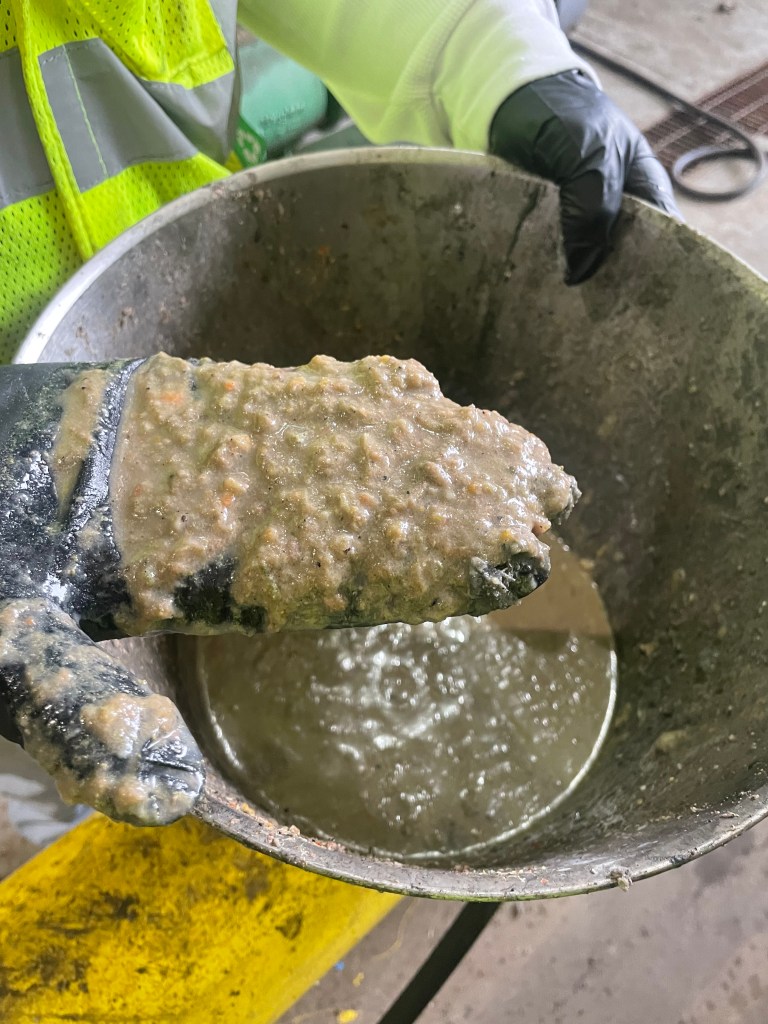
Finished slurry has a chunky consistency and a powerful smell. Jake Bolster
We walked back to the office, the smell of slurry still ringing in my nose. I thanked Burreci and Bernard for their time and left. Once outside, I took a deep breath, my nostrils eager to soak up new aromas after the onslaught of rotting food. The air smelled a little sweet.
Composting and anaerobic digestion sit towards the bottom of the EPA’s food recovery hierarchy. Ideally, municipalities, companies, and individuals would first consume only as much food as they need, reducing the amount of leftovers wasted; after people adjust their consumption habits, any undesired leftovers still edible should be donated to feeding the hungry, then—the thinking goes—to feeding animals. In a perfect world, only after those three options have been exhausted would anaerobic digestion and composting come into play. Landfills remain a last resort.
Almost everyone monitoring the curbside program agrees it is a better alternative to food rotting in landfills. That’s about where the consensus stops.
Composting advocates would prefer if the curbside program led to an increase in the number of composting sites across New York, as opposed to more volume for wastewater treatment plant’s digesters. Christine Datz-Romero, co-founder of the Lower East Side Ecology Center, who was one of the first people to bring composting to New York City back in the 1980s, said she’s “a little bit skeptical about the environmental benefits of it.” She pointed out that the digestate produced by the microbes contains “people’s flushed down medication,” along with “really undesirable heavy metals” present in the city’s wastewater stream, which lowers the digestate’s value as a fertilizer. “You definitely don’t want to throw your spinach in that material.”
Finding swaths of real estate big enough for a large-scale composting site may be difficult in a built-up city like New York. Datz-Romero said the Lower East Side Ecology Center, when operating at peak capacity (their facility is being rebuilt as part of the new East River Park), could handle 500 tons of food waste a year. One study from the Natural Resources Defense Council estimates New Yorkers generate 3.2 pounds of food waste per capita in a week, which would put the city’s weekly food waste output at a little over 13,000 tons.
And composting still sends greenhouse gasses into the atmosphere, albeit on a much smaller scale. “There’s no such thing as a free lunch,” acknowledged Datz-Romero. “The benefits of turning food scraps into compost far outweighs the generation of CO2,” citing increased soil fertility as one such benefit.
Digesters typically require less space than composting piles, and are part of existing infrastructure. In 2017, the DEP and National Grid broke ground on their project to deliver natural gas generated at the Newtown Creek wastewater treatment plant to the surrounding grid, with the idea that un-fracked natural gas could be part of the city’s green-energy future. But by 2021 the city began to legislate towards renewables: that year, Mayor de Blasio signed a law mandating new buildings be constructed fully electric by 2027, and noted that gas-powered appliances are “a primary source of indoor air pollution,” in a press release. How could the city move forward with the project?
“We have certain parts of our society where we do need natural gas,” said Pam Elardo, former Deputy Commissioner of New York City’s Bureau of Wastewater Treatment. The most energy efficient way to sterilize hospital equipment, according to Elardo, is by using natural gas. “There’s going to be niche markets for natural gas,” she said. “We’re never going to not need it.”

Anaerobic digesters and their flare stacks stand on Kingsland Ave. at the Newtown Creek Wastewater Treatment plant in Greenpoint, Brooklyn. Jake Bolster
On March 31, according to reporting in the New York Times, National Grid began delivering natural gas generated at the Newtown Creek plant to roughly 2,500 homes in the area. But the construction and testing phases of this project came with environmental costs: in the absence of a steady outlet for its excess gas, the plant flared methane it could not use.
Flaring methane converts the gas into CO2 (some research estimates that nearly 10% of methane in a flare escapes unburned), not as potent a greenhouse gas as methane, but still harmful—and longer lasting. “If we are talking about global warming—hey! What are we doing here?” said Christine Holowacz, a former liaison between the DEP and the Greenpoint community. “We are not doing our part!” The DEP did not respond to interview requests for this story.
Holowacz, who held her position, which was salaried by the city, for 14 years, also worries about the increased truck traffic in Greenpoint from WM trucks transporting slurry. In a 2014 press release announcing the project, National Grid touted the gas generated at the Newtown Creek plant as “carbon-free,” making no mention of truck-related emissions inherent in the project.
As if flares and truck traffic weren’t enough, an influx of more organics may exacerbate methane-leakages at the plant. A study published in February by the American Chemical Society found that wastewater treatment plants across the U.S. leak nearly twice as much methane as previously estimated by the Intergovernmental Panel on Climate Change, the equivalent emissions of adding over one million cars to U.S. roadways. “It’s been a serious challenge to get information on these plants,” said Dan Moore, a Ph.D. candidate at Princeton’s Environmental Engineering program, and an author of the study. Moore and his team used high-frequency sensors mounted on an electric vehicle (so they would not accidentally measure their own emissions) to observe fugitive methane escaping from 63 wastewater plants across the country. Moore wouldn’t say which plants his team sampled in New York City, and stressed the purpose of the study was to better understand the statistical average of leaks across the country, not single out one plant in particular. In general, however, “the more organics you put through a plant, you’re going to have higher emissions,” he said, a finding supported by other scientific literature and confirmed in this study.
All of the strings attached to anaerobic digestion—the energy-intensive process of making slurry, emissions from truck-traffic in Greenpoint, the city’s push towards electric infrastructure, potential fugitive emissions—have left locals and compost-advocates concerned by the city’s commitment to the practice. Datz-Romero would like to see more composting sites across New York. “We need to, I would say, find the political will to have a discussion about where such facilities could be sited and invest in that,” she said.
At one point, Holowacz described the relationship between the DEP, which was bound by a consent order to keep its neighbors informed about the work going on at the plant, and the Greenpoint community as a marriage. “You argue sometimes, but when we had meetings we were always able to get solutions,” she said. But, when the consent order expired in the early 2010s, the local monitoring committee was suddenly left in the dark. “The community doesn’t know anything,” said Holowacz. “We had the ability to talk about our concerns,” and now, “all of that is gone.”
In late March, Liz French made her inaugural contribution to the restarted curbside program. The program had officially resumed that week after its planned three-month suspension, and French’s organics would be collected later that night.
French’s apartment, a strip of townhomes in Ridgewood, Queens, houses many souvenirs from her 34 years living in the city. She collects vinyl records, CDs, and cassette tapes, and has several aloe plants in the sill of her kitchen window. Music drifted in softly from her living room as she and Screamin’ Nini put the finishing touches on her food scraps for the week. She wore her trademark purple, practically from head to toe, and was sipping a glass of water; its exterior was frosted lilac.
Her haul that week consisted of grapefruit, some hyacinth plants, eggshells, coffee grounds, cherry tomatoes, and dog fur from Screamin’ Nini. To dispose of the bunch, she took her bucket out her door, down the stairs, and dumped it in the organics bin next to her stoop, given to her building by the DSNY.
She will miss the community aspect of her old composting ritual—seeing the GrowNYC employees who ran the compost station at Ridgewood Remembrance park, and chatting with those who recognized Screamin’ Nini. “This is just, put it out on the street and it goes out of my life,” she said. Overall, she’s pleased she no longer needs to lug frozen food scraps around the city with her anymore. “I think it’s about damn time.”
Liz French and Screamin’ Nini sit in her kitchen in Ridgewood, Queens. Jake Bolster
This spring, Queens residents can sign up for soil givebacks, made possible by their food scraps collected in the curbside program. French doesn’t think she’ll sign up for a compost giveaway, since none of them are located near Ridgewood. But, in the past, she has spread soil generated in New York composting facilities across the beds of several of her larger house plants, one of which is named Tina Turner, that crowd her window overlooking the sidewalk. Almost every building on French’s block has a brown organics bin outside its door, but French is unsure how her neighbors will react to the program. “It’s a big step,” for people to sort trash, recycling, and organics, she said. “I just, I wonder how it’s all going to work out.”
French locked her bin and wheeled it to the edge of the sidewalk. She pulled her Grinch-green fleece closer to her against the encroaching evening air, turned, and walked back up the stairs into her apartment. Screamin’ Nini was making a racket. The next morning, French peered over the leaves of Tina Turner and out her window. The scraps in her bin were gone. ◊
A previous version of this article misstated the town French moved to after college and how long she has lived in New York City.

 Planet A Magazine
Leave a comment