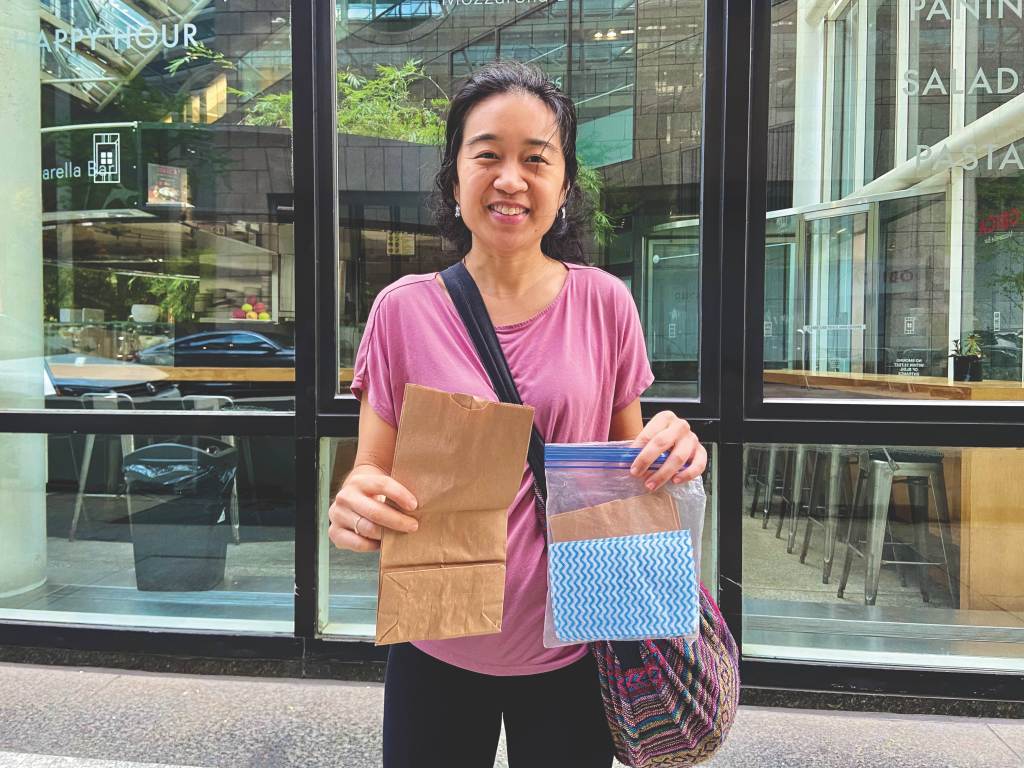
Tina Li with her bird-rescue toolkit. Hypatia Wu
A group of volunteers is working to track and prevent the murder of migratory birds.
Hypatia Wu
Every Friday morning during the two bird migration seasons in New York City—from mid-April to early June for the spring migration and from late August to early November for the fall—Tina Li wakes up at 5:45 in the morning in her apartment in Yorkville and starts getting ready. She packs a messenger bag with tissues, soft fabrics, a map of her route, a spreadsheet, and her camera with a zoom lens for. She then gets on the subway and heads to Columbus Circle—first the IBM Building and then the edifice at Columbus Circle. Li volunteers for the NYC Audubon’s Project Safe Flight and is looking for dead or injured birds.
Li’s fascination with wildlife began at a young age. She grew up in Brooklyn, close to one of the most developed urban areas in the world, but she read books about exotic animals and hoped one day to visit them. “I once wanted to be a veterinarian, so I started to work as an intern at an animal clinic in high school,” she told me. Although Li didn’t end up in a wildlife-related job, she was able to travel widely, including to Costa Rica for sea turtle conservation programs, and dedicated her time to volunteer work in conservation efforts. She now lives with a dog and a beautiful African gray parrot, Bob.
Li began volunteering at the Wild Bird Fund five years ago, taking care of injured animals. Most of the animals they treated were birds, many of whom, she learned, had flown into buildings. As it turned out, this was a problem of epidemic proportions—millions of birds were flying into buildings across the country on a daily basis, and most of them were dying. The numbers were staggering. In 2020, hoping to do something about it, Li joined Project Safe Flight, which attempts to locate some of the top bird-killing buildings in the city and urge them to make alterations so that birds can avoid crashing into them. As the spring monitoring season kicked off, she is now one of approximately 80 volunteers who scour 13 routes for fallen birds across five boroughs of New York City every morning.
Li’s mission is to identify birds that have collided with buildings and carefully assess their condition—injured or dead. If a bird is alive but injured, she will bring it to the Wild Bird Fund for rehabilitation. If it is dead, she will dispose of its remains. In each instance, she documents the time, location, and the species of bird. At the end of the year, Project Safe Flight uses the collected data to reach out to buildings where birds have crashed and urge them to implement measures to prevent further collisions.

For those injured birds she sends to the Wild Bird Fund, Li will sometimes get a call from there if a bird has been released. “Some recovered after several days,” Li said. “I’m so glad to see that.”
On a recent early Saturday morning in mid-April (Li was covering for another volunteer), I met Li outside the IBM Building at 590 Madison Avenue. The neighborhood at this hour was almost totally empty; above us, sparrows and pigeons were navigating the concrete and glass forest. “I like starting my days this way,” Li said, “with the birds.”
But we had work to do. The IBM Building is a 41-story skyscraper at the corner of Madison Avenues and 57th Street whose exterior is all glass, which makes it dangerous for birds. She pointed to the groove next to the sidewalk in front of the building, saying she once found four dead birds there.

Likely a collision victim found near the 5th Avenue. Hypatia Wu
On this day, the sidewalk was empty. Li also made sure to check all the little corners and parterres around the building—sometimes, she said, morning cleaning crews or construction workers would sweep injured birds into there.
“Are you guys finding anything?” A low-pitched male voice interrupted our conversation. It was a security guard from the IBM Building.
“We are looking for birds,” Li said.
“Oh, you might find them in Central Park,” said the security guard. He seemed somewhat puzzled.
“We are looking for dead birds, actually,” Li said. “Birds sometimes collide into the glass, and we are counting these.”
“Okay,” said the guard. “I didn’t know that was a thing.”
After that, he left us alone.
According to the US Fish & Wildlife Service, window collision is the second leading cause of death for American birds. Habitat loss, which shrinks food sources and nesting places, is probably the first. Free-ranging domestic cats are also a huge threat to birds.
The exact figures are hard to determine. Many birds killed in collisions with buildings go unnoticed—other animals eat their bodies, or they just rot away. Nonetheless, a 2014 study by researchers from the Smithsonian combined incident reports and other estimates to conclude that window collisions likely kill between 365 million and nearly 1 billion birds annually in the United States.
In 1832, Thomas Nuttal recorded an incident of a sharp-shinned hawk flying through greenhouse glass—it is considered the first-ever record of bird collision in the world. Almost a hundred years later, C. W. Townsend’s paper on five fatalities of the yellow-billed cuckoo also marked early observations of bird collisions with windows. Townsend’s paper suggested that some species may be more vulnerable than others and that specific windows can claim multiple victims.
It wasn’t until the mid-1970s that the problem was systematically studied. A graduate student in zoology at Southern Illinois University at Carbondale named Daniel Klem wrote his dissertation on bird collisions with glass. Through observing actual collisions with buildings and doing some experiments, he found “collisions to occur,” as he later wrote, “wherever birds and windows coexist.” Klem found that birds crashed into windows because they were trying to reach an “attractant,” such as food or plants, on the other side. Not realizing that there is a window between them and the attractant, the bird collides with the window, often resulting in death.
Another researcher during this period, Richard Banks of the US Fish & Wildlife Service, hypothesized that the use of reflective glass in buildings surrounded by some trees or vegetation was also causing bird collisions since the birds thought they were flying toward trees. Banks first made this observation in 1973. “Reflective plate glass is a relatively new development in the construction industry,” he wrote. “According to corporate advertisements in national magazines, it lowers the cost and energy consumption of both heating and cooling the building. It seems likely that the use of reflective plate glass in large buildings will continue, probably at an accelerated pace.”
It took some time for these worrying discoveries to catch on. As late as 1989, Klem would find the field to still be in its infancy. “Most textbooks and encyclopedia treatments of ornithology present little, if any, description of the fatal hazards that windows pose to birds,” he wrote. The situation has changed since the 1990s. An exponential increase can be seen in academic research into the issue; since then, advocates have also begun to figure out how to address the massive danger that windows present to birds. NYC Audubon’s Project Safe Flight was born in 1997. It became the flagship bird-protecting program organized by NYC Audubon. In addition to documenting as many bird collisions as possible, it also collects data on bird populations and migration patterns around the glass-covered forests of Manhattan and Brooklyn. This year, the monitoring areas have been expanded to all five boroughs.
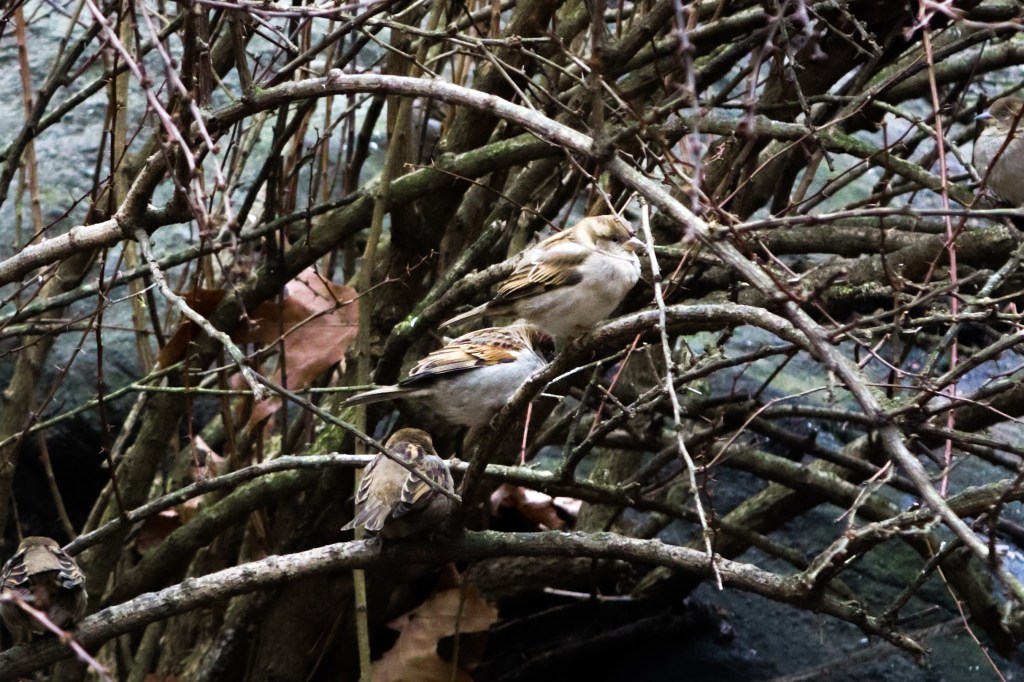
Sparrows are major victims of the ‘glass warfare.’ Hypatia Wu
Researchers have also been documenting the pressure experienced by birds from climate change. A warming planet has led to habitat loss for some species and different migratory patterns for many. The birds identified by NYC Audubon as the most common victims of collisions with windows in the city are white-throated sparrows, common yellowthroats, ovenbirds, dark-eyed juncos, black-and-white warblers, and northern parulas. This last species, the northern parula, is a neotropical migratory aviator that breeds in the Southeastern United States and parts of the northeastern regions. Birding data shows that the northern parula was not commonly observed in New York City until the mid-twentieth century. However, with the expansion of its breeding range northward over the past few decades, the northern parula is now a more regular breeder in the city. According to Audubon’s data, it is a regular victim of window collisions in the city.
After closely examining the area around the IBM Building, Li proceeded to walk about fifteen minutes to Columbus Circle. The buildings there are right next to Central Park.
As Katherine Chen, the community science and outreach coordinator at NYC Audubon who also runs Project Safe Flight, explained, the glass facades of the buildings at Columbus Circle reflect the vegetation from Central Park and confuse birds. The Deutsche Bank Center, at 10 Columbus Circle, with its large reflective glass, is a particularly hazardous building, according to Chen.
Last year, Project Safe Flight’s volunteers documented over 3,000 collisions in New York City. This recorded only a fraction of what Project Safe Flight believes to be the 250,000 birds who lose their lives attempting to fly through New York every year. During Li’s last monitoring season, she found about 15 collision victims and 10 injured birds that were likely window collision victims.

Tina Li with her bird-rescue toolkit. Hypatia Wu
The southern side of Columbus Circle is typically bustling with activity, but on this quiet Saturday morning at 7:30 a.m., the only inhabitants seemed to be the birds. After touring the area with our heads down, scouring the sidewalk, and, to our relief, finding nothing, we looked up.
Warblers and sparrows flitted about, fighting with the resident pigeons for their share of the available food. Our attention was drawn to a solitary gray sparrow perched atop the glass canopy of the front gate of Deutsche Bank Center. Its identity was difficult to discern from our vantage point, but we observed the bird thumping its wings against the glass and seemingly struggling to take flight.
Li suspected that this bird had collided with the building and was now trying to recover. “I sometimes see these kinds of cases,” Li said. Not all collision victims die right away; some are injured and attempt to recover, then collapse. “They might die later,” Li said. “They struggle. Like humans with brain concussions. But you can tell from their abnormal movement.”
She said she would note it as a potential bird collision in her spreadsheet. Other than that, though, it was a light day. It was possible, she said, that some of the mitigation measures put in place by the buildings at the urging of Project Safe Flight were working. But it was also early in the migratory season. Most of the birds had yet to fly through the city.
Both Li and Chen told me that the building of the Deutsche Bank Center at Columbus Circle is really a “major killer of birds” in that area. Li and other volunteers reported this issue to the Audubon, and advocates at Audubon contacted the building manager there, “but it seems like they don’t want to make any changes,” Li said. Li stood at the front gate of Deutsche Bank Center, staring at the gray sparrow resting on top of the steel beam.
She stopped for over five minutes, just wanting to make sure that the little feathered animal was fine—it jumped aimlessly and slowly on the beam for a while. “It looks like it just collided a bit and got confused,” she said. “Sometimes it happens. I will return and check it later.” Sometimes, Li and her volunteer peers might knock on the door of building superintendents to get permission inside the building and take the injured birds stuck in parts of the building, like a roof deck, that they cannot access.
“Sometimes those security guards get to know us,” Li said, “because we show up every single day.”
In the end, the gray sparrow suspected of hitting a window flew away. Li thought it might not be a collision victim.
Once the volunteers collect all the data at the end of the migration season, Katherine Chen begins her outreach work. She and her colleagues call all the buildings near which volunteers found dead or injured birds and inform them. They then walk them through possible solutions. There are several. To deal with the problem of birds trying to get at things on the other side of windows, building managers can put well-organized stickers in a certain grid on their windows to signal to birds that this is a surface rather than simply air. These films are either shown as round dots or UV-sensitive patterns that birds can see but humans cannot. They can also, importantly, make sure that they turn all their lights off at night. Most birds migrate in darkness. A plant or other food source in a well-lit office could be a cause of bird collisions, according to Audubon.
Chen’s outreach efforts are not always successful; some buildings are unwilling or uninterested in making the change. But they’ve managed to convince at least some owners. One of the biggest is the Javits Center, in Manhattan. “It was almost completely glass and a lot of birds were colliding into those windows,” Chen said.
“They did a complete retrofit of all of their windows, and now all of their windows are made with bird friendly materials.” Chen said. For birds, “it makes the building much safer. And we’ve seen a reduction of over 90% at the Javits Center in terms of collisions. That’s very good.”
Indeed, some of the work is just for awareness-raising, and some changes are from awareness-raising. As Dr. Dustin Partridge, director of conservation and science at NYC Audubon, explains, birds have a unique biology. They fly at night, eat all the time, and don’t see how we see. “Bird vision is a whole other subject,” he said. Unlike human beings, many bird species see ultraviolet light. They perceive patterns and shapes in a difficult way to conceptualize, making it difficult for them to understand the dangers of flying into transparent surfaces such as windows and super reflective glass facades. “They are not going to realize there’s glass there,” said Partridge. “They’re looking at what’s there.”
Research on bird-friendly materials, from glass to film, has been going on in the materials science community for nearly 20 years. In 2006, the German company Arnold Glas introduced ORNILUX SB1 Bird Protection Glass, its first commercial product using the technology. This innovative product was installed on the glass façade of a 100-year-old indoor swimming pool building in Plauen, Germany.
Later, for instance, the Bronx Zoo and the Philadelphia Zoo installed SOLYX Bird Safety Film, and ever since the installation, they have reported no fatalities. 3M’s Feather Friendly product also has been used for over 10 years on both residential and commercial installations with over 95% reduction of bird collisions.
Partridge mentioned that there are new products available that are completely transparent to the human eye but still visible to most birds, providing an innovative solution to this ongoing problem. Others are even UV activated.

It is worth noting that the installation of this kind of bird-friendly film will “add the benefit of reducing the cooling needs of the building.” Partridge used the example of Javits Center again, saying that the bird-friendly glass can reduce the amount of sunlight that enters the building, which can ultimately reduce the carbon usage and offset climate change. “So by doing things that are bird friendly, you can reduce climate change by reducing your carbon usage,” Partridge concluded.
In addition to Project Safe Flight’s work, there has been some movement on the legislative front, as well. Working with the Lights Out Coalition, NYC Audubon has already achieved some policy victory: City Council Member Helen Rosenthal proposed Bill 274, which mandates all nonessential outdoor lighting in City-owned buildings and fully leased buildings be turned off during peak avian migration periods between 11 p.m. and 6 a.m. Meanwhile, Council Member Justin Brannan’s Bill 271 requires the installation of occupancy sensors to limit illumination in City-owned buildings. While a third bill, No. 265, which would have imposed similar regulations on privately owned buildings, didn’t make it to a vote, the City is making progress in safeguarding its feathered friends.
While working on this project, I learned that Columbia University, where I am a graduate student, also has student volunteers walking around the campus looking for dead or injured birds. The whole route takes no more than two hours per day. According to Amanda Bielskas, who is the director of the science and engineering library at Columbia and also the leader of the volunteer bird monitoring project, the most dangerous building for birds is Avery Hall, which houses the graduate school of architecture, followed by the Northwest Science Library building. Avery killed 14 birds last monitoring season, and the library killed 11. Alfred Lerner Hall, a large, glass building which houses the student center on Morningside Campus, killed six birds, according to Bielskas.

Alfred Lerner Hall, built in 1999, is one of the top bird killers at Columbia’s campus. Hypatia Wu
I went on five monitoring trips on the campus this spring. The route starts from the Southern Lawn next to the Sundial, right next to Hamilton Hall, and then heads to the John Jay Hall. After Butler Library, it turns to Lerner Hall. After the circuit of the southern part of the Morningside campus, the route goes to the northern part, starting from Dodge Miller Theatre and Lewisohn Hall, another problematic building ranked fourth in Bielska’s report of the most brutal bird killers in Columbia. Although these are not the glass skyscrapers that are usually believed to kill the most birds, like the Northwest Library, greens surrounding these edifices reflected by the windows of the lower floors confuse birds and make them crash into the glass. “I can tell if the birds are flying into those windows they’re seeing the tree,” Bielskas said. “ They think they’re flying into another tree.”
On my first four monitoring trips, I saw no birds; on the fifth one, the student volunteers did not show up, so I was on my own. And I was by myself when I found the first and only feathered body on the ground, right next to the glass facade of Lerner Hall. It was a yellow hummingbird. I picked it up in a napkin and buried its inch-long, cold body under the purple magnolia tree in front of Pulitzer Hall.
“Bye-bye, dear little bird,” I said.
The headline “Glass Warfare” was suggested by ChatGPT, an artificial intelligence chatbot developed by OpenAI.

 Planet A Magazine
Leave a comment