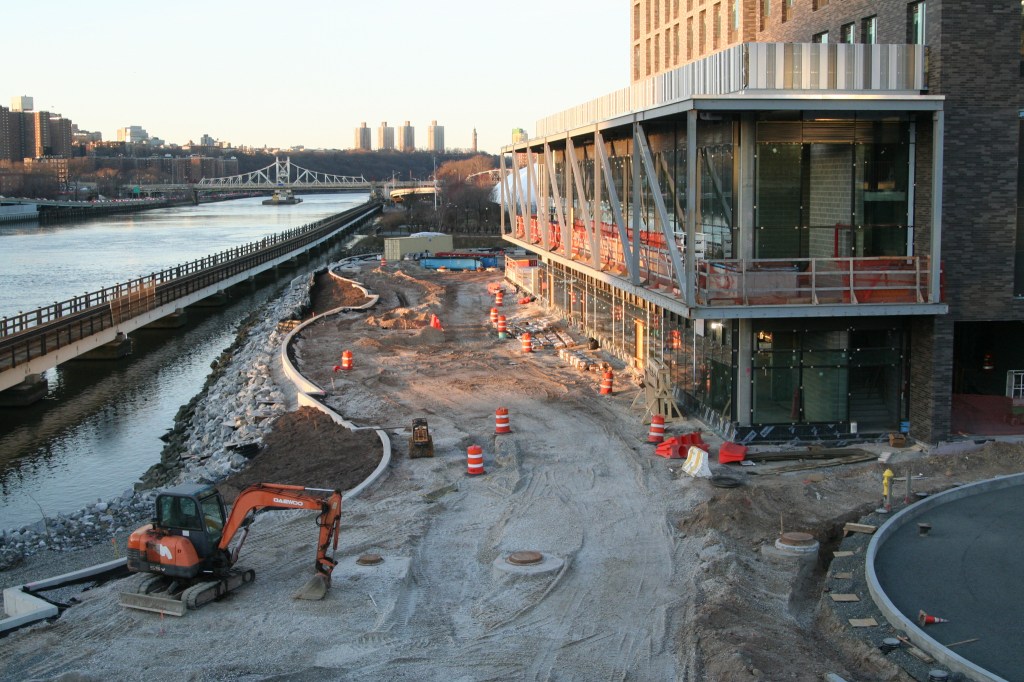
The Universal Hip Hop Museum—which will occupy the first two floors of the Bronx Point development—is set to open next year. Zack O’Malley Greenburg
As hip hop turns 50, a museum rising in the Bronx offers a window into the genre’s mostly hidden—and deeply complex—history with climate change.
Zack O’Malley Greenburg
Under the Major Deegan Expressway, somewhere just north of 150th Street, through a set of double doors wedged between a parking garage and a pizza shop, a humongous gilded throne emblazoned with the letters “S” and “R” sits behind a pair of red velvet ropes. The letters stand for “Slick Rick,” the pioneering hip hop impresario behind hits like “La Di Da Di.” One of the first artists signed to Def Jam Records, his work has been sampled more than 1,000 times, by acts ranging from Snoop Dogg to Miley Cyrus.
Slick Rick himself donated the throne to the Universal Hip Hop Museum, the genre’s long-awaited answer to the Rock & Roll Hall of Fame, set to open in 2024 as part of a brand-new development on the other side of the Deegan. For now, the throne resides at the museum’s pop-up location in the Bronx Terminal Market, serving as the first item visitors see upon entry.
“When he put out his debut album on Def Jam, he took that throne with him on tour every day,” says Rocky Bucano, the museum’s 63-year-old president, as he leads me through the pop-up’s exhibit on hip hop in the 1980s. “So that basically is one of our most important artifacts.”
Bucano stands six-foot-eight; he is also a giant among the Bronx’s trailblazing DJs. He grew up testing his skills against the likes of Grandmaster Flash at parties throughout the borough before founding his own label, Strong City Records, which put hip hop pioneers like Busy Bee and Grandwizzard Theodore on wax. Bucano also served as a financial advisor, artist manager, and youth basketball director before turning his attention to the search for a permanent home for hip hop history.
Now, as the genre celebrates its 50th anniversary, the museum is set to move into the first two floors of a 22-story tower, the centerpiece of a $350 million mixed use development called Bronx Point. The building will include 542 affordable housing units, most of them overlooking the Harlem River. The waterfront location is part of the museum’s allure—and perhaps its biggest problem.
The boundaries between water and land in New York are changing, as Hurricane Sandy reminded the city a decade ago. Neighborhoods that once seemed safely distant from the city rivers suddenly felt as vulnerable as seaside towns. Due to a stroke of tidal luck, the Bronx largely avoided the flooding seen in other areas, particularly Lower Manhattan. Yet many parts of the borough remain particularly vulnerable, including the future home of Slick Rick’s throne.
The museum site used to be a vacant lot, one that the city was desperate to develop into a waterfront destination. But on municipal disaster planning maps, Bronx Point sits squarely in Flood Zone 1—the area you’ll find shaded in red encircling the bottom half of Manhattan, surrounding Staten Island, blanketing coastal Brooklyn. In other words: the museum will be located in one of the areas most susceptible to flooding, especially as waters rise and storms grow more powerful and more frequent.
Hip hop’s most famous artists often glorify conspicuous consumption (“It’s all about the Benjamins,” in the words of Diddy). And, to be sure, many of the genre’s lyrics and music videos create an aspirational energy around gas-guzzling luxury cars and private jets, with nary a mention of mitigation (the nom-de-plume of rapper Offset, a founding member of Atlanta supergroup Migos, has nothing to do with carbon credits).
Yet hip hop has been sounding the alarm on climate for years. The response goes beyond the occasional nod from a rapper such as Pitbull (whose 2012 dance-oriented album “Global Warming” had more in common with Nelly’s hit single “Hot in Herre” than with David Wallace-Wells’ “The Uninhabitable Earth”). It goes deeper than throwaway lines from the likes of Nas (“Global warming about to burn us up,” he rapped in a 2008 track) and Tyler, The Creator (who has used the phrase “Fuck global warming” in multiple songs more recently).
Even Kanye West’s line “Mercy, mercy me, that Murciélago,” which references a Lamborghini model that gets nine miles per gallon in city driving, is a nod to Marvin Gaye’s 1971 classic “Mercy, Mercy Me (The Ecology).” That song is an environmental anthem if there ever was one, lamenting the “oil wasted on the oceans and upon our seas” and asking, “What about this overcrowded land? How much more abuse from man can she stand?”
Led by organizations like the Hip Hop Caucus and backed by some of rap’s biggest names, the genre’s response has intensified as climate change has hit close to home, starting with Hurricane Katrina in 2005. And from the devastation of Hurricane Sandy in Jay-Z’s Brooklyn to the lethal floods in Run D.M.C.’s Queens to the danger of rising waters in Cardi B’s South Bronx, the cradle of hip hop remains especially vulnerable to climate change.
“It might have an impact not just on the museum, but on everyone that lives in New York City,” says Bucano. “There’s gotta be plans put in place to mitigate risk.”
The museum, then, is a lens through which to view the genre’s intertwined history with the environment, as well as its underappreciated role in advocating for solutions. It’s not that hip hop hasn’t been saying anything; rather, most people just haven’t been listening. Just ask Michael Ford, the self-proclaimed “Hip Hop Architect” who designed the museum.
“People have spent time bobbing their heads to our stories of this despair and not seeing it as a call to action,” he says. “Now, I think, is this generation’s opportunity to go back and look at 50 years of these unsolicited, sometimes unfiltered and raw stories of environmental injustices and climate change.”
Hip hop and the Environmental Protection Agency (EPA) don’t share the same birthday, but it’s pretty close. The EPA came into existence on December 2, 1970; hip hop followed on August 11, 1973, when Clive “DJ Kool Herc” Campbell hosted a back-to-school party in a rec room at 1520 Sedgwick Avenue in the Bronx.
Herc’s revolutionary innovation was physically manipulating the vinyl in real time to extend the “breaks,” or the danceable interludes, of popular songs. This enabled “b-boys” and “b-girls” to ply their trade, with break-dancing becoming one of hip hop’s five foundational pillars alongside deejaying, rapping, making graffiti, and accumulating knowledge.
Back in the 1970s, the genre’s activism centered around calling attention to the egregious living conditions—particularly the built environment—in places like the South Bronx. Local legend Grandmaster Flash and the Furious Five’s 1982 classic “The Message” served as perhaps the most potent example: “I can’t take the smell, can’t take the noise / Got no money to move out, guess I got no choice.”
“What is today called the climate crisis was in full effect in the underserved communities when this song was released,” says Kate Harvie, a contributing writer for the Universal Hip Hop Museum. “‘The Message’ represents conscious rap in ways beyond poverty and racial injustice. Whatever has been happening to the climate was first to affect unprotected and unrepresented lands.”

A mural showcasing graffiti—a core pillar of hip hop—covers a wall beneath the Major Deegan Expressway, just south of Bronx Point. Zack O’Malley Greenburg
Yet superstar rockers, not rappers, became the face of music’s response to the climate crisis through well-publicized relief efforts and benefit shows by people like Bono and Paul McCartney. Perhaps the best-known example is Live Aid, the 1985 concert series in the U.S. and U.K. to raise money and awareness around famine in Ethiopia. Hip hop showed up, too: Run-D.M.C. played a set, sandwiched between Black Sabbath and Rick Springfield. And the human consequences of climate change in East Africa served as an early reminder that a warming planet disproportionately affects communities of color.
Even in the 1990s, arguably the peak of hip hop’s era of platinum-certified conspicuous consumption, rappers spoke out on climate. On the ninth track of his album “Black on Both Sides,” Mos Def (who now goes by the name Yasiin Bey) exclaimed: “New World Water make the tide rise high / Come inland and make your house go ‘Bye!’”
But as hip hop was heating up, climate change wasn’t yet having a direct impact on the genre’s most recognizable artists, at least not until Hurricane Katrina. The storm uprooted untold scores of New Orleans residents, including the founders of the city’s top record label, Cash Money—then home to Lil Wayne, Nicki Minaj, and Drake. Chief executive Bryan “Birdman” Williams once told me he lost “20 houses, 50 cars, and memories.” The company decamped to Miami, where it’s based today.
Katrina prompted a stronger than usual reaction from hip hop. Stars like Jay-Z and Diddy donated seven-figure sums to relief efforts. Others, from Lil Jon to Ludacris, performed on charity telethons. During one, Kanye West, incensed over the federal government’s feeble response to the flooding of communities of color in New Orleans, famously declared that “George Bush does not care about Black people.”
There was a more lasting response, too. Reverend Lennox Yearwood Jr. got his start as a minister in 1994 and served as Director of Student Activities at the University of the District of Columbia before signing on to run Diddy’s “Vote or Die!” campaign ahead of the 2004 presidential election. After Katrina, Yearwood, who is from Louisiana, established the Gulf Coast Renewal Campaign to advocate for survivors. And that grew into a larger movement.
“Katrina is the moment when I think hip hop begins to point its gaze at really being part of the solution, and part of the public announcement system, in regards to climate change,” says Yearwood, who now lives just outside Washington, D.C. “It was the Ninth Ward that was devastated and not the French Quarter.”
Yearwood continued his mission as president of the Hip Hop Caucus, a nonprofit focused on amping up the genre’s climate advocacy. As part of its “Green the Block” campaign in the mid-aughts, the Caucus worked with then-Cash Money star Drake to secure commitments to making his concerts more eco-friendly, partnering with the nonprofit Reverb on the Campus Consciousness Tour in 2010. Within a few years, climate news outlet Grist was asking, “Is Drake the perfect role model for the green movement?” (The publication’s answer: yes, though for reasons seemingly unrelated to climate, like “Drake does not deny his roots” and “Drake has perfected swagger.”)
On the East Coast, Hurricane Sandy not only rolled through the city of hip hop’s birth in 2012, but revealed that some of the genre’s biggest names were willing to do more than their part to boost recovery efforts. Mike D of the Beastie Boys reportedly served 19,000 meals to hurricane victims, while Philadelphia’s Meek Mill headlined a relief concert in hard-hit Atlantic City.
Yearwood’s group teamed up with the Sierra Club in 2013 to protest the Keystone pipeline, bringing some 35,000 people to the National Mall—then the largest known climate protest. The following year, the Caucus helped organized “Home,” an album dedicated to protecting the planet. Yearwood says Beyoncé’s “Sandcastles” was supposed to be on the record; they couldn’t get the track cleared in time, so it ended up on “Lemonade.” (The song opens with the line “We built sandcastles that washed away,” but ends up being more about Beyoncé’s relationship with Jay-Z than climate change.)
Still, “Home” featured a stacked roster of potent songs performed by stars such as Ne-Yo and Common. On the track “Trouble in the Water,” Common delivered lines like “Water moves, new world order rules / Through hurricanes, the pain is made audible” and “We think our opponent is overseas / But we messin’ with Mother Nature’s ovaries.”
Other artists stepped up, too. In 2014, Pharrell Williams launched a clothing collection with G-Star Raw made from recycled ocean plastic and has since released a similarly-sourced sneaker line with Adidas. Yearwood teamed with several artists in 2015 to launch a national bus tour highlighting the disproportionate impact of climate change on communities of color.
In 2019, rapper Lil Dicky recruited some of the biggest names in music—including hip hop stars Wiz Khalifa and Snoop Dogg—for “Earth,” a modern take on “We Are The World,” albeit a bit more cheeky. “There’s so many people out here who don’t think global warming’s a real thing,” says Lil Dicky flatly at the end of the track. “We gotta save this planet, we’re being stupid.” The project raised nearly $1 million for environmental nonprofits including the Carbon Cycle Institute and the Global Greengrants Fund.
Lesser-known hip hop artists like Taji Aqib, a Philadelphia-based multihyphenate who also moonlights as a poet and sports podcast host, have placed climate at the forefront as well. Aqib takes issue with the notion that the environment should take a back seat because there are “more pressing” concerns.
“There are,” he says. “But these concerns won’t really matter in the grand scheme of things if we don’t start being more concerned about the climate.”
And yet, in many circles, hip hop’s climate advocacy still goes unnoticed. That sort of invisibility can extend even to superstar artists who don’t fit the stereotypes of climate activists. Yearwood points to the fact that Rihanna recently donated $15 million to groups working on environmental justice, but still isn’t seen by many as a climate warrior on the level as a white male celebrity like Leonardo DiCaprio.
Though Rihanna isn’t a hip hop act by the strictest definition, her example is emblematic of the genre: just because these artists don’t “look like” climate advocates, many observers dismiss hip hop’s role as part of the solution.
“Part of the problem is that hip hop has a very distinct culture, but so does the climate movement,” says Yearwood. “I like Ben & Jerry, I have a Patagonia jacket,” he says, “but it’s a distinct culture. And I think that sometimes the thing for me is, we have for many years struggled to find ourselves trying to be part of, or appreciated within, the climate movement and culture.”
He believes that if progress is going to happen as quickly as it needs to happen, this is going to have to change.
With Bucano’s tour of the Universal Hip Hop Museum’s temporary home complete, we head across the street toward the construction site at Bronx Point. The Major Deegan Expressway soars a few dozen feet above us, the sound of trucks speeding south mingling with the squealing of northbound breaks as the Friday afternoon traffic begins to thicken. We cross the street under the highway and walk along a tall, blue construction fence to a gate where a hardhat-clad man lets us into the site.
The museum landed here after a search that lasted more than a decade, bouncing from a planned site at the Kingsbridge Armory, to the Bronx County Courthouse, to its current location. In front of us, the main tower looks nearly complete, the higher residential floors sporting wide windows accented by gray brick. At the bottom, the outlines of the museum are beginning to take shape, though for now the site looks less like the waterfront park it’ll become and more like a place where you’d have a monster truck rally. Backhoes and bulldozers rumble across the dirt, sloshing through puddles left by recent rain.
I follow Bucano into a temporary turnstile at the building’s base as he nods to another construction worker. As we walk down a hall on the main floor, past unfinished walls with nothing but the yellow insulation showing, I notice something on the concrete floor: more puddles, maybe a centimeter or two deep. This isn’t necessarily unusual at a construction site, but it’s emblematic of the challenges Bucano and his crew have had to confront—especially the architect, Michael Ford.
“There were a number of adjustments we needed to make because we had to deal with the floodplain,” Ford, who is from Detroit, tells me in a phone interview after my tour with Bucano.
Ford linked up with Bucano after meeting hip hop pioneer Kurtis Blow, an early supporter of the museum concept, at a lecture at the University of Wisconsin-Madison. Soon Ford was spearheading the architectural side of the project, hosting “design ciphers” to brainstorm architectural ideas for the museum.
Even before its completion, the physical museum space was influenced by climate. For example, the site’s flood risk means there can’t be a functional basement. Ford initially wanted visitors to enter by descending a series of steps, as though walking into a subway station, before coming face-to-face with a real subway car tagged with graffiti.
“We had to adjust: how far can you actually descend in this space? How far could we go? And that was all because of the Harlem River,” says Ford. “So we’ve designed it with the integrity that we need structurally to have a subway car span the main staircase. You’ll actually walk under this subway car elevated in the air.”

The groundbreaking ceremony for the Universal Hip Hop Museum in 2021. Zack O’Malley Greenburg
Ford sees his mission as creating the sort of spaces that the Bronx rarely got to have before. The borough was defined by the decisions of master planner Robert Moses, who used eminent domain to demolish neighborhoods he deemed blighted. Perhaps the most infamous example: displacing some 60,000 people to create the Cross-Bronx Expressway. Most were resettled into the drab housing projects he constructed around the same time, including the families of many hip hop pioneers.
Moses was heavily influenced by the ideas of the architect Charles-Edouard Jeanneret, better known as “Le Corbusier.” The Frenchman favored broad boulevards and tall, symmetrical buildings over the narrow streets and quirky structures of Paris. In his infamous “Plan Voisin,” he proposed bulldozing much of central Paris and replacing it with a slew of uniform sixty-story residential towers surrounded by parks and shops.
“He wanted to have housing that was surrounded by job opportunities, he wanted to have amenities that were part of the housing for working class citizens,” says Ford. “But all those were stripped away when Robert Moses started suggesting using this as a model, and it was purely about housing and restricting people, and cutting them off from some of the amenities.”
So it’s a fascinating turn of events, then, that the Universal Hip Hop Museum finds itself sitting at the base of a tower packed with government-subsidized condos. To Ford, this is an opportunity to get right what others got wrong. In other words, as much as he’s been taking the natural environment into account in his designs, he’s also been focused on creating a better built environment.
That means ensuring the museum caters to those who live above it in addition to those just visiting. Part of the mission: making sure that the museum will open up jobs to individuals who would otherwise not have the credentials needed to work at traditional museums, which often require advanced degrees in conservation.
“Rocky has shown that he’s not just going to universities or existing cultural institutions to build out his curatorial team,” says Ford. “It’s the Universal Hip Hop Museum. A large portion of it’s going to be about people who spent most of their formative years living in affordable housing and critiquing affordable housing through their lyrics. But also showing opportunities for young people. You can’t become what you can’t see.”
Hip hop has always been a more overtly activist genre than others, and—just like the rest of us—its artists have been motivated by recent natural disasters to focus more intently on climate change. To be sure, hip hop didn’t create the problem, nor should the genre be held responsible for solving it. There is only so much rappers can do: greening their tours, donating proceeds to environmental causes, using the power of lyrical product placement to elevate discourse around global warming, and so on.
Even after storms like Katrina and Sandy, it can be hard for artists to concentrate on climate when the effects aren’t felt constantly on a visceral, personal level. Catastrophic hurricanes may be happening more often, but they’re not happening every day. For the artists on the very front lines of climate change, though, it’s a different story. Lisa Russell has seen this firsthand overseas.
Now based in Kenya, working as a filmmaker for the U.N., Russell started her career as a backup dancer for the likes of Usher and Diddy. She recently made the trip back to New York for a different sort of movement: the United Nations’ 2023 Water Conference. Billed as the institution’s first such summit in a generation, the confab aimed to mobilize member states to commit to voluntary actions to mitigate the global water crisis.
“There are a whole bunch of both emerging hip hop artists and established hip hop artists who are tackling these different issues,” says Russell over drinks at Brooklyn Moon, a Caribbean bar across from the Notorious B.I.G. mural in Fort Greene. “But in my opinion, you’re going to find it in the Global South, or places where climate change is the biggest threat. You find a lot more community artists who are really engaged in it because it is an immediate threat.”
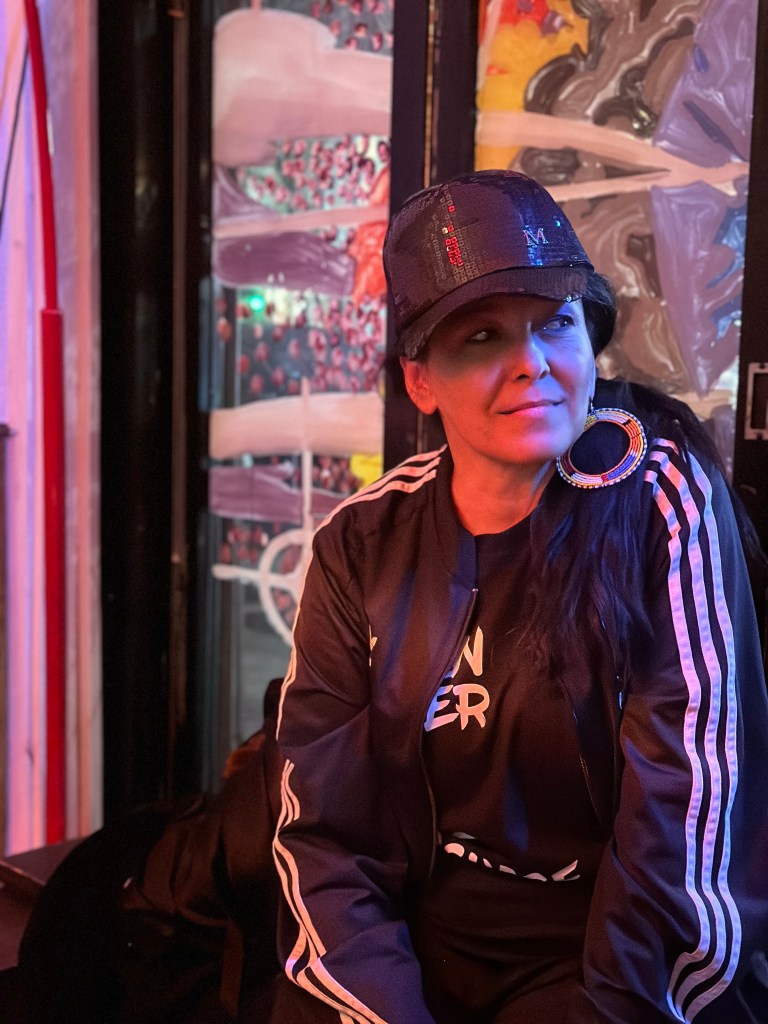
Lisa Russell believes hip hop can be a part of the solution to the climate crisis—starting in the Global South. Zack O’Malley Greenburg
Russell pointed to a handful of examples from Kenya. There’s hip hop star King Kaka, the driving force behind a brand called Majik Water, which harvests clean drinking water from the air and aims to hydrate drought-prone communities. Dave Ojay, an artist manager, runs a global environmental justice campaign called My Lake My Future to help save endangered lakes, and founded a music festival to help save Lake Victoria, Africa’s largest.
One Kenyan rapper, Henry “Octopizzo” Ohanga, made the trip to New York for the water conference in person. He’s been deeply and personally affected by climate change. Though he grew up in Nairobi’s notorious Kibera neighborhood, he spent several years of his youth in his familial hometown of Saiya, in the country’s rural west. His relatives in the village have reported rapid declines in crop yields over the past few years.
In his song “Hakuna Matata,” a Swahili expression that means “no problem,” Octopizzo juxtaposes the popular slogan with the reality that “drought is killing livestock and humans” while “politicians still in denial are just abusing each other in public.” Similarly, at the water conference, Octopizzo grew frustrated with the quantity of talk and paucity of action—especially given the confab’s outsized carbon footprint.
“We are converging in New York; we have 7,000 people, probably 80% flew in, so already we are fucking up,” he tells me. “The hotels, all this money we are spending, we could put it in a bucket and it could build like almost a thousand water spaces in like 20 countries in Africa.”
Russell shares some of Octopizzo’s frustrations, though she views the conference as a step in the right direction to unite hip hop with the U.N. in service of the environment. In fact, earlier this year, she was in talks with the Universal Hip Hop Museum to create a conference that would bring global artists to the U.N. in honor of the genre’s 50th anniversary.
The idea: to use the genre as a platform for raising awareness around the organization’s Sustainable Development Goals, which range from “Climate Action” to “Sustainable Cities and Communities.” But perhaps due to the vagueness of those goals, or the glacial pace of large institutions, the effort is still pending.
Rocky Bucano grew up on the opposite side of the Bronx from the Universal Hip Hop Museum site, in another low-lying part of the borough: a northeastern neighborhood known as The Valley. That name came from its location at the foot of a long slope starting at Haffen Park and stretching seven long blocks up to the top of Eastchester Road.
“Some of the best times of my life were during the wintertime, because when it snowed, you would be able to take your sled to the top of the hill and go all the way down,” he says, elongating his last few words to emphasize the duration of his alpine exploits. “When you’re a little kid and you are in a sled at the top of the hill, and you’re going down and your sled is speeding down that hill, man, you feel like you’re watching something from the Olympics.”
Bucano remembers trying to get to the Pathmark in Co-op City with his young son during the blizzard of 1995, which dumped nearly two feet on New York. The snow was up to his chest, and it was so hard to walk that he decided to turn his son around and head home. Kids growing up in the Bronx today may never come to know winters like that.
“Here we are in 2023, and we had our first snowfall at the end of February,” says Bucano. “My sons, those are gonna be the ones that are going to have to deal with climate change.”
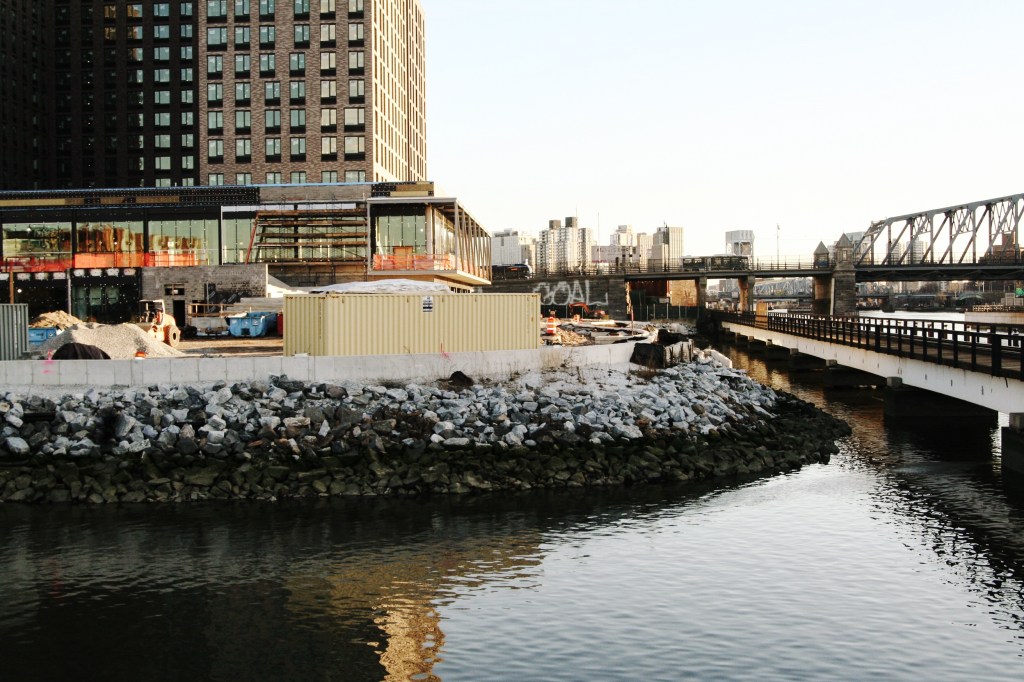
The Harlem River laps against the edge of the Universal Hip Hop Museum site. Zack O’Malley Greenburg
So will the museum, even amid the best efforts of Bucano and Ford and the rest. Addressing climate change begins with electing leaders who prioritize attacking it, and sure enough, stars from Diddy to Snoop Dogg to Cardi B vocally supported Joe Biden during his presidential run. Less than two years into his tenure, Biden signed the Inflation Reduction Act—the most consequential climate legislation in decades.
Hip hop has also been addressing climate through the lens of business. Jay-Z, now a billionaire and veteran venture capitalist, has plowed cash into eco-friendly startups. Among them: oat-based milk company Oatly and vegan snack outfit Partake, both of which offer replacements for carbon-intensive dairy products. Lupe Fiasco, another highly respected emcee, invested in Zero Mass Water, a company that uses solar power to pull water out of the air; he’s used his platform to promote the technology everywhere from Instagram to the CES conference in Las Vegas.
The Hip Hop Caucus has stayed active as well, producing 2021’s “Ain’t Your Mama’s Heat Wave.” The stand-up special, told through the lens of four young Black comedians, was filmed below sea level at a housing project in flood-prone Norfolk, Virginia, an area not unlike the site where the Universal Hip Hop Museum is taking shape.
I went back to Bronx Point by myself to take another look, thinking maybe I could get a clearer picture by wandering around the site alone. It was an unseasonably warm Sunday afternoon, and the main door had been padlocked. So I walked over to the park just to the north of Bronx Point and made my way south toward the main tower along the damp rocks on the riverbank.
With the construction crews off duty, the only sound audible besides the distant din of the highway was the occasional goose clopping around in the riverside muck. I stood on a little patch of sand and stared up at the museum’s outlines, perhaps a hundred yards away. I tried to imagine where Slick Rick’s throne might end up, maybe on the second floor with a commanding view of the Manhattan skyline.
More than anything, I was struck by how tangible the river felt, far closer than it could have in any blueprint. Even on a calm day, the waters lapped against the mossy rocks just a few feet below street level, the most recent high tide already blanketing the outcropping halfway up. It reminded me of something Ford said.
“How do we deal with future tides?” the architect asked, rhetorically, before offering his answer. “You create a space that’s flexible, that allows you to tell the history—while also leaving room for what’s going to happen tomorrow.” ◊

 Planet A Magazine
Leave a comment