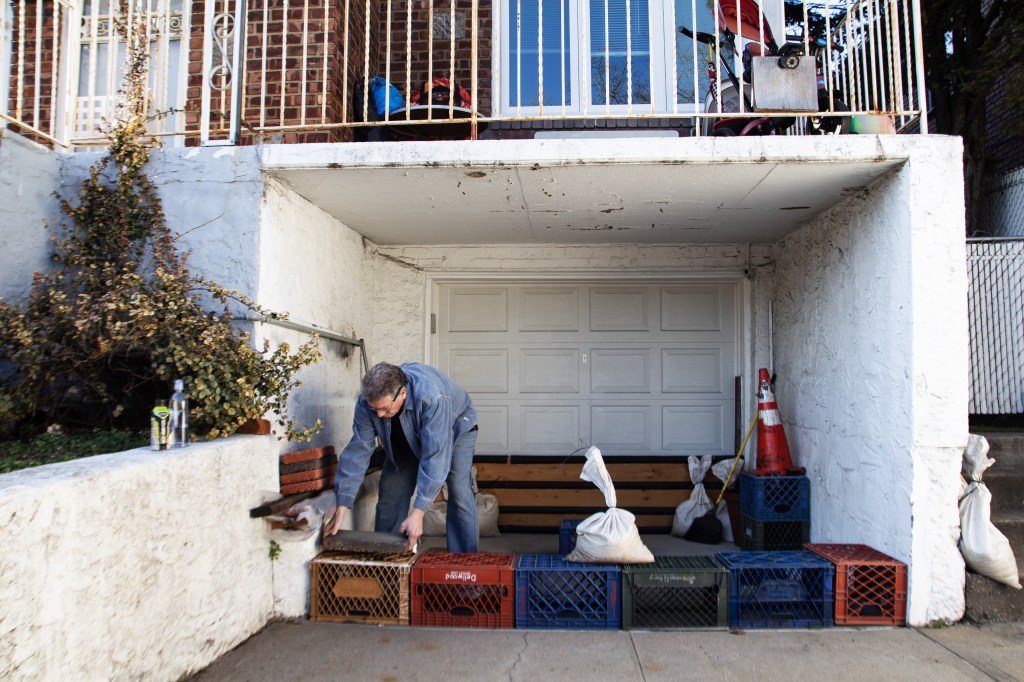
Chris DiLorenzo barricading his house before storm. Jana Cholakovska
Heavier storms are overwhelming the outdated sewer system in Flushing, endangering the property and lives of its residents.
Jana Cholakovska
During the early evening of September 1, 2021, Chris DiLorenzo started cleaning the sewer drains in front of his house in the Flushing neighborhood of Queens. Hurricane Ida was approaching the city, and DiLorenzo was nervous that his basement would flood, as it often did when it rained. Most people, he thought, were not taking the storm very seriously. Though that evening the National Weather Service and the city’s mayor would issue a series of warnings, the severity of Ida would take much of the city by surprise.
DiLorenzo, a former police officer, lives at the corner of Kissena Boulevard and Rose Avenue. His entire neighborhood is in a topographical slump, down the hill from downtown Flushing. Anytime it rains, water and debris rush down to DiLorenzo’s street from all around, clogging all the drains. The intersection beside his house is particularly vulnerable: the sewer underneath lacks the capacity to expel runoff even with the added help of six catch basins. But if DiLorenzo could just get rid of the debris around the storm drains, he thought, maybe his basement wouldn’t get flooded as badly this time.
The storm made landfall that evening. New York City’s Central Park received 7.13 inches of rain that night. Almost half of it fell between nine and 10 p.m., the greatest amount in a single hour ever observed in the city. It was around then that DiLorenzo witnessed three manhole covers near the intersection get pushed up out of their slots and into the street.
“That’s when I knew it was going to be bad,” he said. “I just stopped and watched the sewer drains. Once the sewer begins to bubble, you know it’s at full capacity. You just watch the water come and there’s not a damn thing you can do about it.”
DiLorenzo’s sister owned the house; he had moved in with her in 2015, shortly before her husband died. Since then, the house has flooded at least once a year. It’s always the first in the neighborhood. Now DiLorenzo watched from his porch as water from nearby Kissena Park cascaded onto the already flooded intersection. The drains regurgitated a mixture of waste and stormwater back onto the streets. There was a rancid, sulfuric smell.
He watched people as they tried to drive through the water as it rose. They struggled until their engines shut off. Many of them fled, abandoning their cars on the street.
One stranger, however, remained stranded. DiLorenzo saw a car stop just before the intersection, right in front of his house. It couldn’t move forward because of all the water and debris. But the woman inside did not get out.
DiLorenzo decided to help. He made his way through the water, which at that point reached his navel. Through the lowered driver’s side window, DiLorenzo tried explaining the dangers of staying inside during a flood—the vehicle could be swept away or even fully submerged. The unequal pressure might make it impossible to open any doors or windows. She could die. But the woman inside didn’t budge, seemingly paralyzed by fear. She refused to open the car door. The woman was Chinese, and DiLorenzo wasn’t sure she could under-
stand him.
But he kept talking and gesturing: Door won’t open; you will be trapped. It took him roughly half an hour, but he convinced her. DiLorenzo wrenched the door open and the woman got out. They struggled through the current, their legs bumping into random objects the water had consumed. It was a mixture of stormwater, raw sewage, and gasoline. DiLorenzo felt a familiar burning sensation on his skin. “Every time that sewer goes, my legs break out,” he said.
Together they climbed the concrete stairs that lead to DiLorenzo’s front door, but the woman wouldn’t go any further. She leaned against the wall. DiLorenzo looked from the porch. The murky water had reached halfway up the abandoned cars. He went inside, alone.
His basement was completely flooded by that point. Water pressure had bent both the garage and the side door. From the top of the stairs connecting the kitchen and basement, DiLorenzo could see his compost bin and cleaning supplies floating in the shimmering water just a few steps away. He could’ve touched them if he wanted to. The storm raged into the night. It was almost two in the morning when the woman finally agreed to come inside. She was soaking wet and shivering, DiLorenzo said. He gave her a blanket as she huddled on the living room couch. She didn’t speak English and he didn’t speak Mandarin. Not much was said.
At daybreak, the woman’s father came to pick her up once the storm passed. Most of the water had receded by that point. A few hours later, as DiLorenzo began the long process of cleaning up his basement and his driveway, the woman’s cousin, who could speak English, arrived. He thanked DiLorenzo and explained why she was reluctant to accept his help. He said she wasn’t scared of the water; she was scared of DiLorenzo. She thought he was a white supremacist. The past year, during the pandemic, there had been a spate of hate crimes against Asian-Americans across New York. But the family was very grateful for his help. More than a year later, they still leave the occasional tupperware of food or bottle of wine on his porch.

Chris DiLorenzo in front of his house in Flushing, Queens. Jana Cholakovska
New York City’s first sewer was specifically meant for rainwater runoff. In the 19th century, ditches a few feet deep, also known as gutters, were dug along city streets to divert stormwater into the city’s rivers and canals. Household waste was supposed to go elsewhere. In wealthier neighborhoods, human waste usually went into privies or outhouses. Once they were full, “night soil” or “tub” men—mostly Black Americans and immigrants—collected and emptied the tubs of waste, which were then piled into uncovered carts. The waste was sometimes delivered to local farms as manure. Mainly, though, it was dumped in the Hudson and East Rivers. Over the next decades, wealthy residents created their own private sewers, a patchwork of different pipes and tunnels that emptied into the city’s waterways. Poorer residents tended to put their household waste into the gutters running along the streets; though designed as storm drains, they were soon clogged with rotting garbage and excrement. Predictably, a foul stench often loomed over the city.
As New York’s population swelled, so did its waste. Noxious substances overflowed onto the streets, poisoned the shoreline, seeped into local waterways, and contaminated the drinking supply. This ex- posed people to diphtheria, typhoid, dysentery, and a plethora of other diseases, especially among immigrant and working class communities who lived in tightly packed tenements in lower Manhattan.
Sanitary issues drew little attention from politicians; the role of government at the time wasn’t to ensure equitable access to public works, but rather to create a thriving environment for commerce and industry. It’s not that people weren’t calling for a city-wide sewer system, but that it required copious amounts of water and pressure to move things along pipes that the city didn’t yet have.
That all changed in 1842 when the Croton Aqueduct opened, bringing fresh water from upstate to the city’s reservoirs. Around the same time, the work of English sanitarian and social reformer Edwin Chadwick began to gain traction among public health experts. He proposed a comprehensive urban infrastructure system—a combined sewer—that would connect house and street drainage. Fresh water would flow from reservoirs upstate, to taps and toilets, and then into the sewer; on top of that, storm water would come in from drain holes in the street and help push the wastewater through the system.
In 1849, the first municipal sewer was built in Brooklyn after a devastating cholera outbreak, possibly caused by bacteria festering in the city’s open sewers, took the lives of thousands. Over the next four decades, the city ramped up its sewer construction, adding roughly 500 miles of pipes. When the boroughs consolidated to form New York City in 1897, most of Manhattan, Brooklyn, and the Bronx had functioning sewers. Queens, at the time a patchwork of well-established townships, sprawling farms, and marshlands, took longer; its sewer system remained relatively underdeveloped well into the 20th century.
Despite considerable advances, runoff was still being dumped into local water- ways. As concerns about water-borne bacteria grew, the Metropolitan Sewerage Commission was tasked with conducting harbor surveys and water quality analyses as part
of the city’s master sewage plan. The first wastewater treatment facility opened in Coney Island in 1937; that area was prioritized because people were tired of visiting sewage-infested beaches. The Tallman Island wastewater facility—the first in Queens—opened two years later.
Over the following decades, farmland in northern Queens continued to be divided and developed, steadily transforming into bustling neighborhoods like Flushing. By the 1980s, immigrants from Taiwan, China, Japan, India, and South Korea, among others, established strong communities in the area. Flushing has remained one of the city’s most diverse and densely populated neighborhoods. But sewer construction has struggled to keep up with rapid population growth.
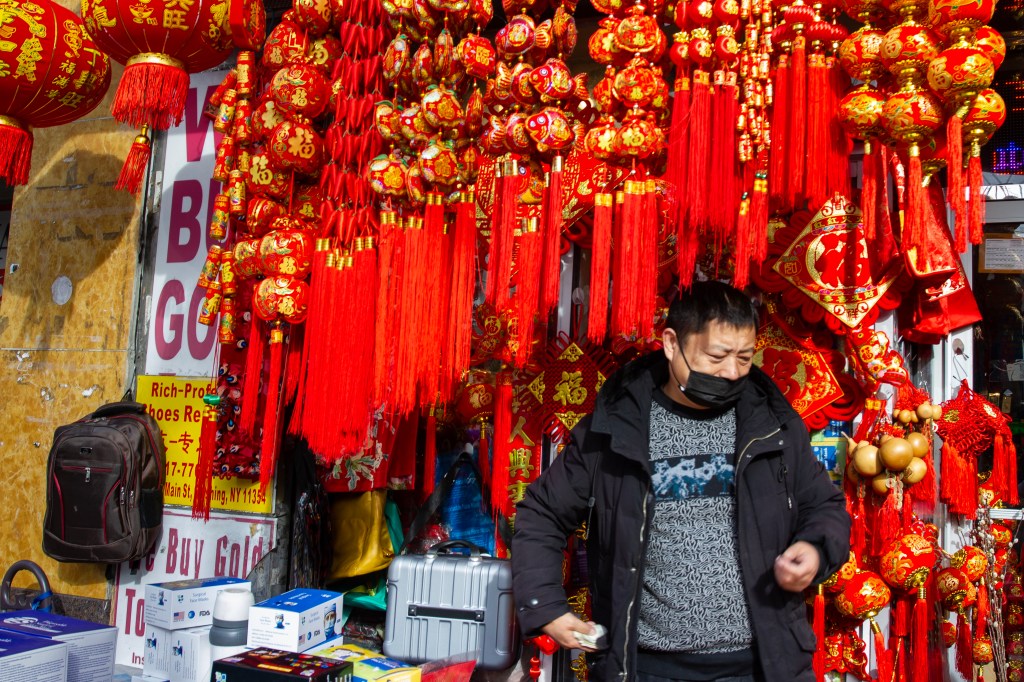
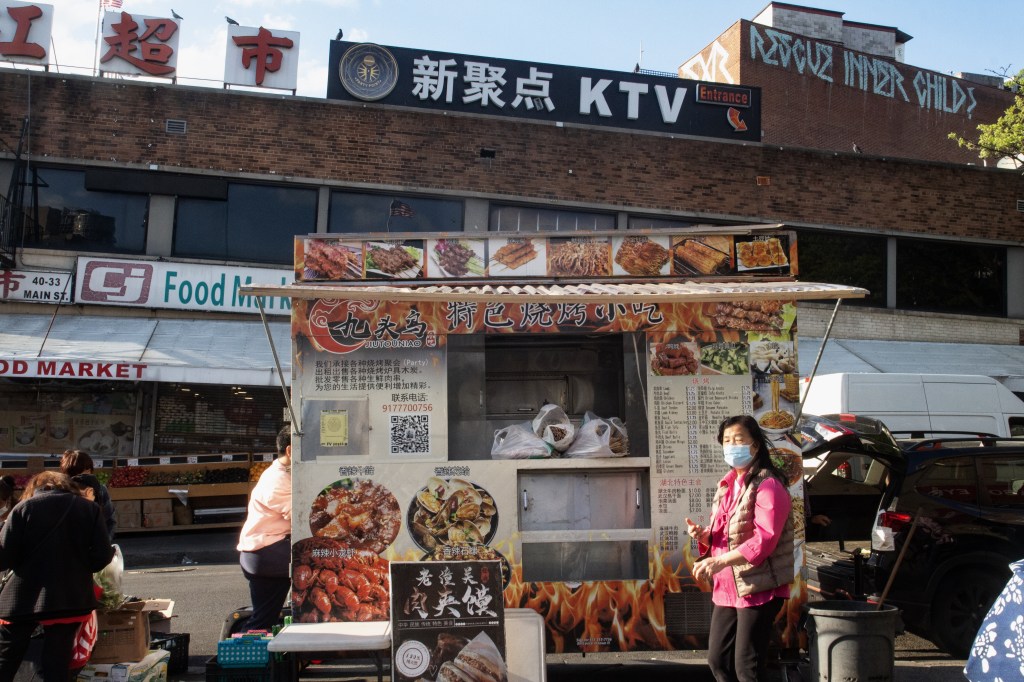

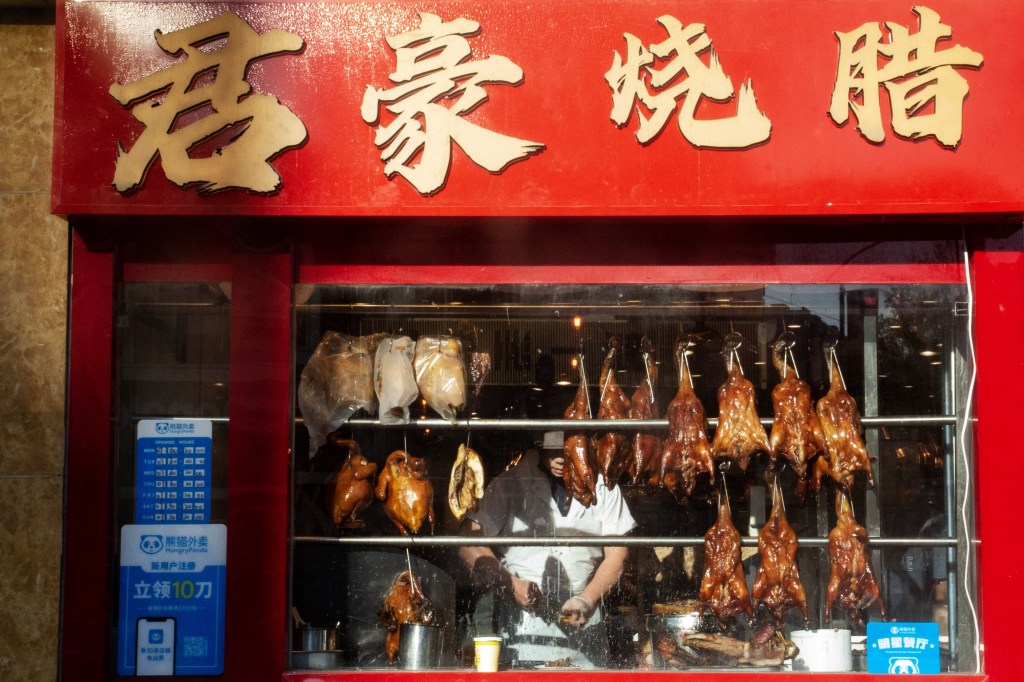
A Sunday in Downtown Flushing. Jana Cholakovska
Over the years, the sewer network has been repaired and upgraded countless times. But almost two thirds of the city—including Flushing—still depend on the combined sewer system. This means that when storms hit and the system is overwhelmed, the runoff is a combination of rainwater, raw sewage, gasoline, household chemicals, insecticides, and anything else the water might’ve picked up. This creates an environmental and public health hazard, in addition to the danger of the flooding itself.
In 2015, the city received its first Municipal Separate Storm Sewer System (MS4) Permit, which aims to prevent pollution from ending up in local waterways and requires parts of the city to end their dependance on the combined sewage system and to add things like additional catch basins, gutters, and storm drains. The MS4 system,
however, serves only between 30 and 40% of New York City. Most of Flushing isn’t covered.
I first met Chris DiLorenzo in early 2023, while visiting Flushing to talk to people about the after-effects of Hurricane Ida. DiLorenzo was eager to talk about flooding. Anytime there’s a chance of rain, he said, he sweeps debris caught in the drain grates on his street. He pointed to a drain in front of his driveway. Frequent pressure from runoff had eroded the asphalt around it.
“This is the catch-all,” he said. “That’s why this area here gets hit so hard, considering we’re not near any water. For us to flood, it’s just from the influx of all the rain. This infrastructure wasn’t built for this many people.”
The neighborhood was quiet except for the occasional car passing at the intersection of Kissena and Rose. Birds chirped around us.
DiLorenzo, who is 59 years old, wore a blue corduroy button-up and jeans. He has startling amber eyes, which peered at me from behind wire-framed rectangular glasses. His smile rarely faltered, even when we spoke about difficult things. He was lively, but his movements were measured. Bad joints and several surgeries on his hip, neck, and stomach have limited his range of motion. He had a hard time standing for long periods. He invited me into the living room to sit down.
Inside, the place was neat. A U.S. Marshals flag and a few badges that used to belong to his brother-in-law hung on the wall. DiLorenzo had grown up in Astoria and had started to work as a general contractor after high school. He said he joined the NYPD on a whim. A woman he was dating at the time aspired to become a police officer, so when she went to take the entrance exam, he came with her. “I had no desire to become a cop,” he said. “I never thought about it, it never crossed my mind.” But, he said, “I ended up being really good at it.”
He graduated from the police academy in 1986 and was assigned to the 30th Precinct in West Harlem. At the time, the area was in the grip of the crack and cocaine epidemic. “We called it the Wild Kingdom, and that was a good name for it,” DiLorenzo said. “It was a strange place. I had a friend firebombed. Body parts and homicides all over the place. It’s hard to believe it because I drove by there a couple of years ago. It’s nothing like it used to be.”
But DiLorenzo’s career was soon derailed. In the early 1990s, a large group of officers in the 30th Precinct began raiding drug dealers and stealing their product, which they would then arrange to sell on the streets. They were eventually caught and indicted on a wide range of charges; the New York Post labeled them “the Dirty 30.” DiLorenzo was among them. In 1995, he began an eight-year stint in federal prisons in New York, Pennsylvania, and New Jersey. He was released in 2003.
DiLorenzo did not want to talk much about the case, nor about his time in prison, though it was clear that he resented it. He had a tough time when he got out. He had a falling out with his siblings, unrelated to his time in prison. He was a convicted felon, and employment opportunities were scant; he eventually found work as a truck driver. He got divorced. He struggled with depression.
In 2015, DiLorenzo’s sister called him out of the blue. They had not spoken for about 15 years, but her husband had cancer, she said, and she couldn’t handle all the household and caretaking responsibilities on her own. She asked if he would help. He said yes and moved in with her and her husband. When her husband died a few months later, DiLorenzo stayed. That’s where he was, six years later, when Ida hit.
After I learned all this about DiLorenzo, I began to wonder whether his heroism on the night of Ida, rescuing the woman from her car, was a form of redemption. He had lived a complicated life and had made many mistakes, but when there was a crisis, he came through. I asked him this, but he doesn’t see it that way.
“It’s not that I’m a good person,” he said. “I need to help people. That’s my drug. That’s my addiction. I’ve only figured that out recently.”
The storm did tremendous damage to the neighborhood. Across the street from DiLorenzo’s home, a family of three, from Nepal, drowned in their basement apartment. According to the New York Post, when their apartment had started flooding, they called their landlord; he said he told them to get out as quickly as possible. When the landlord called them back, they did not pick up. Their bodies were discovered by NYPD divers at 3:30 that morning.

At DiLorenzo’s place, though everyone remained safe, many things were damaged beyond repair, and many were lost. The water knocked down a wall, multiple pipes, and the oil tank. Boxes of his clothes, jewellery, and mementos, his young daughter’s collectibles, drawings, and report cards were washed away. His daughter’s entire childhood was lost, he told me.
“I can’t even tell you all of the things I lost,” he said. “People might say that was all stuff, but to me, it meant something.”
Klaus Jacob has spent more than five decades at Columbia University’s Lamont-Doherty Earth Observatory. A geophysicist and a climate scientist, he forecast the consequences of a Sandy-like storm a year before Sandy actually hit New York City. For him, the quick succession of Hurricanes Henri and Ida during the summer of 2021 was just another reminder that storms like these were becoming more severe and more frequent.
“Now the water came from above, not from below,” he said. “And sure enough, disaster struck.”
A warmer climate has fuelled the development of more powerful and more destructive hurricanes over the last few decades. The science is fairly straightforward—hurricanes are powered by the release of heat when evaporating water from the ocean surface condenses into a storm’s rain. More rain means more heat is released, and more heat released means stronger winds. Mightier storms have put unprecedented pressure on aging infrastructure, particularly old sewer systems.
Hurricane Ida quickly overwhelmed the city’s sewer system, which was only designed to handle 1.75 inches of rain in an hour. And since almost three quarters of the city is covered in impervious surfaces—streets, roofs, parking lots—runoff rushed to low lying areas like East Flushing.
“We’ve inherited really old systems done by people with a very different view on how science and nature works,” said Kim Worsham, a water and sanitation expert. “Now we’re at a crossroads where we’re having a bit of a reckoning with our old infrastructure and we’re trying to figure out what to do with it.”
After the devastation of Sandy, New York had invested billions of dollars in coastal resiliency to protect against another deadly storm surge when the ocean rushes into the city. In the face of flash floods like those during Ida, those efforts were useless at protecting inland neighborhoods. The storm dumped inches of rain in a matter of hours, a problem that cannot be solved through coastal protection. An upgraded sewer would help alleviate some risks of flooding in low-lying places like East Flush-
ing, but, according to experts, overhauling the old system would be close to impossible.
In Queens, the problem of aging sewers is multi-pronged: low-lying topography, expensive and disruptive projects, and risk averse agencies.
Worsham said that the borough was never prioritized during the city’s initial sewer expansion because it mostly consisted of sparsely-populated farmland. Digging in the marshy ground required arduous effort. Since then, the sewers have not managed to keep up with the expanded population.
Sam Redway, a civil water engineer at the design company Arup, added that Queens is the most problematic borough for combined sewer overflows because it’s the most low-lying and has the highest water table. Tearing up roads to replace pipes, not to mention shutting down parts of the system to install new infrastructure, makes little sense, he said.
“Developing new sewers is prohibitive- ly expensive and incredibly disruptive,” he said. “With the way we do things here in America, it’s just not something you can execute.”
Redway said that instead of tearing the whole system down, the city is exploring other ways to address the issue through green infrastructure like rain gardens, rain barrels, sunken basketball courts, and permeable paving that would soak up some of the water during a flood. Governments are often reluctant to sign off on expensive projects when taxpayer dollars are involved.
Worsham echoed this sentiment.
“Our systems are publicly owned, which means they’re really risk averse,” she said. “They’re not going to start testing out a lot of new technologies, especially when we’re talking about climate. On top of that, there’s not a lot of money going around.”
Last September on the one year anniversary of Hurricane Ida, New York City Mayor Eric Adams announced a suite of stormwater infrastructure initiatives aimed at making the city more resilient to extreme rainfall in the future.
“We are taking action to protect our city and prevent future tragedies, by ramping up flood protection with sewer advancements and curbside rain gardens, as well as by building out our cloudburst infrastructure and expanding other flood mitigation options, including the blue belt drainage system,” Adams said at a press conference.
A few weeks prior to the mayor’s announcement, the City Comptroller’s Office denied every one of the 4,703 negligence claims people had filed against the city after their homes flooded during Ida. The decisions relied on precedent set by a case from 1907 that ruled municipal governments aren’t liable for damage from “extraordinary and excessive rainfalls”—even if the city’s sewer system was under capacity.
The Department of Environmental Protection and the Department of Design and Construction are working to upgrade the sewer in Southeast Queens. The city has also deployed micro-tunneling technology to double the size of sewers in the neighborhoods of Woodside, Maspeth, Middle Village, and Glendale in central Queens. There are no plans to upgrade the sewers in Flushing, but the neighborhood has gotten a couple of hundred rain gardens and infiltration basins.
Jacob, who served on the Mayor’s New York City Panel on Climate Change between 2008 and 2019, said that certain strides have been made to make the city more resilient to flooding. But the overall approach, he said, has been too lethargic, too slow, and too narrow.
“I’m going crazy,” he said. “Even after so many climate events, Sandy, Henri, Ida, there’s still no real wish on the part of various city agencies. The same applies to the state and the federal government. They need to come up with a comprehensive plan. That’s the key word: comprehensive. This is an interagency problem.” He believes that the short term solutions the government has implemented thus far need to “dovetail” into a long term vision of climate adaptation. Jacob isn’t optimistic that the government is up to the challenge.
Every Friday morning, DiLorenzo sweeps the street before a garbage truck arrives at around 11 a.m. “If I don’t do it, the drains will clog and then my house is flooded,” he said. Each week, he starts by sweeping the pavements, then the crevices in between parked cars, and finally the street. He takes a leaf blower, a sweeper, and a dustpan, working methodically down the street.
His basement flooded again last October. This time it was only 21 inches, com- pared to six feet during Ida, but for his sister it was the last straw. She’s decided to sell the house, he said. DiLorenzo isn’t sure where he’ll end up if she goes through with
the sale. He told me he’ll be sad to leave. He loves the neighborhood and its people.
In the meantime, he’ll continue sweeping the street, hoping to keep the water at bay. ◊

 Planet A Magazine
Leave a comment