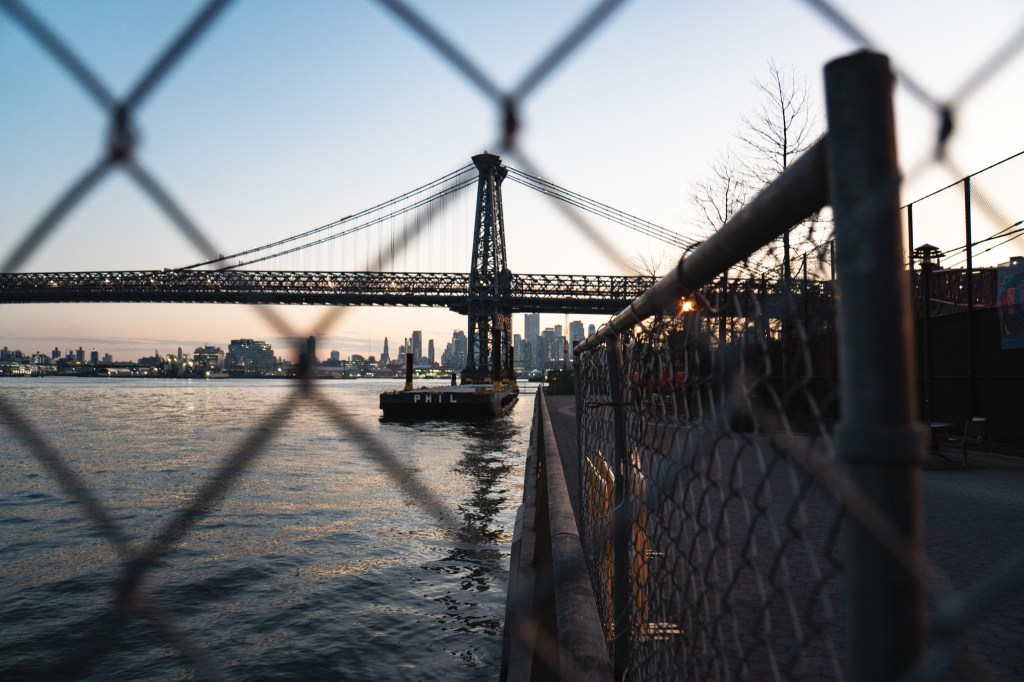
The Manhattan Bridge, viewed from East River Park. The park is undergoing a significant rebuild as part of New York City’s efforts to protect its communities from the effects of climate change. Ben Moore
As storms intensify, an activist fears the Bronx will be left behind.
Ben Moore
Christian Murphy never thought he would become an activist. Soft-spoken and cerebral, he is most at home among the plants, birds, and insects that inhabit the banks of the Bronx River. He can often be found along the river taking water samples, teaching community science classes, and riding his bike, which is always by his side.
Murphy, who is 27 years old, is a native New Yorker, though one might not guess it from the slow, considered way he speaks. His first experience with the river was when he took a seasonal position with the Bronx River Alliance just out of college doing habitat restoration work along the riverbank. It was “eye-opening,” he said, “to see how much work it takes to maintain habitat. Once you have brought it back, how quickly it can be destroyed.”
After an internship in Colorado, where he worked for the federal Bureau of Land Management, Murphy returned to New York and rejoined the Bronx River Alliance, this time as part of its full-time staff. Though there have been setbacks, Murphy is proud of the progress he has seen.
“I’ve seen more parks open. I’ve seen the trees that we planted years ago get taller,” Murphy said. “I’ve seen the river get slightly greener, just in four and a half years, which is pretty remarkable.”
Walking with Murphy along the Bronx River is not unlike entering a laboratory with a scientist. As he walks, he constantly scans the trees and bushes, looking for the first signs of new growth. Often, he gets distracted by the flash of a colorful bird, momentarily losing his train of thought as he calls out Blue Jays, Woodpeckers, and Swallows. He observes the world with quiet intensity and holds an awareness that the plants, animals, water, and city that surround him are not just objects of study, but partners in a delicate, ever-shifting relationship.
In September 2021, the balance of this relationship was upended when the remnants of Hurricane Ida, a ferocious category 4 storm when it made landfall in Louisiana, arrived in New York City. The storm unleashed historic levels of rain that immobilized the city’s subway system and prompted the National Weather Service’s New York City office to issue the first-ever citywide flash flood emergency.
“The rainfall predictions were so, so, so low for that storm,” Murphy said, recalling the day Ida struck. “That’s why so many people died in New York City, because they were simply not prepared.”
The storm overwhelmed the city’s drains, forcing a toxic mixture of stormwater and untreated sewage out of the series of combined sewer overflows that line the Bronx River. Bacteria levels skyrocketed, and the river, which needs only a few inches of fresh rainwater to overflow its banks, poured water into the Bronx’s Hunts Point, Soundview, and Clason Point neighborhoods.
On land, the Southeast Bronx is home to hundreds of thousands of residents and historically has had one of the lowest average household income levels of any locality in the country. In the event of a storm, community members worry that the socioeconomic disadvantages of the neighborhood would make it difficult for residents to quickly relocate, increasing vulnerability to damage and death.
Ever since Ida, Murphy’s focus has shifted. While he still works directly on ecological stewardship, he is increasingly drawn toward efforts to lobby city, state, and federal governments for equitable protections for the people of his borough. This work is laborious and frustrating. “I probably wasn’t equipped to be doing a lot of this work initially,” Murphy said. “I’ve kind of grown into that role.” But he feels it must be done. Existing plans, Murphy says, don’t do enough to insulate the Southeast Bronx from the next big storm.
Currently, residents in the low-lying Southeast Bronx are exposed on two fronts, from the sky and from the sea. Storms like Hurricane Sandy, which hit New York in 2012, have the potential to whip up ferocious storm surges that flood coastal neighborhoods from existing tidal bodies. The Southeast Bronx was fortunate to be spared during Sandy due to low tide, which mitigated the effects of the historic surge that devastated other parts of the city, but Murphy believes that proactive measures are needed to protect these vulnerable communities from future storms.
“Cloudburst” storms like Ida, on the other hand, dump historic amounts of rain on city neighborhoods in very short periods of time, overwhelming existing infrastructure and causing flash floods in topographic depressions, features the Southeast Bronx is full of. Residents often stack sandbags outside their doors and prep go bags for the next incident. These storms are tough to prepare for. They are unpredictable, and resiliency measures like rain gardens, storage tanks, and bioswales are needed even in inland neighborhoods that are not typically at risk from storm surges. The Bronx, with its high density of industrial and residential infrastructure, lacks a necessary concentration of these mitigating features.
Time is of the essence.

“Hurricane Sandy was more than 10 years ago at this point,” Murphy said. “In those ten years, there’s a lot that we could have done already that we didn’t do.”
As the city has gradually awoken to its vulnerability, officials have proposed a variety of strategies to bolster its resiliency. Some, like the East Side Coastal Resiliency project in Manhattan, which plans to insulate the area by building storm walls and physically raising vital infrastructure to make it more resistant to rising water levels, are already underway. The Bronx, on the other hand, has seen little real progress on climate infrastructure projects.
“Not every borough of the city has received the same amount of green infrastructure,” Murphy said. “The Bronx is lagging some other parts of the city. That is where we saw some of the most severe flooding from Ida.”
Another proposal inching towards adoption is the U.S. Army Corps of Engineers New York and New Jersey Harbor and Tributaries Study. Commissioned after Hurricane Sandy, the proposal outlines a massive, $52-billion mega construction project that would erect a series of storm surge gates, flood walls, and other protective features in New York City’s waterways to guard against coastal flooding. Out of the five proposed designs, which range from most comprehensive, and therefore most costly, to least, the Army Corps selected a design that leaves the Bronx completely unprotected.
“The Army Corps of Engineers had looked at a plan that would’ve protected the majority of the Bronx,” Murphy said. “They chose not to pursue a plan that would’ve protected New York that evenly.”
Due to the absence of new green infrastructure development in the South Bronx and concerns about the design chosen by the Army Corps, Murphy and a group of activists are working hard to mobilize the community. If no action is taken, the next storm could endanger the safety of the nearly half a million residents of the South Bronx as well as the delicate river habitat that Murphy has spent years stewarding.
The Bronx is no stranger to the effects of dangerous storms. In September 1938, a category 3 hurricane swept across New York, killing hundreds and dealing an estimated $6 billion in damage to the region, when adjusted for inflation. Flooding in the Bronx knocked out all electrical power in the borough, and the Independent Line, the last of the major New York City subway systems to open, couldn’t run.
While much of the Southeast Bronx is at risk from coastal storm surges, the Bronx River, the borough’s major artery, is one of the most common sources of flooding for the region. The river’s history of exploitation by humans over the last several centuries is a major reason why.
As Maarten de Kadt’s 2011 book The Bronx River: An Environmental and Social History explains, until relatively recently, the Bronx River was utilized primarily as a driver of economic growth for neighboring communities. Mills producing gunpowder, cotton, bleach, paint, and other products were erected along its banks, generating tremendous wealth without regard for the environmental consequences of unrestricted pollution. Local governments, unable or unwilling to restrict the growing industry, did nothing.
In order to increase productivity, the river was artificially straightened from the mid-Bronx north through Bronxville, which quickened water flow while sacrificing the natural, meandering characteristics that had served to calm the river’s speed. Advocates say that straightening the river has served to increase flood risk in downstream communities by increasing water velocity. Changing the river’s shape also reduced its natural mixing qualities, decreasing its ability to effectively absorb pollutants.
Concurrently, in the mid-nineteenth century, railroads were constructed along the newly straightened river, adding coal ash, slurry and other pollutants to the already noxious water. In an 1896 report, the Bronx Valley Sewer Commission described the water as “an open sewer,” and efforts to reclaim and restore the river began in earnest.
Though park areas were designated and sewers built, it wasn’t until the 1970s that community members, driven by a desire for more green space and a safe environment to raise their children, mobilized and began cleaning out 150 years of waste from the riverbed.
“They just worked tirelessly,” Christian Murphy said of the original organizers. “The city took note. The parks department took note. Eventually, elected officials began to actually notice them.”
These community efforts eventually consolidated into what is now known as The Bronx River Alliance. The organization’s grassroots approach to conservation has proved largely successful in reclaiming the Bronx River. Between 1997 and 2011, the organization and its affiliates removed an estimated 657 tons of garbage, planted over 100,000 trees and shrubs, and opened five new parks, according to de Kadt’s book.
Despite the ongoing efforts of the Bronx River Alliance to reclaim the river, long ago decisions, namely to straighten the river’s path, mean that it is forever changed. While water quality can be improved, the Bronx River still poses a major flood danger to surrounding communities. As extreme rain events increase, this threat has come into clearer focus and opened a new front in the campaign to ensure the river is an asset, rather than a threat, to the communities that line its shores.
Just as the Bronx River Alliance was starting its work in the 1970s, the New York City Planning Commission was circulating reports recommending the construction of a massive food distribution facility that would transform the Hunts Point peninsula, which at the time contained, according to the report, “almost 50 acres of vacant or underutilized, industrially-zoned land with good immediate redevelopment potential.”
The resulting complex, now known collectively as the Hunts Point Terminal Market, supplies 3.3 billion pounds of produce annually and employs around 8,500 workers, many of whom live in the neighboring communities. Since its construction, any upgrades to the facility have been minor. Tellingly, many of the pre-Sandy proposals to modernize the facility mentioned terrorist attacks, not climate vulnerability, as the greatest threat to the hub’s functionality.
It was not until after the area was narrowly spared by Sandy that serious attention was given to how the hub could be insulated from the effects of flooding. As extreme weather events become more common, the facility’s inherent vulnerabilities are forcing policymakers to decide whether it is worth investing hundreds of millions, perhaps billions, of dollars into making the coastal facility more resilient, or breaking the region’s food supply up into many different, more modern, more resilient hubs.
The resulting approach has seen the city invest in alternate food distribution hubs around the city, including sites in Maspeth and Sunset Park, in hopes of lessening the region’s wholesale reliance on the vulnerable Hunts Point peninsula. Even so, the Hunts Point market still processes one billion more pounds of food than all of the other locations combined.
Acknowledging the importance of Hunts Point in the entire region’s food ecosystem, the city is proposing several plans totaling hundreds of millions of dollars to insulate the hub. However, most of these proposals are still inching towards adoption, with several having been thrown out due to cost concerns, leaving the market exposed more than a decade after Sandy alerted policymakers to its vulnerability.
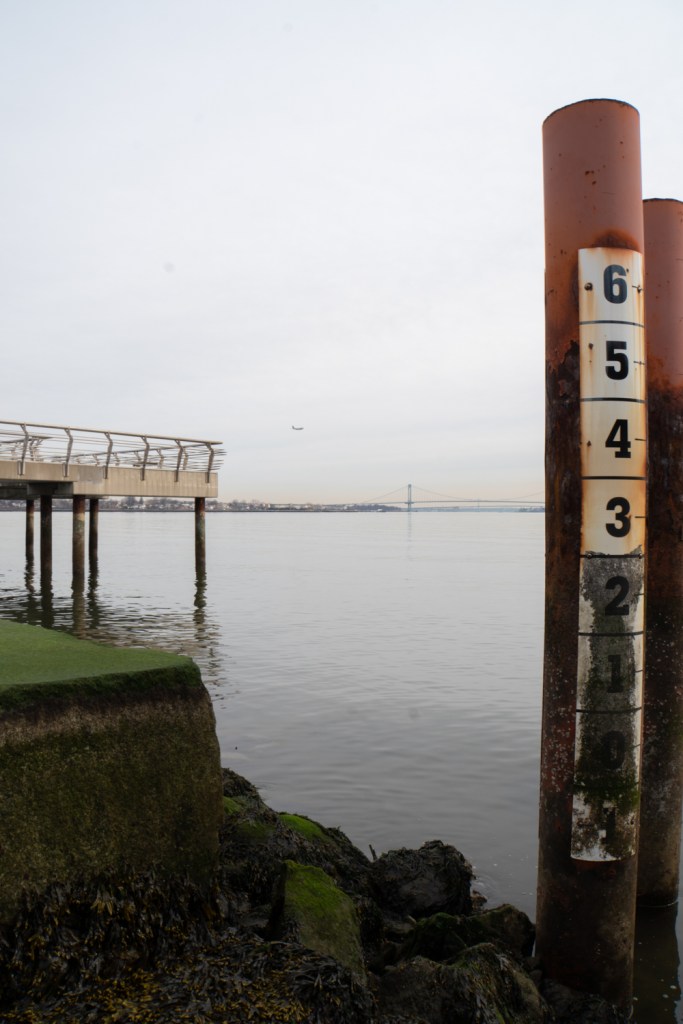
Low tide at Hunts Point Landing, looking out over the East River towards the Whitestone Bridge. Ben Moore
Superseding the scale and effectiveness of any city initiative is the U.S. Army Corps of Engineers’ colossal infrastructure proposal which, if enacted, has the potential to protect entire swaths of the New York and New Jersey region from coastal flooding through the construction of floodwalls, levees, and giant storm surge gates at a scale never seen before.
Recognizing the enormous size and potential of the project, local environmental advocacy groups are banding together to press the Army Corps for changes to the proposal while they still can. In a joint letter released in late February, 10 groups, including the Bronx River Alliance, pointed out that the plan is too narrowly focused on the threat posed by coastal flooding and “largely misses the mark at protecting our communities from many aspects of future storms and climate change.” They asked for more local and small-scale solutions—restoring marshland, dunes, berms, and other green infrastructure—that would protect their communities from both storm surge and inland flooding caused by rain events. The letter also emphasized that the current proposal leaves the Bronx unprotected. “We believe that these locations have been deprioritized and sacrificed,” the coalition wrote. In a 17-page letter, the Columbia University Resilient Coastal Communities Project and the New York City Environmental Justice Alliance urged the Corps to adjust their cost-benefit analysis so that it is not “biased towards areas with higher property values,” and put people before property.
While feedback from advocacy groups is important, Murphy knows that sustained and vigorous public engagement from community members is more likely to make a difference. In February, he hosted a call to action for Bronx community members, telling the nearly 20 participants about the Corps’ sole planned Bronx listening session before closing the channel for feedback .
On the same day the joint letter was released, the Corps held its public feedback event in the auditorium of Cardinal Hayes High School in the South Bronx. The auditorium—dimly lit, with red chairs, wood paneling, and spacious enough to hold hundreds—was virtually empty. Murphy himself couldn’t attend. He was in Las Vegas on vacation, eagerly anticipating an Adele concert. The Corps of Engineers staff, which outnumbered the few participants scattered in seats throughout the room, looked bemused as they began their presentation, whispering amongst themselves that turnout elsewhere had been much higher.
After an hour-long presentation, Corps staffers asked audience members to submit anonymous comments for response. Some questioned why the Corps’ plan did not address the threat posed by cloudburst storms like Ida, while others asked why the plan seemed to lack some of the waterfront amenities included in the plans for Manhattan. For the most part, the Corps staff seemed receptive to the questions and promised to take them under consideration, but on more than a few occasions they seemed to shift responsibility for climate resiliency back to the city and state governments.
Leaving the auditorium that night, it was impossible not to feel a sense of inevitability about the project, despite the activists’ efforts to persuade community members to show up. The Corps had gone through years of planning, cost-benefit analysis, and bureaucracy to arrive at the current proposal. The tepid response at Cardinal Hayes High seemed unlikely to knock them off their course.
On a brisk winter morning a few weeks later, the Bronx River Alliance headquarters, which is nestled in a gentle curve of the Bronx River in the South Bronx next to a riverfront bike path and turf soccer field, was quiet. A ramp sloped down to two docks, which bobbed gently with the current. A smattering of ducks honked happily in an eddy. Moss marked the waterline on the tall wooden pylons that anchored the dock, indicating low tide.
Christian Murphy waited at the top of the dock, layered in jackets and wearing a Bronx River Alliance hat. He led the way to the entrance of the River House, which was completed in 2020 and now serves as the Bronx River Alliance’s headquarters—part community center, part remote classroom, part science lab.
Fittingly, the River House is a paradigm of eco-forward design. A moss wall that rings the building supposedly wraps the office in a bubble of clean air. Rain barrels line the perimeter of the building. Piping that stretches several hundred feet into the ground comprises a cutting-edge geothermal heating system.
At least, that’s how it’s supposed to work. On this day in early March, the moss wall was barren. This first iteration didn’t pan out because of a design flaw. Several rain barrels were piled up to block a gap in the vine screen, a barrier to prevent uninvited visitors from entering, Murphy said. The geothermal system had never functioned properly. “We think the Parks Department ordered the wrong part,” Murphy said.
In a large garage, kayaks, canoes, life vests, and other boating equipment sat on trailers next to a workbench. The bench was covered with foreign-looking instruments used to test water samples for pH, silt density, water temperature, and the dangerous levels of chemicals caused by an overflow of city sewage into the river. Murphy still gets to work here; he remains the organization’s Ecology Coordinator. But a desk inside the main building is where he spends more and more of his time, writing grant requests and sending emails to coalition partners and policymakers.
The conversation turned to the Army Corps info session. At first, Murphy was eager to hear the debrief, but as he learned about the poor turnout, his face fell. “That’s really disappointing,” he said.
After a pause, he turned philosophical. The low turnout was to be expected, he said, since many of the Bronx’s residents don’t have the luxury of spending a weekday evening scribbling comments on a project that won’t be completed for decades. There’s money to make, children to feed. Even when facing an existential threat, life must go on.
It’s part and parcel of the problem Murphy sees with all state, city, federal, private programs aimed at helping marginalized communities. A lot of federal money, he said during a later conversation, “is earmarked for disadvantaged communities, but the process of actually applying for a grant, or trying to put in a proposal, or recommendation, for the money to get sent is so difficult that it becomes prohibitive for a lot of groups. It’s almost like, ‘Why even bother designating this money for an environmental justice community that can’t actually then participate in the process, because you’ve made it so difficult?’” An increasingly large part of his job at the Bronx River Alliance is figuring out ways to channel state and federal money to his community, but, like the Army Corps of Engineers listening session, it’s a flawed system.
Research has shown that the community input process, also called “citizen voice,” has actually inhibited progress on infrastructure projects, raising costs and lengthening timelines by mandating types of participation that often exclude disadvantaged groups. In just the same way, bureaucratic red tape starts from the moment an organization applies for grant funding and stretches all the way to when the money is spent. The exhaustive documentation required both to secure funding and then to spend it presents very real challenges to smaller, community-based organizations with big goals and little bureaucratic experience.
Still, Murphy is not the sort of person to dwell on setbacks. Community members who may have missed the info session can still submit feedback to the Corps. Interested parties can send comment letters, which Murphy and his team have drafted a template for. The Corps is required to respond to every letter. Murphy thinks the community can be heard, but they’ll have to drown the Corps in a flood of comments.

Christian Murphy stands on the roof of the Bronx River House, the office and headquarters of the Bronx River Alliance. Behind him, the Bronx River winds its way east, where it will eventually meet the East River at Hunts Point. Ben Moore
Mychal Johnson, one of the few audience members in the room at the Army Corps info session, did not seem too surprised at the turnout. “They just got that space the week before,” he said later. “So it wasn’t very well advertised.”
Johnson, who is tall, with a gray-tinged beard and a wide, infectious smile, is one of the founding members of South Bronx Unite, a community organization that advocates for a variety of quality of life issues in the borough. He first moved to the Bronx in 2003 and got involved on his local community board shortly thereafter. “I just kept seeing the cycle of harm that kept replicating itself over and over again and wanted to be a part of, or contribute to, some kind of change,” he said.
In Johnson’s estimation, policymakers need to be focused both on protecting the South Bronx from future flood risk while also examining ways they can lessen the burden on surrounding communities.
In recent years, however, Johnson believes there has been progress. “I think we have initiatives and laws now that we haven’t had before,” he said, “that are leaning towards funding a large percentage of the investments in communities like ours we never had before.
“I think that climate change and how frontline communities are affected is getting a lot more attention. So yeah, I see a lot of movement. I see a lot of things have changed in the last three years.”
Thanks to the advocacy work of groups like South Bronx Unite, the city government released the “NYC Comprehensive Waterfront Plan,” which it intends to update every decade with new recommendations to make the city’s 520 miles of shoreline more equitably appointed, resilient, and healthy. Still, at this point, many of the plan’s proposals—like much of the money earmarked in the past few years by federal legislation—are theoretical, and Johnson knows that it will take continued advocacy and pressure on the government to ensure that his neighborhood gets what it’s calling for.
Paul Gallay, Director of Columbia University’s Resilient Coastal Communities Program, is no stranger to the drawn-out fights that define climate activism. Gallay spent a decade prosecuting polluters in the New York Attorney General’s office before serving as the president of Riverkeeper, one of the state’s leading clean water advocacy organizations. He is as seasoned as anyone in New York climate advocacy and believes that the US Army Corps’ approach was flawed from the start.
“How do you develop a plan that protects all these communities without consulting them effectively?” he said. Congress’ directive to the Army Corps included addressing storm surge, sea level rise, and extreme rainfall events, Gallay said. Right now, the plan only addresses storm surge. “The Army Corps is not doing what Congress told them to do because they’re staying dead set on solving for storm surge, not these other problems,” he said.
However, Gallay remains optimistic that the Corps will be compelled to make changes to their plan due to the widespread and strong public outcry. In the case of the Army Corps plan, not only have advocacy groups such as South Bronx Unite and the Bronx River Alliance been vocal, but other organizations like the New York City Mayor’s Office of Climate and Environmental Justice, the New York State Department of Environmental Conservation, and even the National Oceanographic and Atmospheric Association have submitted letters requesting changes during the public comment period, which ended on March 31. The New York City Mayor’s Office of Climate and Environmental Justice requested changes to the Corps’ cost-benefit analysis, while the New York State Department of Environmental Conservation emphasized the need for continued public engagement, and the inclusion of non-structural and nature-based features in the final proposal. Gallay argues that the alignment of requested changes made by these groups underscores the influence of the advocacy community in New York.
“To give you some sense of the power of the advocacy community, you could look at our comments, you could look at South Bronx United’s comments or Riverkeeper’s comments, and then you could look at these government agencies,” he said. “You’re going to see a tremendous amount of overlay.”
Back at the Bronx River, Murphy is pensive. “There’s one more thing I want to show you,” he says. He points down the river, where a solitary column protrudes from the gently flowing water. Murphy explains that when the Cross-Bronx Expressway was completed in the 1960s, Robert Moses proposed an expansion of the highway that would have required further displacement of the area’s residents. Incensed by the plan, citizen groups protested the expansion. Eventually, their efforts were successful, but not before construction began.
“It’s an example of how a community can really make incredible things happen and stop terrible things from destroying them,” Murphy says.
To advocates like Murphy who work in the trenches, the slow pace of change can be daunting. “Sometimes, you feel like, ‘What’s the point? I’m a little drop in the bucket. I’m not going to be doing that much,’” Murphy says. Despite continued promises from policymakers, funding for group’s like his has remained at well below one percent of the city’s annual budget, limiting the ability of group’s like Murphy’s to work effectively and forcing them to spend more time and effort winning outside grants to supplement their allowance from the city.
“That’s a big frustration when an administration breaks their promise, and it’s just the same thing that happens year after year after year. That’s also discouraging,” Murphy says.
Even constrained by a tight budget, Murphy refuses to lose hope. He is able to celebrate the small successes he has seen during his time with the Bronx River Alliance—from the return of dolphins and bald eagles to the river, to the opening of new park space for the residents of the Bronx—while also acknowledging that this is a consequential moment for the entire region.
Murphy’s focus has shifted from “‘Oh, we need to clean the river. Oh, we need to build a park,” to “Oh, we need to protect New York City. We’re a component in that.”
Despite decades of activism, which have resulted in statewide fracking bans, reducing air pollution, and decarbonizing the state’s energy resources, Paul Gallay says he’s still motivated by the battles that lie ahead. “Sometimes I feel like the fights that remain unwon are even more motivating because you know you’ve won some, you know you have partners who are counting on you, you know you have the law on your side,” he said. “And damn it, just keep pounding on the glass.”
As more attention is given to the escalating threats posed by the region’s changing climate, it is possible to imagine a cleaner, more resilient New York City. That New York has upgraded its sewer systems so they are not overflowing into the city’s rivers. It has a functioning, real-time flood alert system with broad coverage. It has partnered with community-based organizations to identify and address other environmental justice concerns, and it’s protected by an Army Corps of Engineers project that is comprehensive and equitable.
Until that vision is realized, however, Murphy will continue organizing meetings, advocating for policy change, and stewarding the plants, animals, and people that call the banks of the Bronx River home.
Are we too late? Murphy doesn’t think so.
“I’m going to choose to believe that we’re right on time,” he says with a smile. “You need to believe that you’re going to be successful, and fight for it.” ◊

 Planet A Magazine
Leave a comment