
Deicy Curillo, a Safeway construction flagger, monitors traffic on Nassau and Fulton St. Tamia Fowlkes
As concerns over a rapidly warming climate spread nationwide, New York legislators seek a solution to the heat and cold stress that has plagued workers for decades.
By Tamia Fowlkes
Tim Barber’s second day of work at Pavilion Drainage Supply Company was July 7th, 2020, and even in the early morning, the heat was stifling. He left home just before 6 a.m. to ensure he would make it on time. As he laced up his work boots on the stairs, his father, Jim, bid him goodbye, telling him to drink plenty of water. “It’s going to be hot today,” he warned. Barber was excited about his new job; he had just moved back home to LeRoy, a small town near Rochester, New York, after living for several years in Syracuse and working a warehouse job. Now, he could be closer to his family. He planned to live with his parents for the first few months, then find a new apartment.
Barber joined a team working on a bridge across the Genesee River; by mid-afternoon, the temperatures would climb to 96 degrees Fahrenheit. Some of Barber’s colleagues later told government inspectors that they gathered in clusters, refurbishing cracked masonry and prepping to replace bent and rusted iron, sunlight bouncing off their bright yellow visi vests. Barber sat on a bucket by himself, hand-sorting slotted round head bolts and assembling spring lock washers with a hex nut for the new railing on the bridge. His task was supposed to be light duty and low stress. But the scalding temperatures were starting to wear on him.
For a trained construction worker–which Barber was not–the scorching heat was nothing new. In 2020, New York City experienced more than 20 days with a temperature over 90 degrees Fahrenheit, up from 12 days in 1990 according to data from the National Weather Service. The unwritten protocol for most new workers was that they would work limited days if the weather was hot, slowly increasing their hours as their bodies adjusted. They might start with a short two-hour day, then a four-hour day, and get to eight hours in two weeks. Experienced construction workers also know that it is vital to take breaks and cool down if the weather is very hot; some simply decline to go to work on the warmest days. Without proper acclimatization, a person’s experience with the heat could go from tolerable to dangerous in just a matter of hours.
The New York State Department of Transportation had dropped off popsicles and water at the site that morning. The next few days were going to be pretty hot, they warned.
According to the government inspector’s report, when Barber began to tire, he approached the engineer-in-charge and asked where he could get some water. When the engineer-in-charge told Barber to ask the foreman, Barber decided to keep working. He had made it through the day prior without lunch or water; his parents had been surprised to find that his lunchbox was still full when he came home the first day, looking sunburned and famished. He told them that most of the guys he watched in training said they ate while they worked, only occasionally pausing for breaks.
Barber’s parents had become worried. Their son, determined to make a good impression, was working in relentless summer heat. That morning of the second day at work, they urged him to take additional breaks during the day if he needed them.
Though he had a lunch pail and a thermos full of icy water in his car, Barber fell in line. For nearly eight hours, he continued to sit on his bucket and sort and screw. It was 2:50 p.m. when he finally decided to take a break, rising from his post. At first, according to a coworker, he seemed frantic, in a hurry to reach his car but also disoriented. One worker asked if he was all right, and Barber did not respond. His car was just 300 feet away, but his nausea had already started to kick in.
It all seemed to happen in an instant, his coworker said. Barber was “zig-zagging” across the pavement. He began to retch and vomit. Then, he collapsed to the ground. A coworker ran to his side, seeing that Barber had already lost consciousness. As he lay on his side, pale skin against the hot cement, his coworkers called an ambulance. The ice and water they brought to cool him came too late; he couldn’t drink it. The ambulance to transport him to Strong Memorial Hospital arrived quickly, but the medical team couldn’t revive him. Barber had hyperthermia, an abnormally high body temperature caused by a failure of the heat-regulating mechanisms in the body. Within minutes, he was pronounced dead.
Tim Barber was 35 years old, and he had no pre-existing health conditions.

Tim and his parents at his college graduation. Jim Barber

Tim and his family at his last Thanksgiving 2019. Jim Barber
In 1970, congress passed the Williams-Steiger Occupational Safety and Health Act, which gave the federal government the authority to set and enforce safety and health standards for most of the country’s workers. It also established the Occupational Health and Safety Administration or OSHA. But it was, as critics soon began pointing out, a very vague law, merely “encouraging employers and employees in their efforts to reduce the number of occupational safety and health hazards at their places of employment,” without really spelling out how. Despite the fuzziness of the law, and its growing popularity and support from labor unions, it was still vehemently opposed by the U.S. Chamber of Commerce, which claimed it would place burdensome restrictions on businesses and major industry players.
Over time, the law was strengthened by amendments that covered additional workplace hazards. In 1972, the first standard on asbestos protection was adopted. In 1976, a coke oven emissions standard was implemented to limit exposure to steel production emissions. In 1977, a lead standard was introduced. In subsequent years, protections were included for workers who handle chemicals, are exposed to noise levels above 85 decibels, work with cranes or on scaffolding, and more. But only in recent years have lawmakers begun considering addressing the problem of heat exposure.
According to a 2010 report by The National Institute for Occupational Safety and Health (NIOSH), from 1992 through 2006, 68 workers employed in crop production and related services died from heat-related illness. In 2005, California became the first state to enact stringent heat protection laws in response to a series of farmer deaths in the state. The laws demanded that employers provide their workers with access to shade, water, and rest breaks when outdoor temperatures rose above 95 degrees. Though the initial action marked a crucial acknowledgment of heat stress as a life-threatening problem, employers continued to put their workers in danger. Demands for national heat protection regulations went unanswered.
Concerns over the state’s regulations were amplified in 2008 when 17-year-old undocumented farmworker Maria Isabel Vasquez Jimenez collapsed and died during a shift at a vineyard near Stockton in northern California. Jimenez was tying off grape vines in the searing summer sun. As temperatures soared, she begged her foreman for a break. Her fiancé, Florentino Bautista, would tell reporters after her death that workers at the site were often denied water and food breaks. The nearest water station was more than a 10-minute walk and there was often no time to spare.
After Jimenez collapsed, Bautista said that the employer delayed calling an ambulance. The company said in a written statement to NPR that Bautista had refused their offer to take Jimenez to the hospital, and he had tried to revive her with rubbing alcohol from a local drugstore.
Though the actual series of events is unclear, two things were certain. By the time Jimenez reached the hospital, her body temperature had reached 108 degrees. Her fiancé would also learn that she was two months pregnant. Jimenez was pronounced dead two days later.
California adopted the Maria Isabel Vasquez Jimenez heat illness standard soon after. It was more robust than the 2005 standard, mandating a minimum 10-minute preventative cool-down rest period every two hours when temperatures exceeded 95 degrees and requiring employers to maintain a designated shade area with access to open-air or cooling systems and to provide training to employees to help them navigate extreme heat situations.
In 2019, legislators introduced an amendment effort to reform New York labor law to include protections for employees exposed to excessive heat. The amendment would have required employers to develop a heat-related illness prevention plan and provide annual training to employees exposed to high heat levels.
Due to the COVID-19 pandemic, the amendment stalled in committee.
Since the California law’s establishment, several other states—including Minnesota, Oregon, and Washington—have established heat-related protections in their health and safety regulations. Washington’s rule is currently in force only from May to September and has the possibility of being amended in 2023 to serve workers year-round.
Even so, workers and climate experts alike have said that the regulations are an inadequate solution to a rapidly growing problem. Advocates say, there is not enough action being taken to enforce the rules set by OSHA, and the danger to workers on our increasingly warming planet will only become worse.
On the day of their son’s death, Jim and Kathy Barber rushed from their home in LeRoy to Strong Memorial Hospital. They arrived at the emergency room around 4 p.m., only to be told that their son hadn’t been admitted yet. There was no record of a patient named Tim Barber.
Jim remembers pacing around the lobby in confusion. He and his wife asked nurses and passing doctors if anyone had recently been admitted for heat stress. The buzzing phone in his pocket gave him the answer. It was the Geneseo County Sheriff Investigator Brad Schneider. An ambulance was waiting in the back parking lot of the Geneseo Fire Department with the county coroner and Livingston County EMS, the caller said. Tim was dead and they needed his parents to come and identify him.
An OSHA report on Barber’s death indicated that Tim had succumbed to heat stroke. Inspectors found Pavilion Drainage, a local construction company founded in 1979, had no extreme temperature safety program at the time of his death. There wasn’t proof that he had undergone any form of heat safety training ahead of his first day. Until Barber’s death, the company had no OSHA inspection history.
“I’m 66 years old,” Pavilion president Phil Plossl told the “Democrat & Chronicle” newspaper in 2021. “We used to have two-a-day football practices and they’d give you salt pills, and no one ever died.”
When contacted by phone in February 2022, Plossl bristled at the mention of Barber’s death and questions about the company’s safety protocols, declining to answer questions about the company’s safety training and Barber’s death.
The company paid a $7,600 fine to settle the OSHA complaint.
For months following Tim’s death, Jim and Kathy met with lawyers and OSHA officials. Jim was retired but said taking on his son’s personal affairs and heat-protection advocacy started to feel like a full-time job. He spent his mornings burrowed in their home office on the phone with the Sheriff’s Office and the medical examiner. Their lawyers were awaiting details of a toxicology report that would take six months to complete.

Insurance company letters piled up on the kitchen counter. He and Kathy needed to sort through Barber’s belongings that were in storage and decide what would be donated to their local AMVETS store in Rochester or kept. They lingered on the hundreds of drawings Barber made over the years, sketches for the murals he painted at LeRoy Central High School and Batavia Showtime Theater. Jim spent the rest of his time reaching out to legislators with his wife by his side.

Tim’s murals at Batavia Showtime Theater. Jim Barber
“They didn’t care that Tim died. It was all politics to those people,” Jim said in an interview, reflecting on times that he had reached out to the offices of legislators like former Congressman Chris Jacobs and U.S. Senator Kirsten Gillibrand. “My son died 50 miles from your office. Can you take the time to come down here and talk to me and my family and try to bring awareness to it?” Jim recalled asking. Neither politician met with them.
“It’s the employer’s responsibility to make sure you provide a safe workplace, that’s number one,” Jim said. If you provide a safe workplace and you take the time to look out for your employee, then this should never happen. He just wanted to do a good job, and he did and he paid a price for it. It’s preventable, and it should never, ever happen again.”
In 2022, the family worked with OSHA to share their son’s story and raise awareness about the threat of heat illness in the workplace through a video. They hope that sharing Barber’s tale will prevent incidents like this from occurring to other families and encourage the establishment of new regulations for companies.
In many cases, advocates say, inadequate safety training and resources have increased the risks to workers in high-heat environments. “People don’t look at western New York and think heat illness, but it’s an important factor to consider. People aren’t used to working in 90-plus-degree weather with high humidity,” said Michael Scime, OSHA’s Buffalo Area Director, in the OSHA video. “Tim was a healthy 35-year-old male. People don’t take into account that heat illness is something that can affect anyone, not just someone who might be compromised medically or have some other risk factors.”
Two months before U.S. Congresswoman Claudia Tenney was elected, Jim Barber called her office, asking if she would be interested in introducing a heat stress bill in his son’s honor. She represented another district not far from his own, so maybe there was hope.
“I was in my workshop and it was one of those days I was feeling low. I said I can’t give up, I’ve got nothing left,” Barber said. “I just went online and looked up a number for her office, and I called.”
After several meetings with Barber’s family, on March 20th of this year, Tenney introduced the Timothy J. Barber Act. The law’s passage would require the Secretary of Labor to conduct a study on spending by OSHA and its efforts to assist companies’ and businesses’ response to heat-related illness. Technical support and compliance assistance funding would be made available to help small businesses comply with OSHA’s regulations and defray the costs of compliance.
The Timothy J. Barber Act, however, is more of a proclamation than a concrete policy shift. The law requires OSHA to gather additional data about heat and cold stress deaths and injuries. It does not create a national climate standard. Whether such a measure could get support from legislators who now oppose the bill, mostly Republicans, is another question.
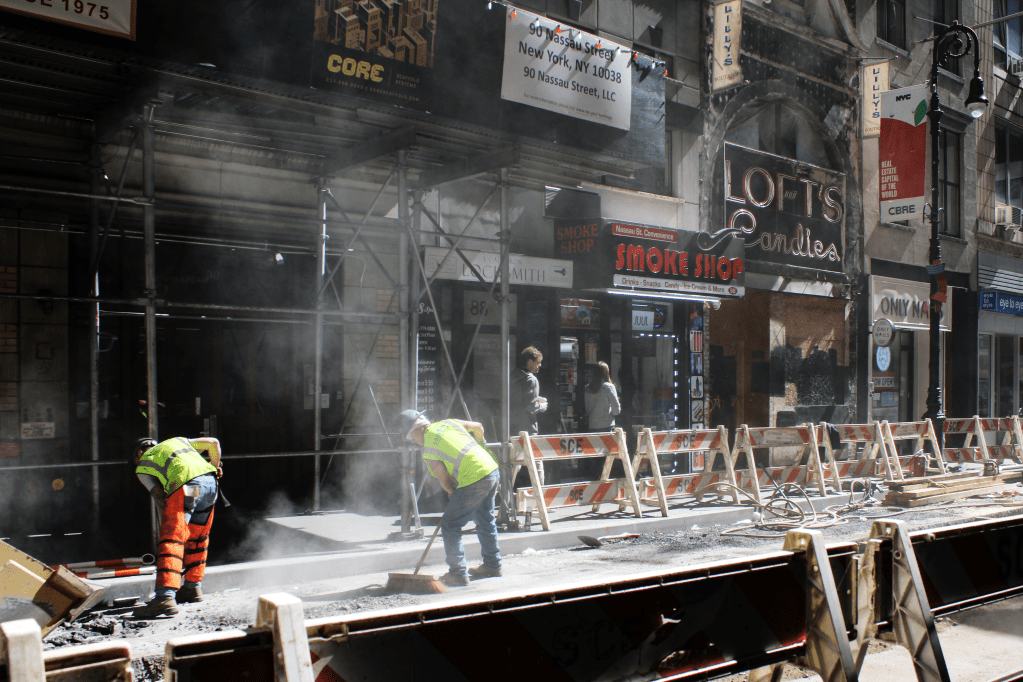
Construction workers brush away debris at a New York City construction site. Tamia Fowlkes
As extreme climate conditions have grown more commonplace in recent years, several states have made attempts to enact labor protections that address health risks in high-temperature work environments. California, Minnesota, and Oregon were among the first states to establish detailed rules for protecting workers from heat. Nevada, Maryland, and Colorado have passed such bills within the last year.
In an interview, Nellie Brown, an industrial hygienist and the Director of Workplace Health and Safety Programs at Cornell University’s School of Industrial and Labor Relations, said that barriers to heat standard implementation do not come from a lack of understanding of the risk, which has been apparent for years, but rather an unwillingness to change business practices. Technological and economic concerns are primary concerns for employers.
“When it comes to regulation, it’s definitely high time and I think we just have to recognize the limitations of the human body and to realize that we can’t just treat people as commodities,” Brown said.
Her work focuses on training employers, labor unions and the public to combat a variety of workplace hazards, including poor ergonomics, chemical exposure, and indoor air quality. When new regulations are implemented and are hazard-specific, Brown said, they often come with mandated medical surveillance or monitoring that employers might try to side step. Businesses argue that compliance costs money, and they may push back against things like medical removal protection, which protects injured people from losing their pay after being evacuated from a work site.
With an aging workforce, there are a variety of pre-existing health conditions to consider: heart, lung, and kidney problems; the effects of medications such as antidepressants, antihistamines, antipsychotics, and diuretics. And since discrimination on the basis of age and physical ability can never serve as a solution—it’s illegal—Brown said many businesses will have to accept and adapt to heat law modifications.
Brown says companies, which may already have some good safety programs in place, don’t want to be told what to do. “Safety pays, and if you take a look at what injury and illness, lost work time, training replacements, and insurance costs—and everything else that goes along with that—you can make a very good argument that safety not only pays but it can be a profit center.”
New York’s T.E.M.P. Act, a 2023 bill introduced in the state Senate and Assembly, takes steps to eliminate loopholes to provide heat and cold protection to indoor and outdoor workers. Unlike bills introduced in other states to deal with heat stress, New York’s is the first to address heat and cold stress illnesses simultaneously.
Unlike heat stress, cold stress occurs when skin temperature and internal body temperature drop dramatically, leaving the body unable to warm itself. Some common symptoms of cold stress are trench foot, frostbite, hypothermia, and chilblains. These conditions and symptoms can cause permanent tissue damage and even death.
Winter blizzards in the northern parts of New York and summer heat waves throughout the state offered the latest example of how rapidly changing weather patterns could target working populations like delivery workers who spend most of their days outside. According to a report by the U.S. Bureau of Labor Statistics, from 2003 to 2019, exposure to environmental cold resulted in 31 worker deaths and 2,770 serious injuries and illnesses in the U.S. Among the workers sharing their stories were individuals from companies such as UPS and Amazon, organizations with employees who have died or collapsed in warehouses and on delivery routes in recent years.
Among the new requirements laid out in the New York state Senate and Assembly Bills (S1604/A3321), employers must submit a report every three months on how temperature-related stress will be mitigated. They are required to distribute the document to unions, display a thermometer at indoor and outdoor workspaces to monitor the temperature, and pay penalties of no less than fifty dollars per day for failing to create a written plan. At its most severe, a proposed Temperatures Standards Bureau would fine violators up to $10,000 for not following the adopted plan.
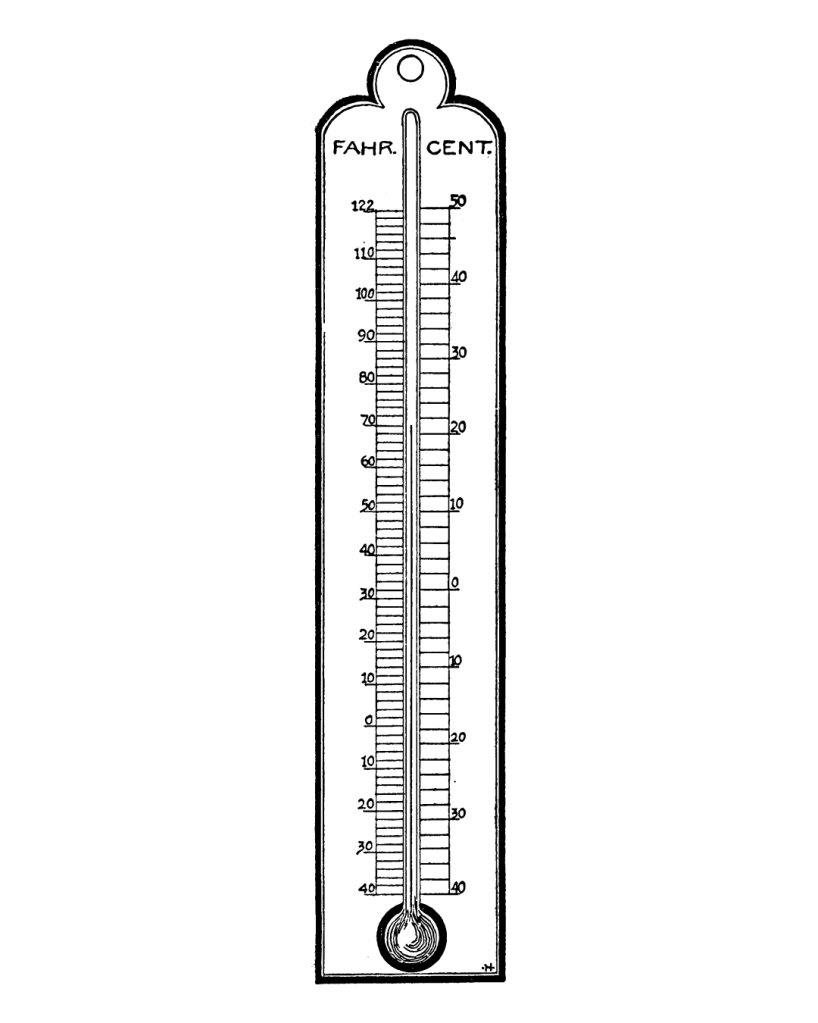
“Employees would have access to PPE and the state Department of Labor who provide training and education so employees know the warning signs of temperature stress. And employees would be protected from retaliation if they file a complaint because an employer is violating the law,” Assembly member Latoya Joyner said.
The new legislation would also ensure that businesses and corporations based in New York had an actionable plan on days when the temperature exceeds 80 degrees and provided resources such as cooling centers and water to employees during work. Additionally, in the face of temperatures under 60 degrees, the bill would require employers to create a training program that outlines the signs of cold illness, provide protective equipment and uniforms to withstand temperatures at or exceeding a cold threshold and provide preventative warming areas for employees to use for 10 minutes for every two hours of work.
Advocates for the bill argue that without regulation and clear rules for heat-illness mitigation and climate awareness, companies can continue to benefit and profit from the labor of their employees without ensuring their safety.
In 2023, opposition to the legislation emerged when major businesses and corporations claimed that they would place untenable expectations on their daily business practice and high cost, what some would call “job-killing regulations,” said University of Wisconsin, Madison professor Michael Childers.
“This proposed rule will increase costs on our members, slow our production and ask our members to be experts on something they are not professionally trained to do,” James Maeder, Michigan Association of Timbermen (MAT) wrote in a 2021 public comment for an OSHA public hearing. “The proposed rule also assumes that we as business owners don’t always have the best interest of our employees in mind.”
The Kentucky Chamber of Commerce wrote to OSHA insisting “a federal heat standard is unnecessary” and that “businesses represented by the Ky. Chamber already manage heat illness prevention in a manner that is protective of worker health and safety.” Similarly, The National Cotton Council wrote, “NCC urges OSHA not to create a duplicative rule. Instead, NCC believes that OSHA providing comprehensive training materials for employers and employees would be a better solution to mitigate heat-related incidences.”
And there are many more opponents of such legislation. In the same hearing, OSHA received 965 responses with ranging support and opposition to a national heat standard. Some small businesses have raised concerns that providing these resources could significantly cut into their budget.
Big corporations like Amazon and UPS have fielded an uptick in employee complaints about unsafe working conditions due to temperature. Both companies have made statements claiming that they have adequate protections in place. Professor Childers, whose research focuses on work standards, employee monitoring systems, and collective bargaining—and how union efforts intersect with societal issues like the Green New Deal, Medicare for All, and Black Lives Matter—said that union advocacy such as New York’s has been critical in realizing demands for additional work breaks and provisions for coolers and ice water.
“OSHA sets the floor, not the ceiling,” Childers said when speaking about work safety regulations. “Some states try to go below the floor, but most embrace this effort and go above and beyond, being more nimble to react and adjust the law than national law does.”
Members of Teamsters Local 294 Union in New York City jumped into heat protection advocacy following several incidents of worker injury at large corporations like UPS and Amazon. “It wasn’t about climate change that I’m aware of, maybe for other folks,” said Union President Thomas Quackenbush. “For us, it was about the working conditions which our members and other union members may be subjected to.”
At the federal level, there are currently no laws guiding national standards for working in the heat.
A 2012 study on Workplace Safety and Health by the U.S. Government Accountability Office detailed that among OSHA’s challenges were delays to safety standard enforcement and a failure to periodically reevaluate their safety standards. Between 1981 and 2010, the organization took 15 months to 19 years to apply broad-reaching standards nationwide. In the case of heat protection regulation, the agency had made scant changes to its standard since 2010, meaning that the changing climate landscape would not be taken in full consideration when guiding employer safety practices.
While OSHA can issue emergency and urgent standards, like requiring employers to supply masks for employees during the COVID-19 pandemic, some experts have flagged rising temperatures as an issue that will only continue to worsen if left unchecked.
In January 2022, New York joined California, Maryland, Massachusetts, New Jersey, and Pennsylvania in a push for the implementation of national labor standards for occupational heat exposure. The states’ letter to the Department of Labor’s Assistant Secretary of Labor for Occupational Safety and Health highlighted the pervasive and threatening influence of climate change on workers in construction, postal and delivery services, agriculture, fishing, forestry, hunting, transportation, and more.
In a letter, United States Attorney General Letitia James said, “As extreme heat events only get more severe and more frequent, it is long past time for OSHA to set strict, enforceable national standards that respond to the grave consequences of escalating heat in the workplace. Every worker deserves a safe work environment, and my office will continue the fight to prioritize the health and wellbeing of working New Yorkers.”
On Friday, February 10th, New York Assemblymember Latoya Joyner stood in front of 216 West 14th Street with a poster board that read, “It’s getting hot in here.” Her sign, sketched with a bright red marker, featured a drawing of a UPS truck engulfed in flames. It was not in reference to the unusual warmth of the 58-degree winter day.
She joined New York State Senator Jessica Ramos and a contingent from the City Employees Union Local 294 to deliver a critical message: New York’s workers were facing a climate crisis, and a new bill could provide the solution.
“We’re hot, we’re cold, exploitation is getting old!” Ramos called out to the crowd that joined her in a chant. “Today, workers from across industries made one thing clear: workers will not become victims of a heating and cooling planet. Not here, not in New York, not today.”

A Safeway construction employee wets the concrete at a construction site on Nassau and Fulton St. Tamia Fowlkes
The event was one of several rallies for Ramos and Joyner’s T.E.M.P. Act.
The bill offers a glimmer of hope for worker protections and for families seeking justice for those lost to heat illness. Every couple of weeks, the Barbers jump on a phone call with Assemblywoman Joyner’s chief of staff to check on the bill’s progression and offer their insights.
But some workers have expressed their doubts about the passage of any new heat-related protections because of the traditionally slow churn of legislative change—and potential opposition from major industry players. Still, Jim and Kathy Barber are hopeful that something will pass, though an official vote on New York’s climate bills isn’t imminent.
“We have some friends that have lost their sons or daughters, and they’ve been very helpful to support us at times of need,” Jim said. “Tim was just a loving, 35-year-old young man that we miss every day. And we’ll do whatever we can to keep his name out there and support anybody we can to make sure it never happens to another family.”
A previous version of this article stated the Geneseo Fire Department called the Barber family to notify them of their son’s death.

 Planet A Magazine
Leave a comment