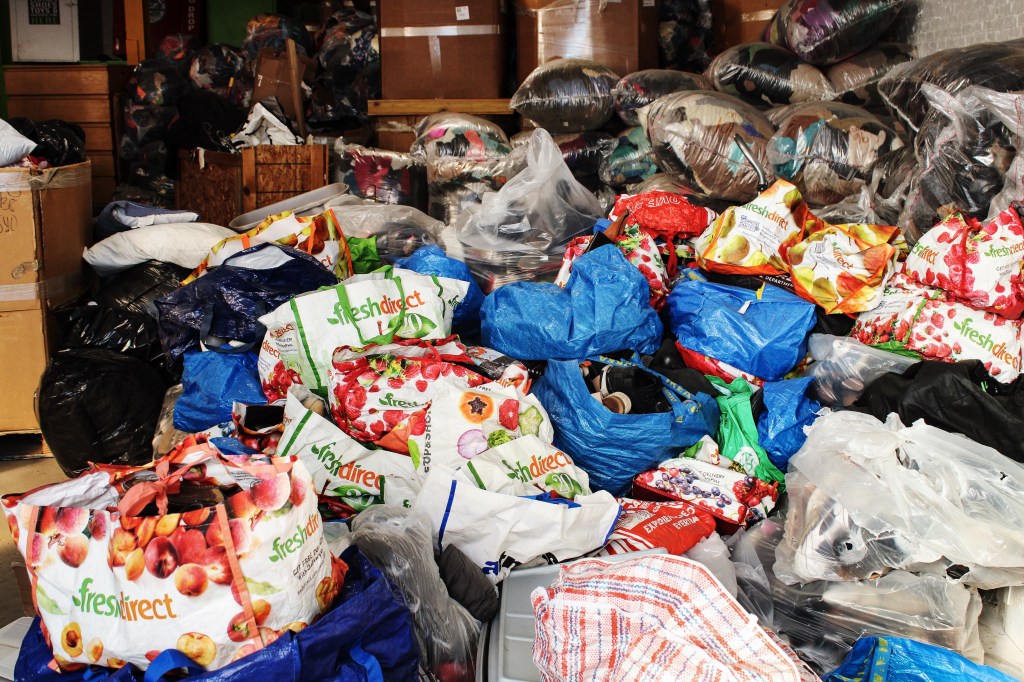
Unsorted recycled textiles stuffed in plastic and reusable bags at Green Tree Textiles. Juanita Gordon
The people that steward the journey of recycled textiles, each have their own interests in the second-hand fashion industry.
Juanita Shanice Gordon
Janet Carabollo always loved fashion. When she was a little girl, growing up in the Bronx, she knew she would find a place for herself in the industry one day. As a teenager, though still attracted to fashion, she ultimately decided on a more practical career. She worked as a receptionist and Spanish interpreter at a medical center in Brooklyn, then for child protective services; eventually, she joined the New York City Police Department.
But even as she worked her various jobs and raised two sons, she purchased a lot of nice clothes. A generous person, she enjoyed lending them to friends. But items left Carabollo’s closet never to return—her friends liked the clothes so much that they kept them. “I was very giving, but I was always on the short end of the stick,” she says now. Finally, Carabollo decided to start selling her clothes to her friends. Carabollo figured this was a way to keep shopping and sharing. As some of the early online marketplaces appeared, she began to use those as well; she sold clothes on Craigslist and eBay. Her hobby became the basis for her business. “I could always resell them somehow,” she said. “You know, because I would wear them once, and once you take photos you don’t even want to wear them again.”
As Carabollo continued to sell on the internet, she noticed that more people were entering the resale market. “And then little by little, reseller apps started emerging,” she said. In 2013, Carabollo joined Poshmark. She could sell clothes on Poshmark well enough, but Carabollo imagined a larger role for herself. She wanted a store of her own. But she couldn’t afford a storefront.
Then she had an idea. As an officer and addiction counselor, she frequently worked near ambulances. She spent so much time near ambulances, in fact, that she began to wonder if they could have a different use. “You know, ambulances have so much space,” she thought, “maybe I can have a portable store in one.” She considered other options, like a UPS truck, but those had no interior lighting, whereas an ambulance does. It also has exterior lighting. Carabollo figured the ambulance would have the space and capacity to run a store out of the back. “I wouldn’t have to change much. It wouldn’t be any extra expense.” Through her own research, Carabollo learned that she only needed a license to run a small business and a certificate to sell in the five boroughs. As long as Carabollo didn’t drive with customers in the vehicle, the paperwork remained fairly light. She also happened to know that ambulance companies often sell their older models.
In June 2015, Carabollo purchased “The Bus,” a Ford ES Ambulance diesel truck, from A Care 1 Ambulance facility, an ambulance company in New Jersey.
On her first day out with The Bus, Carabollo encountered NYPD officers. She had brought The Bus to the South Bronx so her former husband and some friends of his could do maintenance on it. She parked in the lot of her ex-husband’s accounting business, and as the men started working on it, tearing out some of the metal bars inside the ambulance, a small crowd gathered. Carabollo found that The Bus always managed to surprise people. Most people are used to a mobile food truck, what about a mobile thrift store? Carabollo was answering questions about how she came across the ambulance truck when a police car drove by.
“Now they see the two back doors of an ambulance open, right?” she said. “They see some guys with hammers and everything. They’re like, ‘What the hell is this?’ And it still looked like an ambulance. It was a fully loaded ambulance.”
Carabollo said the officers were surprised by her idea to turn the ambulance truck into a mobile thrift store. The officers left Carabollo alone once she informed them she also worked as an NYPD officer herself and just happened to love fashion. For Carabollo, The Bus became an integral component of her business that represented her experience as an officer and her love for clothes. “Even as a police officer, everyone knew I loved fashion. They knew I was going to do something in fashion,” Carabollo said.
As part of her initial distribution plan, Carabollo drove to busy streets in Throgs Neck. People would already be in the mood to shop on a busy street, she thought. She parked for the weekend and sold clothes out of the back of her truck. There was always a lot of interest, and in December 2015, she was even featured on the local news. The anchor introduced Carabollo as “a fashion entrepreneur from Throgs Neck who is also an NYPD officer.” In the segment, Carabollo wore a cheetah print shirt and a black puffer coat. “I have a passion for shopping,” she said as she stood in front of her ambulance truck. The ambulance had a white exterior with a green banner that featured a cartoon image of a woman happily carrying colorful shopping bags. Inside the truck, Carabollo showed off her shelves of bracelets, scarves, and jewelry. She proudly declared her aspiration to share her love of fashion with her community at an affordable price.
But Carabollo also believed she was doing something to save the planet. “We can dress you for less,” Carabollo says now, “you know, while saving the world.” And one of the things she found as she worked in her ambulance store was that people weren’t entirely on board with sustainable fashion practices. “I’m talking about the Bronx. It’s not like the East or West Village,” Carabollo said. “I’m trying to introduce people to spend a little bit of money on better tags, better items that are brands, and also recycling items that someone else might have worn. And they don’t really believe in that. Some people, they get freaked out. They’re like, ‘I’m not gonna wear something that someone else wore and I don’t know who it was.’” Back then, Carabollo noticed that fewer people felt worried about the impact of their clothes on the environment. “People really didn’t know about fashion and the damage,” she said.
As Carabollo was beginning to sense, she was part of a larger movement, made up of small entrepreneurs, mid-size thrift chains, and huge global corporations that were getting into the business of fashion resale—though not always for the same reasons.
Fashion recycling is not new. In the early 20th century, pushcarts, popularized by Jewish immigrants, were wheeled through the streets of cities like New York with used clothes and textiles. The Salvation Army began collecting castoff textiles in 1897. Goodwill followed suit in 1902. Thrift stores existed as an affordable way for people to purchase clothes; in the second half of the 20th century, thrifting became a trendy alternative for customers to save money and shop vintage. Somewhere around the turn of the millennium, recycling clothing also became an environmental imperative: the more people bought used instead of new clothing, the less clothing went into landfills.
But as the clothing resale movement grew, so did the clothing industry. Clothing manufacturing had begun to boom in the late 19th century as mass cotton production and sewing machines allowed factories to produce millions of items of ready-to-wear clothing. In the 1980s, major American clothing manufacturers began to move their production overseas; this trend exploded after 2005 when the provisions in the Multifiber Arrangement (MFA), which had established quotas that restricted the amount of clothing developing countries could send to developed countries, expired. More cheaply made clothes with synthetic fibers, also known as “fast fashion,” now dominate the Western consumer market.
With this quicker clothing cycle, the amount of clothing consumers discarded increased. In 1990, the U.S. generated 5,810 thousand tons of textile waste, according to the Environmental Protection Agency. In 2005, the year the MFA quotas expired, the U.S. generated 11,510 thousand tons of textile waste. And in 2018, the U.S. generated 17,030 thousand tons of textile waste. Textile waste now accounts for 6% of overall American waste.
When textiles enter landfills, they can degrade for up to a hundred years, depending on their material. For example, natural materials, cotton, break down in about five months. Synthetic materials, such as polyester, take longer to biodegrade. Either way, it is harmful. Biodegrading cotton releases carbon dioxide and methane. Synthetic fibers stick around indefinitely, though they, too, eventually release greenhouse gases into the atmosphere.
As awareness of the massive amount of waste increased, so did the movement for clothing recycling or “resale.” Where once the resale segment consisted of the massive old charity organizations (Salvation Army and Goodwill) and some local vintage stores, the internet changed how people resold their goods. People on Craigslist and eBay sold clothes in addition to all sorts of other items; the appearance of ThredUP in 2009 and Poshmark in 2011 signaled the entry of dedicated clothing resellers to the online market. ThredUP releases Resale Reports, an annual report on the health of the second-hand clothing industry. ThredUP estimates that the global secondhand market’s value will reach $350 billion by 2027. More recently still, major clothing retailers have entered the market. In 2017, Patagonia launched Worn Wear, a platform where people could trade their used Patagonia goods. And in 2021, H&M, one of the world’s largest fast fashion retailers, bought a majority share in the second-hand app Sellpy. In March 2023, H&M reported that operating profits increased due to the success of Sellpy.
As the resale market expands and more people try to recycle their clothes, critics have begun asking what exactly happens to clothes that are donated at farmer’s markets or thrift stores. Some, obviously, get sold. But what about the rest?
In East Harlem, Andrea Reyes runs a thrift store with a business model focused on education over profits. Reyes operates the New York City Fair Trade Coalition. The store is located at 1795 Lexington Ave between E 111th and E 112th Streets. In the windows of the shop, you can see jackets hanging on racks, plants, and friendly signs. To reach the Fair Trade Coalition, you must walk up a set of stairs and wait for Reyes to buzz you in. Although on another visit to the shop, customers could freely enter through the open door.
Reyes sells used clothes, shoes, and accessories for a set cost. Customers will spend $15 no matter if they grab one shirt or three. Reyes believes this business model requires consumers to slow down and think about what they are purchasing. Her goal is to educate others regarding sustainable fashion and decrease the number of clothes people purchase impulsively. “We want you to think about, is this really worth it? Do I need this? Am I buying it just to buy something?” she said.
Reyes receives donations from members of the FTC and neighbors in the East Harlem community. Often people come to drop off their clothes and unwanted textiles stuffed into FreshDirect reusable bags. Some of the clothes are sold in the store; others online. Reyes and a crew of neighbors, volunteers, and unpaid interns post items to Poshmark and ThredUP. Very recently, The Real Real, an online luxury second-hand retail platform, visited the community center and purchased 16 of Reyes’s luxury items, including a pair of Gucci sneakers.
On the other hand, clothes with stains and rips do not sell well in thrift stores. Reyes donates clothes she cannot sell to Green Tree Textile Recycling in the Bronx, a non-profit that sells and distributes worn clothing at the industrial level. When she told me this, I decided to try to follow the path of discarded clothing and headed for the Bronx.
When I first entered Green Tree Textiles in Hunts Point, I noticed a mountain of plastic bags stuffed with clothing. Some of the plastic bags were ripped, bursting with too many clothes to keep tight. Someone had scribbled “97lb” with a black marker on one of the larger plastic bags. I noticed the boxes next, and then a tiny retro television. At a table located as close to the center of the warehouse as possible, Serge Lazarev, the owner of Green Tree Textiles, pulled plastic bags, paper bags, and reusable bags out of a green bin. Pulling items out of the bags, Lazarev sifted with his bare hands through unworn baby clothes, running sneakers with unidentifiable stains, and leather purses. He wore a hat he had plucked out of a pile that morning. Lazarev liked that the hat said “Hollywood” across the front.

Piles of bagged textiles at Green Tree Textiles reached the warehouse celing. Juanita Gordon
Lazarev founded Green Tree Textiles 10 years ago. Before Green Tree, he owned a gas station and decided he should be doing work that benefited the environment instead. He researched what issues in the industry he could help fix with his own business. Lazarev found that the bottle and paper recycling industry was already pretty saturated with companies. Then he came across the textile recycling industry, which, at the time, had few businesses to compete against. He founded Green Tree Textile with a mission to keep unwanted textiles out of landfills.
Although Lazarev runs a small team of 12, including himself, he was the only person sorting on the day I visited. One employee left to go pick up more Green Tree drop-off bins. The other employee was a bit late. To that, Lazarev shrugged and said, “Life happens.”
Listed on their website, Green Tree Textiles has about twenty green drop-off boxes throughout New York City. People donate their favorite shirts, pink-leopard print shoes, and everything in between. In Lazarev’s warehouse, a pair of Nike sneakers are displayed on cardboard boxes and a discarded Chanel purse sits atop a blue plastic bag.
Lazarev operates with a reuse mindset first—but not everything he receives at Green Tree can be reused. “We don’t keep clothes or shoes with stains or logos,” Lazarev said. He explained that clothing with a company logo typically belongs to a former employee. These shirts do not sell well on the reuse market. Lazarev doesn’t place these in the designated reuse pile. He sells stained but otherwise wearable clothing to companies that sell them again. According to Lazarev, he can sell items in the worst condition to factories that break down the material into house insulation. He declined to tell me which companies he sells the used textiles to.
Although the Green Tree Textile employees leave signs on the drop-off boxes instructing people not to donate pillows, Lazarev pulled a pillow from the bottom of a bag. And then another pillow. Both were white, stained, and useless for Lazarve’s operations. Lazarev cut open a pillow to show me the fine strands of soft gauzy material. He picked at it to show me. “We can’t take this. For pillows they only want virgin material,” Lazarev said. “Think about it, no one wants to sleep on the used material.”
Lazarev finds the work simple and rewarding enough. It pays him and his employee’s salaries, helps the environment, and they each get to keep items passing by that catch their eye. He knows the textile industry has problems but he believes small changes can help sustainability overall. He’s more focused on running Green Tree, which according to the company’s non-profit 990 tax form, has had a negative net income for the last three years. In 2022, according to its impact statement, Green Tree recycled 1.3 million pounds of textile waste. This equals about 2,249 metric tons of carbon dioxide mitigated or 37,491 trees planted.
In the arms race between clothing recyclers and clothing manufacturers, the manufacturers are winning. They churn out far more new clothing than the recyclers can possibly reuse. That the clothes they’re making are by their nature disposable—to the point where garments start falling apart on their own pretty quickly—gives them an unfair advantage over anyone trying to keep clothes from ending up in the trash. The Environmental Protection Agency (EPA) tracks data for textile manufacturing, recycling, and a third option, combustion with energy recovery, in which textiles are burned in a factory designed to capture their energy. All three categories continue to grow, but in recent years recycling and combustion have been growing at a slightly faster rate than manufacturing.
Recent legislation in New York State is beginning to try to address the manufacturing issue. In 2022, two fashion policy initiatives caught the attention of professionals in the fashion industry. The Textile Act connects New York State farmers who produce fibers with local manufacturers, in an attempt to increase local and less harmful manufacturing. Meanwhile, the NY Fashion Bill will require fashion retailers to map their supply chains and take accountability for negative impacts on people and the environment. According to Tasha Lewis, an adjunct professor at Ohio State University who teaches courses on clothing and textile research, these initiatives can begin to move the fashion industry toward a more responsible manufacturing model. “When these policies are put forth in large states like New York and California,” she said, “companies must begin to act in order to do business in these states which can cause them to rethink their existing infrastructure around sustainability.” These policies push for economic growth, more sustainable practices, and better labor laws within the pre-consumer textile industry. Another local law in New York City requires businesses that produce a substantial amount of textile waste to recycle that waste.
Lewis believes that what is known as “circular fashion” is the future we should be fighting for. “I think we need a more connected supply chain that factors in the ‘end-of-life’ management for textile waste,” Lewis said. “This can go from the design stage to textile and garment production, all the way to the consumer at the point-of-sale.” Lewis says that legislators can begin looking at how much textile waste is being created by a particular manufacturer and think about addressing it.
Ultimately, the grassroots recycling movement is going to need government help. On one thing, it seems, everyone can agree. As Erin Weins, an education coordinator at FABSCRAP, a nonprofit textile recycle and reuse program in Brooklyn, said, “No matter what, textiles just shouldn’t be in landfills.”

Pre-consumer textiles sorted in black trash bags at FABSCRAP warehouse. Juanita Gordon
The last time I saw Janet Carabollo, she was proudly standing in front of an information desk for sustainable fashion at the First Spanish United Methodist Church located at 163 E 111th St. She is a small woman with a confident personality. Her hair’s dark brown roots fade into light brown at the ends. She wore a silver statement necklace that drapes to her belt and glows as she talks about sustainability within the fashion industry. She happily spoke with people interested in the ambulance truck she previously drove to run her thrift store. She handed me a copy of her business card, an information sheet, and her impact statement. Carobollo’s business card has a picture of her smiling. On the other side of the card, there are two images of emergency vehicles.
She’s excited to speak with everyone and share how her small business became what it is today. Carabollo created the Facebook group, “Mobile Thrift Shop Buy, Sell, Repurpose NY,” which now has over 3,700 members. She’s proud of the work she was able to accomplish over the years even if her business no longer travels. The Bus broke down in January 2021. When her boyfriend could not fix it, she sold it—and bought a new ambulance that same month. Carabollo said her new truck is the same model but “a little more modern.” But she must complete paperwork with the Department of Motor Vehicles before the second truck can get on the road. With the ambulance’s maintenance costs and the tolls she pays to travel to New York, Carabollo said that for now, she’s making more money selling online.
Janet Carabollo at First Spanish United Methodist Church. Janet Carabollo
Carabollo’s mobile operations are not the only part of the textile recycling industry that changed. She found that people are becoming more interested in the sustainable fashion conversation. “A lot more people want to be part of the solution and not get rid of this clothing and have it in landfills,” she said.
Over the years, sustainability became a part of the mainstream conversation surrounding the fashion industry. Even as recent as 2022, Bain & Company released a report documenting the future of sustainable luxury. The organization speculated that the increase of Gen Z consumers will steer companies to become more sustainable to maximize potential profits. According to the World Economic Forum, although 64% of people globally feel responsible for acting on climate change, “a proportionately high number of respondents said recycling was either inconvenient or they lacked trust in recycling programs.” Many people recycle their clothes at sites such as farmer’s markets, and not all farmer’s markets visit every neighborhood. Where Carabollo used to live in the Bronx, the greenmarket GrowNYC has no textile drop-offs during the winter months. According to GrowNYC’s website, the organization has four sites in Brooklyn, three in Manhattan, and only one in Queens. If recycling and purchasing quality textiles remain out of reach, people will not have the access needed to decrease textile waste.
Ultimately, because of the sheer volume of the clothes we produce, the solution to decreasing waste will hinge on textile production. The companies that helped create this fast fashion waste issue will need to decrease the number of textiles they produce and sell to consumers. And the most successful method for people to decrease their waste is to stop treating clothes as commodities. Once companies begin to sell fewer quantities of clothes, and these clothes are sourced from better materials, consumers will begin to value items in the way people did before fast fashion dominated the industry.
Carabollo is still doing her part to service customers interested in repurposed fashion. Although the Mobile Thrift Shop is no longer mobile, Carabollo’s working on getting The Bus back on the road. Until then, she will continue to sell on Poshmark. ◊
 Planet A Magazine
One response to “The Business of Textile Waste”
[…] she told me a few days after I met her at the organics collection site in Ridgewood, run by GrowNYC. She credits them with introducing her to the practice; they explained to her that sending food to […]
LikeLike