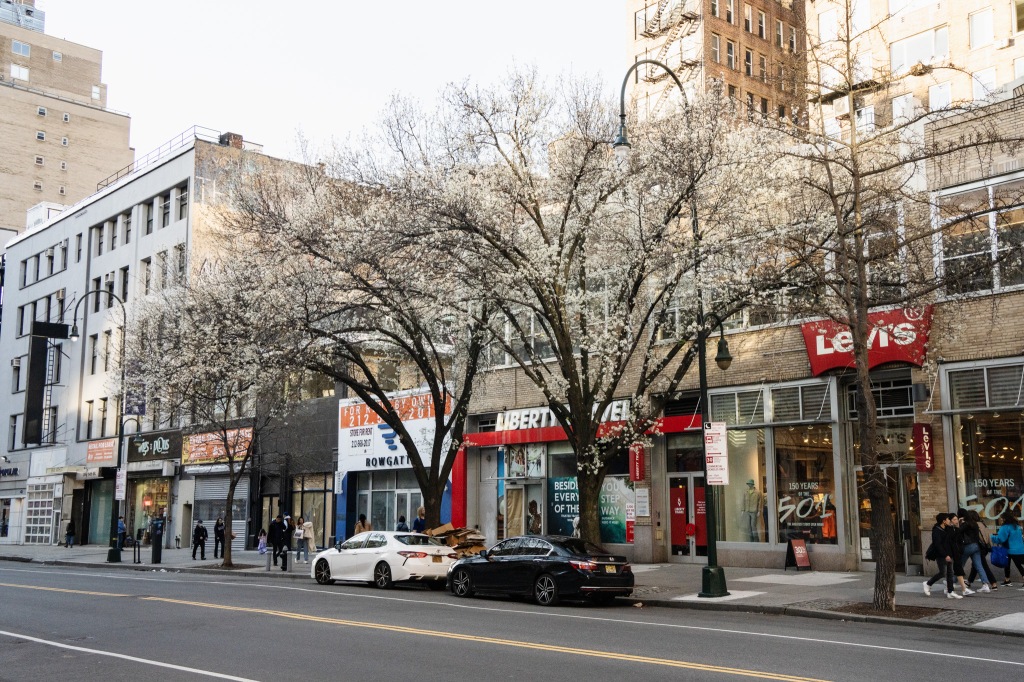
Two notoriously weak-wooded Callery pear trees planted on 14th St. in Manhattan. Nina R. Dietz
As climate change accelerates, New York City is turning to an
ancient technology to beat the heat: trees.
Nina R. Dietz
Sara Evans grew up in Montgomery County, Maryland, surrounded by nature; she attended an elementary school named after the nature writer, Rachel Carson, built around programs about the environment. There were frequent trips out to the Potomac River and Chesapeake Bay to learn about wetland ecology and volunteer with programs to save the bay.
When it was time to choose a major for college, she elected biology; Evans knew she wanted to make human-nature interfaces the focus of her career. However, due to the 2008 recession and family issues, she was forced to put her studies on hold and find work at a bar. She stayed in the Washington, D.C. area for a few more years to be close to family and save up money, before finally deciding to go back to school in New York to finish her degree, this time in urban sustainability.
While studying at Brooklyn College, she was lucky enough to find an internship with Green-Wood Cemetery, digitizing their tree records so they could be accredited as part of an arboretum network. She stayed on after her internship and was soon promoted to a position as the cemetery’s manager of horticulture. It was the sort of work that she’d always wanted to do. She planted wildflower meadows for pollinators and to eliminate mowing around fragile old headstones, added chokecherries to the tree scape, and helped write grants to finance the horticultural program’s work. She maintained Green-Wood’s partnership with Morris Arboretum, which provided the cemetery with a free source of trees for experimental plantings. She has helped plan and plant more than 4,000 new trees throughout the cemetery and reduce the overall age of the collection.
More recently, Evans has been focusing on the problem of New York’s trees. As the climate warms, the city’s trees are coming under unprecedented pressure. They are being flooded during hurricanes and rainstorms, attacked by insects, and subjected to extreme temperatures. Fungal resistance is getting more important by the day. In the last few years, the city’s trees have been dealing with the spotted lantern fly. These invasive pests can be added somewhere below rats and above pigeons on the list of New York City’s most hated pests. Originally from China, the spotted lantern fly feeds on trees and leaves behind a black sticky fungus, which can cause infections. The worst part is, 20 years ago they wouldn’t have been a problem. If temperatures drop to 12 to 14 degrees Fahrenheit and stay there for more than three days or so, you have just pretty much killed off next year’s invasion of spotted lantern flies. One tree species in particular—the London plane—which has traditionally been protected by these cold snaps, can no longer count on them. Though not a death sentence, attention from the spotted lantern fly increases the likelihood that a tree will have a fungal infection. And this is in addition to the many other insults and injuries urban trees are subject to, including poor drivers, small children, and dog owners who don’t respect the “Don’t pee on this tree” signs.
In 2020, the National Climate Assessment announced that New York City no longer had a continental climate, but rather a subtropical one. This meant that the city’s average summer temperature is consistently above 72 degrees Fahrenheit (a criteria it has met since 1927) and an average winter temperature of over 27 degrees, a criteria New York City has met consistently since 2015. This past January was the warmest on record, with an average temperature of 43.5 degrees Fahrenheit.
This was not news to the tree community of New York. For more than a decade, head gardeners, arborists, and directors of horticulture have been experimenting with camellias, fig trees, and full-sized crape myrtles, and watching them thrive. At the same time many of the tree species that had always done well in New York—Norway maple, sugar maple, and pin oak—were showing signs of trouble. This means that soon New York City’s plant life may more closely resemble Atlanta’s than Boston’s.
At Green-Wood, Evans runs tree trials that seek to discover which trees can weather New York’s new climate. She plants them and then sees how they behave. Do they grow? Do they blossom? When the weather suddenly grows cold in January, then warm, then cold again, do they do well? Is central Brooklyn coastal enough for a coastal pine? When the humidity in the summer rises, can they absorb the moisture, or do they require precipitation? She is also looking for how well the trees interact with the existing ecosystem. Do the more than 900 species of caterpillars that depend on oaks enjoy munching on live oaks as much as on white oaks? Can sourcing seed from southern arboretums mimic the northward shift of tree ranges? Can reintroducing keystone species bring back the fauna they support? At any given time, Evans has over 800 unique cultivars of trees growing, at different stages of maturity. The trees she plants and studies are not automatically adopted by the Parks Department if they survive, but it is certainly Evans’s hope that, should New York’s current trees run into trouble, the ones she’s seen thriving can be planted in their stead. But trouble is coming: that she is sure of.
There are over five million trees in New York City; of these, nearly a million are “street trees,” and fall under the purview of the Parks Department.
The Parks’ tally doesn’t count any of the trees in Central Park, Green-Wood Cemetery, or any of the wilder areas of, say, Van Cortlandt Park, or Inwood Hill Park. Still, there are a lot of trees on New York’s streets.
New York City hasn’t always been this green. In the late 18th century, New York City was still a small settlement confined to the lower tip of Manhattan. And though it had plenty of trees, they were almost entirely in the private sphere or on the agrarian lands of upper Manhattan (yes, you read that correctly). Trees would never have been planted on the street in those years unless it was a public promenade of the kind found in London’s Hyde Park. Most city trees of the area were fruit trees, often found in back gardens. At the time, trees were viewed in two ways: either as a luxury to be toured in manicured gardens and admired on estates, or a facet of the agrarian landscape, to be harvested annually for food and chopped down for heat or building materials. They certainly were not seen as a vital part of the city as such.
You can see a gradual change in the attitude toward street trees in the first half of the 19th century. The first Commissioner’s Map from 1811, which laid out the plan for New York City’s grid system, did not include any parks aside from Madison Square, which at the time was a much larger planned military parade grounds, and Inwood Hill Park, which wasn’t actually a park but rather all of Inwood. By the mid-1800s, ideas about the city had changed so much that it was seen as necessary to set aside “natural” land for the enjoyment of the common people. Much of this can be traced to the early work of scientists and doctors who had noticed the rise in severe illnesses such as typhus, cholera, and tuberculosis among tenement residents. Illness at the time was tied to bad air, so the recommendation was to set aside a part of the city where residents could retreat for a country-like breath of fresh air. In 1858, construction began on Central Park.
It was around the time of the Central Park design competition that street trees started to enter the urban vernacular. They were primarily the work of individual residents, or of private garden associations, dedicated to planting trees in a particular area. They began to appear on large boulevards and in central squares, where they were often abused by the ubiquitous livestock of the time. Comics chastised New Yorkers for allowing their mounts to gnaw on tree bark and sheer leaves from low hanging branches. Significant damage could be seen where trees were used as hitching posts. As Sonja Dümpelmann writes in Seeing Trees: A History of Street Trees in New York City and Berlin, some of the earliest tree guards were invented by enterprising New Yorkers to prevent just such damage from their neighbors’ horses.
The first survey on the condition of New York City street trees was conducted in 1914 by a forester from Syracuse University, the first official head of forestry of New York City. He found that many of the trees were in poor condition due to repeated damage and lack of maintenance, though the city did not have the budget to address this. Parks Commissioner Robert Moses planted hundreds of thousands of trees during his long tenure from the 1920s to the 1960s. Moses was fond of the London plane, already known from its history in industrial Britain, to be great at capturing air pollution because of the scales on the back of its leaves, and also the elm, at that time regarded as the greatest of street trees for its hardiness and attractiveness. By this time, Dutch elm disease was already present in the U.S., but a robust eradication campaign in the 1930s and 40s gave the elms several more decades of life in the city.

Golden hour lights up the Washington Square Park Elm. At an estimated 350 years old, it is the oldest tree in Manhattan. Nina R. Dietz
The elms’ luck ran out eventually. During the New York City financial crisis of the 1970s, the city abandoned eradication and management efforts to cut costs. Not long after, the city saw its massive elm tree population rapidly die. Dutch elm disease was passed from tree to tree by both bark beetles and, when row planted, intertwined roots. In some parts of the city, entire blocks, once planted primarily with elms, became barren and empty of trees. The Parks Department tried to fight back. The second a tree was found to be infected; it would be removed. Entire groves were sprayed with pesticides to eliminate bark beetles. Growth inhibitor was put on roots to prevent them from entwining. It worked for a time, then it apparently stopped working. When the first city tree census was conducted in 1995-1996, more than 10,000 standing dead trees were found, and those were just the trees that were sturdy enough to stay standing and not receive 311 complaints.
It is hard to get a real sense of just how many elm trees once graced the streets of New York. However, prior to Dutch elm disease, Chicago, America’s second city, had nearly 750,000 elms between street trees and surveyed park and wild area trees. The number in New York was likely that high.
Since the first tree census in 1995, it has become a decadal ritual in New York City. There have been three total, with the most recent in 2015. New York City is due for another tree census in less than two years. In the 1995 census, 21% of the street trees were Norway maples, 17% were London plane trees, 7% were pin oaks, 7% were honey locusts, and 6% were Callery pears. Things have changed a lot since then. Now the Norway maple accounts for only a little over 5% of street trees and is no longer being planted, London plane trees make up 13%, pin oaks make up 8%, honey locusts have risen to 9%, and Callery pears are back down to 7% from their peak of nearly 10%.
The city is doing a valiant job in its mission of diversifying the tree canopy, so that should a plague or mass die-off affect one species, it will not devastate entire blocks. Though there are 5-10 species that tend to dominate the canopy, there are 537 different tree species in the urban forest managed by the Parks Department. However, Parks is having to contend with a more complicated issue now.
In the last few years, New York City has begun to deal with the legacy of institutionalized racism through street trees. During redlining, redlined areas weren’t seen as good investments for street trees, and following New York City’s bankruptcy in the 1970s it was unable to fulfill its agreement to plant three street trees for every tree planted by residents.
The city’s block planting was mostly replaced by a policy of tree replacement and addition at residents’ request. Only in the last decade, after several studies found that trees were overwhelmingly requested in more affluent neighborhoods where canopy cover was already substantial and heat was already being greatly mitigated, has the Parks Department shifted its focus to areas most impacted by heat and with the fewest existing street trees.
It is doing all this while dealing with the new threats from climate change. It has always been a challenge to get a tree through its first few summers in New York, but the temperature is only going up. And New York is increasingly contending with weather whiplash. It goes through periods of drought where the steam room heat ubiquitous to a New York summer doesn’t let up for weeks on end. But that humidity never manifests into the promised cooling rain. Humans aren’t the only ones who suffer in a heat wave. Young trees don’t have the reserves to handle sun-burnt leaves. Contractors even have to be careful about when they schedule their watering. If you water a vulnerable plant in the heat of the day, you will practically boil the roots.
On a sunny 87-degree day in early April, Evans took me on a tour of Green-Wood Cemetery’s experimental groves. Fittingly, though it wasn’t intentional, nearly all the plantings were from the southern United States. Evans, an athletic brunette dressed in business casual and a warm smile, seems just as ready to field a meeting with donors as to prepare plots for conversion to wildflower meadows.
Evans told me that she does her best to schedule tree plantings for the fall so trees will have a full nine months for their roots to establish before being subjected to a New York City summer. “We try to get them out early,” Evans said as she pointed to a Magnolia Fraseri seedling. “We don’t have a large greenhouse staff, so they tend to do better out on the grounds.”
The seedling was less than two feet tall and boasted a single bud from its lone stem. At this point, it didn’t look like much—more like a stick someone had stuck in the ground and inexplicably put a protective cage around than the beginnings of a beautiful magnolia that could easily outlive both Evans and me. But that’s what it was.
As we walk through the southern grove Evans points to a low plant that looks almost Seussian, like a baby Truffula tree. It is a pinus cluster in its grass phase. “All of its energy is going into building gigantic roots right now,” Evans said. “If someone were to accidentally mow it, it would come back just fine.” This is a tree that does well on southern coasts.
Then it is on to the true star of the show, the Southern live oaks. Clustered together, they look nothing like the Google image search results for “live oak” or my vague recollections from a trip to South Carolina many years ago. These look more like holly trees than any oak I’ve seen before. That’s partially because they are still pretty young. At less than 20 years old, including time spent at the Morris Arboretum, they are barely toddlers in terms of tree age. But the most confusing part is the leaves.
“They’re just starting to shed their leaves,” Evans said, as she held up a branch for inspection. “You can see the new leaf buds coming in.” The leaves are prickly, shiny and thick. They look like they belong on a Christmas wreath, not a tree with “oak” in the name.
Evans finds these odd, nearly evergreen oaks impressive. “Live oaks should be street trees, 100%,” she said. “Like, you think about them in the South and their ability to withstand high winds, heavy rain, salt tolerance. They just require more training when they’re younger, so that they grow into an upright tree form.” Evans points out that they are already used as street trees in cities all over the South.
Before she goes, Evans has one final treat for me. She points out a tree with bulbous fuzzy round buds hanging from its branches. This, she says, is a pawpaw tree. As it happens, I have been on a quest to locate a pawpaw tree for the last three years so I can try the pawpaw fruit. Pawpaws are weird. They are the only species of custard apple to grow outside the tropics. They are found all over the eastern United States and as far north as Maine. But the fruits are not commercially viable, because they are extremely delicate and have a shelf life of only a few days.
For me, this pawpaw was a find because it meant I knew exactly where to go later in the season to try a pawpaw. But for Evans it was something bigger. Pawpaws have a wide growing range; they aren’t a niche species. This gave Evans and other horticulturalists an opportunity to get seeds for native plants from a southern seed source and use them to grow “native” plants that are already adapted to the hotter, less predictable climate. So far it’s working.
In the last few years, New York City has been uncomfortably reminded that one of its best heat-fighting technologies is planting street trees. As night-time temperatures increase, residents lose the opportunity to get a reprieve from the oppressive summer heat. A robust tree canopy can help. Canopy shade prevents the asphalt of roadways from soaking up the excess heat of the day only to radiate it back at night.
The need for a return to block planting, where an entire block of trees is planted all at once, became unavoidable following a series of studies and articles tracking the correlation between canopy cover and subsequent street temperature and the socioeconomic status and demographics of neighborhoods. There was suddenly undeniable proof that poorer neighborhoods actually were hotter and it all came down to the trees.
Unfortunately, planting new trees is so complicated and expensive that, according to Sam Bishop of the non-profit Trees New York, up until a couple years ago the city had “been planting fewer trees every year, in part because of rising tree costs.” The average new street tree costs $3,500, just for the sapling.
Trees New York, where Bishop works, is a non-profit tree-planting contractor that handles contracts for only 300 to 500 trees per year; there are usually in the range of 10,000 to 15,000 damaged, dead, or dying trees to replace a year. However, Bishop said, that can increase significantly if there’s a big storm. For example, Tropical Storm Isaias downed at least 8,500 street trees in New York City when it came through in 2020, according to the Parks Department. The tree procurement budget for the year doesn’t change in response to “acts of god” so some years the number of trees in the city drops quite a bit.
This is doubly concerning as climate change is increasing the frequency of these events. Saltwater flooding can wipe out a stand of 100-year-old London planes with a single king tide. A cloudburst storm can oversaturate the soil to the point that ancient trees tip, ass-over-tea-kettle, as the ground just can’t support them. Severe thunderstorms with freak tornadoes have gone from freak to frequent. All of these do a number on the tree population.
It actually took a herculean reorganization of the contracts and procurements method for street trees for the Parks Department not only to be able to replace all the downed trees, but also to resume their mission of planting new ones. The evidence of those efforts are apparent on my own Central Harlem block. Harlem has some of the lowest percentage of canopy coverage of anywhere in Manhattan. The city has been working to improve that for nearly a decade; however, it is slow-going as tree canopies take a long time to grow. In mid-April, city contractors came to dig new street tree pits along my block, 115th Street, and many of the neighboring streets. In Central Harlem there are already street trees; however they are farther apart than on the Upper West Side and many lack tree guards. The city doesn’t provide tree guards, but they are looking to plant trees and fill up any empty spaces to help fill in the canopy.
Add to that the complications of choosing the correct tree for the location, and it takes a lot of planning to add trees to a previously barren block. The city is trying to avoid a situation where whole blocks, let alone entire neighborhoods, are planted with a single species of tree. “In those situations, if you think about it, the impact of having to remove say 50-75% of all those trees if they’re dead, it’s a huge visual impact,” said Bishop. “It’s very upsetting to people. So we’re trying to eliminate some of those vulnerabilities.” That means a lot more thought has to go into planting on a previously empty block.

A close up of red maple flowers. Nina R. Dietz
Different parts of the city, meanwhile, have different requirements from their street trees. Since Sandy, when, Bishop said, it became clear that “London planes do very badly when flooded,” and honey locust, swamp oak, and red maple have become the new go-to trees in the flood-prone Rockaways. But in the East Village, near the pollution-heavy old power plant, ginkgo trees, beloved for their tolerance of heavy air pollution, are being planted, and the over-planted London planes will be replaced.
But Dr. Angelica Patterson, who tracks tree range migration in response to climate change, worries that by trying to choose trees that meet individual criteria, New York City is missing the overall problem with climate change. It doesn’t just change one aspect of the climate, she cautioned, but rather the entire system. It’s great if you have salt-tolerant trees in flood-prone areas, but, Patterson said, using red maples as an example, “if you’re looking at precipitation, then maybe that would do well, but if you’re looking at temperature, not so well.” The work will involve a lot of trial and error, she said.
Patterson’s example shows why finding good candidates for street trees is so difficult. They have to pass the ultimate Swiss cheese test. Imagine that there are 10 trees, each a different species, growing together in a grove. Suddenly a giant slice of Swiss cheese, labeled “root compaction,” falls from the sky and crushes three of the trees. Miraculously, the other seven trees make it through the holes. Then another slice, this time labeled “air pollution,” falls and crushes one more. We have six left. More slices fall, “fungus” takes out two, “structural integrity” one, “sidewalk jelly” two, and the final two are done in by “invasive species.” None of these hurdles are climate-related, but clearing these alone is hard enough. Now we have “heat stress,” “drought,” “flood,” “warm winter,” “polar vortex,” and “salt intrusion” thrown into the mix. You can see how meeting the requirements of the Swiss cheese test is only getting harder.
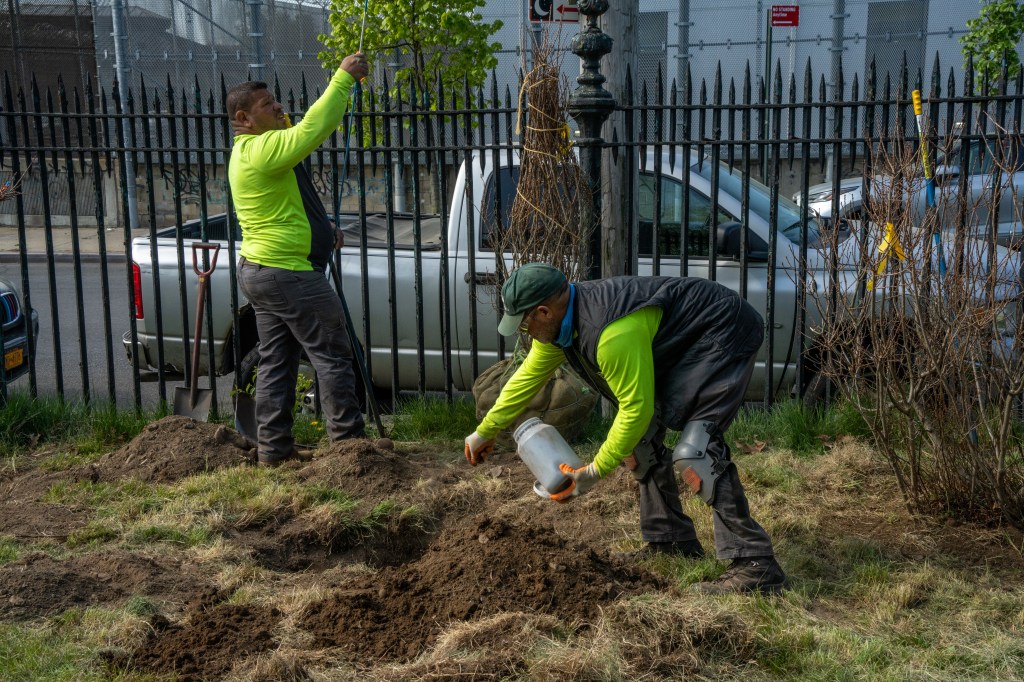
Gardeners prep the area for new shrubs on the edge of the Freedom Lots in Green-Wood Cemetery. Nina R. Dietz
On a cool April morning, just two days shy of Earth Day, I waited for Evans to pick me up as feral parrots swooped and dived from their nest in the gothic archway above me at the Northeast entrance of Green-Wood Cemetery. I was there to see some new trees being planted.
These were not experimental trees that were part of the tree trials; instead, that morning, the gardening crew was focused on the Freedom Lots, a set of small plots formerly known as the “Colored Lots” that had been restored and renamed by a group of high school interns in 2017. They were the historically segregated lots of Green-Wood Cemetery. Much like redlined neighborhoods had to make do with disinvestment and little to no canopy coverage, prior to their restoration the Freedom Lots had seen little maintenance and were relatively barren of plantings.
Today, the Freedom Lots are getting around a dozen new shrubs, to be planted along the border fence, continuing the forsythia hedge from the next plot over. Evans is as proud of this work as she is of the tree trials. Now, in addition to the new trees and hedges, irises encircle some of the headstones, and grape hyacinths mix with pink dwarf tulips with luminous yellow centers among the graves.
“We’re looking 50, 100 years into the future, we also want a collection,” said Evans, “with a lot of young trees.” She, of course, has more experiments in the works—hundreds more trees to plant this spring and fall alone. There are already experimental American chestnut tree crosses growing in one area of the cemetery, and maybe soon it will be time to add one of the newly approved blight-resistant varieties to the mix.

 Planet A Magazine
Leave a comment