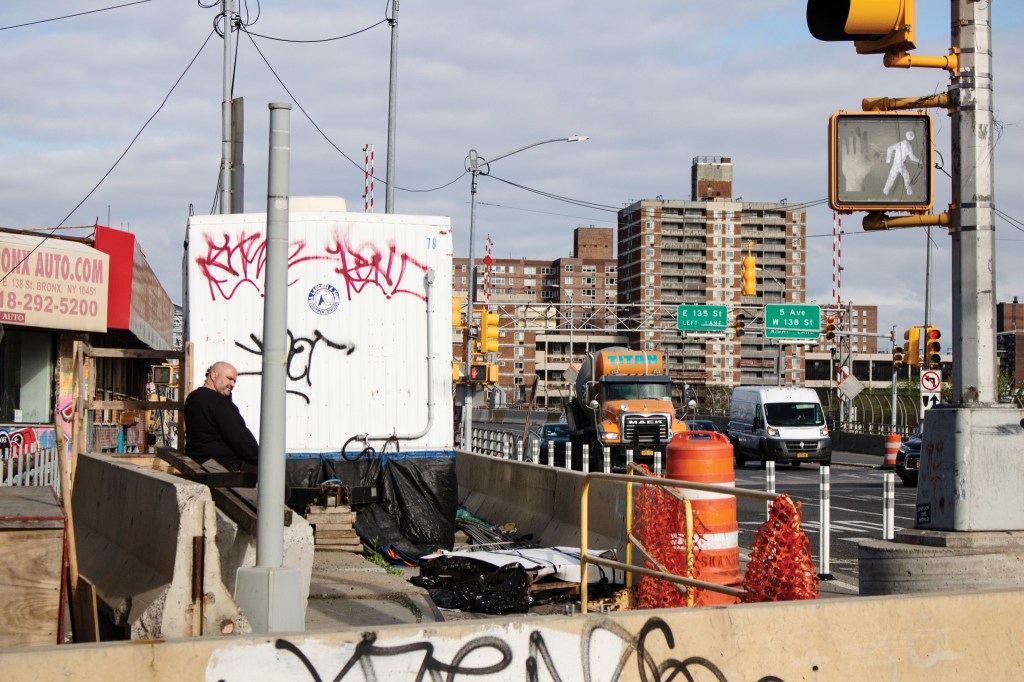
A worker pauses for a coffee break next to rush hour traffic piling onto the Major Deegan Expressway in Mott Haven. Ani Freedman
The South Bronx has suffered through decades of air pollution and high asthma rates. Locals, activists, and scientists are fed up.
Ani Freedman
Maritza Franklin talks about the South Bronx like she has a bad taste in her mouth. She’s lived there her whole life, a third of it spent working as the receptionist for the Mercy Center, a community center in Mott Haven. There are two doors to get in, both of which Franklin has to buzz you in for. Once you enter, Franklin greets you from behind a desk. She is often dressed in brightly-patterned tops and her outfits are always color-coordinated—purple sneakers to match purple bracelets, earrings, and a necklace, and a blouse coated in purple flowers. The only thing that doesn’t match is the light blue surgical mask on her face. Most of the people who come to the center speak Spanish, and Franklin responds in their native tongue, making them feel comfortable and safe, especially if it’s their first time there for one of the parenting, anger management, or English classes offered by the center.
Franklin, who is 58 years old, started wearing masks long before the COVID-19 pandemic. She doesn’t keep it on consistently while she’s working, lowering it to talk to coworkers or visitors, or when she’s munching on an apple during a break. Outside, though, is where the mask is really meant to protect her, from the air in the neighborhood nicknamed “Asthma Alley.”
When Franklin steps out of the Mercy Center at the end of the day, she’s met by unwelcoming air. Working in the South Bronx means facing the particulates spewed by a constant flow of diesel-burning trucks going to and from the many warehouses south of the community center. On the three large expressways that encase the Bronx, stagnant rows of cars flood the air with fumes during rush hour. “It’s like I’m choking up half the time,” she said.
Franklin’s always been aware of the air pollution in the Bronx. She says everyone is. She hears her friends talking about asthma, saying their kids all have it. One of them, a mother of five, used to constantly bring her children to the hospital when they were younger, Franklin said.
Franklin grew up around Hunts Point during the 1970s, the height of a time known as “the Bronx is Burning,” because of the frequency of building fires in the borough, including, infamously, during Game 2 of the 1977 World Series, when a huge fire engulfed an abandoned elementary school near Yankee Stadium. Franklin looked for any opportunity to get out of the Bronx, even if that was just a quick trip to Manhattan. She said Manhattan was cleaner, and it wasn’t how she “saw” her home: only in the South Bronx, Franklin said, would she witness so many deserted buildings and homes ablaze. “I hated it,” she said. “I hated walking around the streets with all the burning buildings.”
Twenty years ago, a doctor told Franklin she had asthma. She refused to believe him. Despite how much she says she suffers from breathing problems, she says it’s nothing compared to others she’s known with asthma. She sees them dealing with more pain, wheezing, being hospitalized. Franklin’s respiratory problems have never gotten to that point, but it’s not just the car and truck exhaust that gets to her—she fears getting sick. Even just a common cold will spiral her into wheezing and coughing fits. She’s only felt her cold symptoms get worse over the years, believing long-term poor air quality exposure to be the culprit.
Franklin still looks at the South Bronx through the same frustrated eyes she did as a child. Nowadays, she’s preoccupied with the inadequate healthcare from local hospitals, especially as she’s become more concerned about her health. When Franklin calls the doctor, she said, they’re always telling her they’re too busy. They push her appointments months away. “What if something is happening to me now?” she said.
Most of the time, Franklin said, people in the South Bronx go to the emergency room for their health concerns. That seems to do little to help. “Unless you’re showing signs of dying, you have to wait,” Franklin said. She’s heard of people willing to pay a steep cab fare just to receive better medical care in Manhattan, but Franklin wants to see improvements in her own backyard—in the place with the highly polluted air.
Franklin is tired of her health problems, the traffic, and the pollution she’s experienced. She and her friends have lived in the South Bronx long enough to know that the air harms them. Researchers and medical professionals have known for a long time, too, with studies about high asthma rates in the South Bronx going back to the 1970s. Nonetheless, things don’t seem to be changing quickly enough, for Franklin or anyone else who breathes the air in the South Bronx.
In 1939, city-planner Robert Moses’ proposal to connect the Triborough Bridge and the Bronx’s Grand Concourse began the encasement of the South Bronx between three major expressways: the Major Deegan, the Cross-Bronx, and the Bruckner Expressways. Over the next three decades, Moses’ desire to connect Manhattan to New York State’s interstate highway system would come at the cost of the people of the South Bronx’s health and homes. The New York City Department of Parks and Recreation cited Moses’ own calculations to estimate that for each mile constructed of the Cross-Bronx Expressway, approximately 50 apartment buildings were demolished and 5,000 people were displaced. With each section of the expressways completed, more cars and trucks flooded the South Bronx. As construction and displacement pushed forward in the South Bronx, the federal government was confronting the adverse health impacts of an aggressively industrializing country.
In late 1958, according to Scott Hamilton Dewey’s book, Don’t Breathe the Air: Air Pollution and U.S. Environmental Politics, 1945-1970, a doctor from the California State Department of Health warned of “unknown potential health damage from long-term, low-level, chronic exposure to air pollution.” Transportation and booming industrialization seemed to be the main culprits. Meanwhile, the Surgeon General at the time pointed out lung cancer rates were twice as high in large cities versus rural areas. In 1961, the United States Public Health Service announced it was “abundantly clear that acute air pollution can cause death among the aged and serious illness in the general population.” In 1963, partly in response to these concerns, Congress passed the Clean Air Act, giving the federal government authority to reduce air pollution between the states. Then in 1966, the Surgeon General declared air pollution to contribute to rising chronic respiratory diseases, including chronic bronchitis, lung cancer, and asthma.
It was one thing to acknowledge air pollution, but another to do something about it. New York City took its time in embracing the warnings of scientists. The people breathing its air knew it was toxic, and they could see it. Smoke, ash, and smog often floated in and above the streets as coal burning, combustion engines, and garbage incineration were all sewed into the fabric of life in New York. By 1970, the New York City and New Jersey area was seen as “perhaps the worst air pollution problem in the nation,” Dewey writes. That year, the Environmental Protection Agency (EPA) was formed to enforce air pollution regulations. The National Ambient Air Quality Standards were created to establish permissible levels of pollution based on Air Quality Criteria reports, which emerged from a 1967 amendment to the Clean Air Act.
As federal regulations on air quality tightened, the Bruckner Expressway was nearing completion. In 1972, after 20 years of construction, Moses’ vision of transforming Bruckner Boulevard into an expressway was realized. Air pollution and asthma were not leaving the South Bronx. A 1977 study of the now-closed Morrisania Hospital, located just east of the Major Deegan Expressway, told a story that people living there could tell today—asthma and respiratory hospitalizations were everyday occurrences. The study found that of asthma-related hospitalizations from 1973 to 1974, 54% were pediatric. Half of those children were under the age of six. 80% of the people treated in this southern Bronx hospital were living in poverty, and of the registered asthma patients, 59% were Puerto Rican. The study made no mention of air pollution or the many highways and industries in the Bronx as possible reasons for this overwhelming health problem.
Nearly 20 years later, in 1995, an article in the New York Times echoed the Morrisania findings. The article described parents of coughing children, men who struggled to breathe on the street, and doctors at Lincoln Hospital in Mott Haven, who were inundated with close to 13,000 asthma-related visits per year in the 1990s.
Scientific knowledge was improving; health outcomes were not. By the 2000s, hospitals could begin to differentiate between asthma caused by ozone (a gas created by the mixture of various pollutants and chemicals, and exacerbated by heat and humidity) and asthma caused by PM2.5 (particulate matter smaller than 2.5 microns in width). From 2005 to 2017, asthma hospitalization rates and emergency department visits in the Bronx due to ozone increased for children under 18, according to the NYC Health Department, with emergency department visits increasing from 136.1 to 177.5 per 100,000 children. Asthma visits due to PM2.5 decreased from 212.5 to 146.9 per 100,000 children.
It wasn’t until 2008 that the NYC Community Air Survey was created, the same year the EPA set a nationwide smog standard—which Bronx County has violated every year since 2012, according to data from the EPA. While NYC was bolstering its air quality monitoring, and asthma rates saw little improvement for Bronx children, the real estate company, Galesi Group, was laying the groundwork for transforming the Hunts Point and Mott Haven waterfronts into industrial hubs. In the early 1990s, Governor Mario Cuomo gifted the group a 99-year lease for the control over the 104 acres of the Harlem River Yards, located at the southernmost part of Mott Haven’s waterfront. This land would soon turn into the Hunts Point Produce Market and streets packed with warehouses and industrial facilities. Part of it would, in 2018, become the FreshDirect warehouse, from which diesel trucks go in and out to deliver over 100,000 online grocery purchases each day.
Soon after ground was broken on the FreshDirect center, the Galesi Group secured a $100-million loan to refinance Harlem River Yards, The Real Deal reported in 2016. NYCommons, a site that compiles public land use information in NYC, reports that the Galesi Group’s land at Harlem River Yards includes a 28-acre intermodal rail facility, a Federal Express Distribution Center, 21st Century Fox America, Inc., a printing/distribution facility, and a Waste Management solid waste transfer station in addition to the FreshDirect warehouse. For years, the South Bronx has been a center for industrial development, at the expense of the surrounding neighborhoods.
The NYC Health Department estimates that PM2.5 pollution in the city causes over 3,000 deaths, 2,000 hospital admissions for lung and heart conditions, and approximately 6,000 emergency department visits for asthma in children and adults. Ozone is estimated to cause 400 deaths, over 800 hospital admissions, over 4,000 emergency room visits among children and adults each year. And the people experiencing the worst health outcomes from New York City air pollution are in the poorest neighborhoods.

The people in the South Bronx carry the burdens of the highest poverty rates in New York State. Mott Haven, Hunt’s Point, and Morrisania each reported over 39% of residents living below the poverty line in 2019, based on data from the NYU Furman Center. According to NYC’s Environment and Health Data, the Bronx had the highest rates of asthma-related hospitalizations and emergency room visits due to ozone and PM2.5 from 2012 to 2017 (the most recent data available).
While chronic respiratory illness has persisted in the South Bronx, pollution levels of PM2.5, sulfur dioxide, and nitrogen dioxide have all decreased since 2000, according to the latest data from the New York State Department of Environmental Conservation. Air pollution emissions standards have only gotten stricter and regulations have introduced cleaner burning fuels, while air quality monitoring in New York City has grown substantially since the program was introduced in 2008. But as the South Bronx’s asthma epidemic persists, the need to understand the air on the ground level grows, shedding light on the socioeconomic problems that transcend science and measurements.
At the end of December 2022, New York State Governor Kathy Hochul signed the Cumulative Impacts Bill, adding a section to the state’s 2019 Climate Act considering “disadvantaged communities.” These laws require agencies to consider whether proposed projects will “increase a disproportionate or inequitable or both disproportionate and inequitable burden on a disadvantaged community.” The laws also require “equitable siting” of environmental facilities in consideration of how that facility may impact a disadvantaged community. According to the Climate Act, 178 communities in Bronx county were identified as “disadvantaged.”
The income and health disparities between the South Bronx and the rest of the city have not gone unacknowledged by politicians, activists, and scientists. But there is a dissonance between the speed with which policymakers, business owners, and regulators have acted on air pollution within Bronx communities, and the suffocating situation on the ground.
On the evening of March 30, the New York State Department of Environmental Conservation (DEC) hosted a virtual meeting about the Community Air Monitoring Initiative in the Bronx. State officials from Albany connected with Bronx activists and community members as they went over what the DEC is doing to address air pollution in the Bronx—and what the community actually needs from them.
Adriana Espinoza, Deputy Commissioner for Equity & Justice at the DEC, introduced the air monitoring program as part of New York’s Climate Act. “Ten communities with evidence of disproportionate air pollution burden were selected for air monitoring, including large areas of the Bronx,” Espinoza said. The Climate Act, Espinoza explained, “aims to eliminate a disproportionate burden of pollution that is facing disadvantaged communities.”
The initiative focuses on block-by-block air monitoring, explained Randi Walker, a researcher at the department’s Division of Air Resources. The state will use hybrid or low-emissions vehicles with sensors mounted on top to gather data on gaseous pollutants such as CO2, ozone, methane, black carbon, and fine particulate matter, or PM2.5, as they drive through the Bronx. “The goal of this initiative is to identify sources and, with the community input, develop emission reduction strategies,” Walker said.
Following the passing of the Climate Act in 2019, New York State pledged to reduce economy-wide greenhouse gas emissions 40% by 2030 and no less than 85% by 2050 from 1990 levels.
Margaret LaFarr, Assistant Director of the Division of Air Resources at the DEC, introduced the “Cap-and-Invest” program, which will establish a legally binding cap on greenhouse gas emissions, and every year the cap will decline to meet the goals of the state’s Climate Act. The program will force large-scale polluters and distributors of heating and transportation fuels to purchase allowances for emissions, which will be invested in programs that drive emissions reductions. According to LaFarr, 35 to 40% of those funds will be used to benefit disadvantaged communities.
There were about 45 people on the call, including representatives from the activist groups South Bronx Unite, NYC Environmental Justice Alliance, and AirNYC. They weren’t shy to speak up once the hosts opened up the meeting for questions.
Leslie Vasquez, Clean Air Project Coordinator from South Bronx Unite, went first. She was skeptical about the cap-and-invest plan. “It is very evident that the largest emitters do have money and can afford to produce emissions and pay for allowances,” she began. “How will we ever moderate that 40% reduction or 80% reduction if these facilities are always able to purchase the amount of emissions that they emit?”
LaFarr and Espinoza explained that the emissions reduce each year, as will the amount of allowances these emitters can purchase.
Vasquez remained dubious.
“What happens when the facilities produce more than the allowance permitted?” she asked. “Is there any accountability that you guys are planning on?”
Lois New, the DEC’s Director for the Climate Change Office, took that one. “Each year, the facility has to prove that they have purchased allowances, put them into an account that we manage and then provide the number of allowances, equal to their reported emissions,” she said. “And then there are compliance and enforcement penalties if they don’t.”
It was clear, however, the DEC representatives weren’t sure what those penalties would look like yet. “You know, some of the details haven’t been laid out yet,” LaFarr said.
Eunice Ko, Deputy Director NYC Environmental Justice Alliance, echoed Vasquez’s concerns. “From our perspective, it’s really important to hear and to see guardrails for environmental justice communities,” Ko said.
At the end of the discussion, Dirk Felton, another research scientist, went over black carbon’s presence in the South Bronx. Looking at a map of black carbon measurements from the monitoring thus far, Espinoza, from the DEC, pointed out that the levels seemed high across the South Bronx, whether along the expressways or in residential areas.
“There’s so many sources that they really don’t get a chance to decline,” Felton said.
Espinoza said the department hopes to incorporate community voices into their air pollution initiative. They are in the process of forming a community advisory committee to “support robust engagement,” Espinoza said. “Any interested stakeholder can participate.”
While the DEC representatives made it clear they wanted to work with the Bronx community, the activists remained frustrated. The call was a step forward in on-the-ground collaboration, but it was undeniable that a computer screen and hours of driving remained between the South Bronx and the DEC. Working up in Albany, the researchers and state workers aren’t on the streets of the Bronx—nor have they lived the decades-long asthma crisis that just doesn’t seem to be getting better. While they work on timelines that look toward 2030 and beyond, activists from the Bronx breathe the polluted air every single day. They don’t have the time to keep waiting for regulation and enforcement. They don’t have the time to wait for policies that may or may not make a dent in the steadily high rates of asthma hospitalizations for their kids.
A few days after the conference call, I took a walk through the South Bronx with Renán Orellana, a health worker and former community organizer who’d lived in the northwest Bronx for part of his childhood. He returned to the South Bronx to serve as a community health worker for three years in Hunts Point between finishing his undergraduate degree and starting medical school. Orellana believed that it was vital for health care to leave the forbidding walls of the giant hospitals and reach the communities that most need it. When he worked in the Bronx, Orellana said, he conducted workshops at community centers, clinics, and churches in Mott Haven in both English and Spanish. But what stood out to him was the life outside of the walls in which he was speaking—a life colored by asthma, polluted air, and unlivable housing conditions.
“There was one point where a child had an asthma attack in front of me,” Orellana said. “I still hadn’t started med school so it was kind of like, ‘What can I do?’ Luckily, he knew exactly what he was doing, because he had already lived much of his childhood with asthma.”
When we met in the South Bronx, Orellana, who is 30, took me through the places that he’d lived and worked in—the places where he witnessed the worst health outcomes in New York City. He first took me past Lincoln Hospital; they used to have a program to combat asthma, he said, but its funding was cut. “When not enough resources are being allocated not only in quantity but in terms of quality and appropriately, you start to see these health disparities,” Orellana said. “And usually it’s the vulnerable and marginalized communities that get affected the most.”
The Bruckner Expressway loomed above us. Orellana took me down by the industrialized Hunts Point waterfront, where he had begun community organizing while he was a healthcare worker. At the intersection of Hunts Point Avenue and Lafayette Avenue, Orellana stopped. From where we stood, we could see trucks, warehouses, and industrial sites in all three directions. We turned right, toward the Hunts Point Industrial Park.
“Imagine being a child growing up around this,” he said, throwing his hands toward piles of old clothes, empty Gatorade bottles, and wrappers from fast food restaurants. We had just walked by Joseph R. Drake, a public elementary school. As we walked back towards the Bruckner, Orellana’s tone changed. “I don’t even have asthma and I can feel it,” he said. He was holding his chest. I asked him what he meant by that. “It’s just tight,” he said, rubbing over his ribs. He was having trouble breathing, a man who competed in long-distance running events in the little free time he had. We had only been walking through the industrial park for 15 minutes. As we approached the Bruckner Expressway again, Orellana pointed ahead to a big brick building, less than a block from the highway. “And there’s a school.” It was the second school we had seen just blocks from the Bruckner Expressway.

Renán Orellana stands beneath the Bruckner Expressway, waiting for traffic to pass. Ani Freedman
As of April 30, the EPA lists Bronx county as a “non-attainment area” for ozone, meaning the National Ambient Air Quality Standards have not been attained for ozone pollution levels. While the city is no longer submerged in the black smoke and smog of the 1950s, scientists have found this progress has been slow.
Dr. Jim Schwab, Senior Research Faculty at the Atmospheric Sciences Research Center of the University at Albany, has focused his research on air quality monitoring. He’s noticed measurable improvements in air pollution reduction in New York City as emissions standards have become stricter—but he’s seen little change in how often the city violates the national air quality standards. “There’s about 15 days a year where the greater metro area’s ozone standard is violated,” Schwab said. And the disproportionate health burdens in the South Bronx remain, even as the rest of the state sees steadily decreasing levels of pollutants like PM2.5 and ozone.
“The most persistent regulatory problem in New York State is ozone non-attainment,” said Schwab. “It’s been that way for decades.”
The city has begun to acknowledge that the South Bronx experiences the worst health outcomes from poor air quality, in part from the body of health risk assessments that have emerged from air pollution research. Sarah Johnson, executive director of the New York City Department of Health Air Quality Program, was a lead author on an assessment which modeled emissions-reducing scenarios to understand the impact it would have on different neighborhoods in the city.
Johnson explained these scenario-driven studies are largely for policymakers to see the impacts of stricter standards. The emissions-reducing scenarios reflected the greatest benefits overall for the highest poverty neighborhoods—notably, the South Bronx. The study found “10 times more avoided asthma emergency department visits in low-income neighborhoods as compared to the wealthiest neighborhoods even though median declines in ambient PM2.5 were similar.”
Johnson said that there is an abundance of evidence linking ozone to respiratory outcomes and hospitalizations. She explained that PM2.5 is made up of “tiny particles that penetrate the lungs and get into the bloodstream. It could be bits of tires or asphalt, soot, combustion emissions,” she said. “There are a wide variety of impacts from increased risk of cardiac hospitalization, asthma, respiratory hospitalizations, to premature death.”
There’s little Johnson can do in her role at the Health Department to intervene in high poverty neighborhoods. “We are not regulators. Our role is to find ways to be at the table in the conversations in which these policies are being designed and implemented,” Johnson said.
Margaret LaFarr, who was one of the DEC representatives at the online meeting in March, wants New Yorkers to consider their individual roles in air pollution to reimagine the issue. “We have to start focusing on things that are harder to get accepted by people, because it does mean a personal choice,” LaFarr said. “It’s certainly a goal we have, to electrify the fleet of vehicles here in New York, but it’s also making sure we have a charging infrastructure in place and educating the public about owning and driving an electric vehicle.”
But it’s not easy to convince people to act. “Some of the challenges that are coming up are because it’s harder to make those types of regulatory changes, because it means we have to explain to everybody individually how that can make an impact, whereas with facilities or businesses, we can say, ‘This is what the emission limit must be and these are the controls you must put on industry,’” LaFarr said.
Dr. Markus Hilpert, Associate Professor of Environmental Health Sciences at Columbia University, has focused his research lately on the intersection of environmental injustice and health—and he wants to direct solutions towards the congested expressways and streets of the South Bronx that Orellana showed me.
Last April, Hilpert and his colleagues published a study assessing the impacts of traffic and congestion in the South Bronx between 2017 and 2019—right as the FreshDirect warehouse was being completed. While they couldn’t make direct conclusions about the food distribution company, Hilpert and the other researchers found a measurable increase in traffic congestion all hours of the day during the study’s timeframe. Coupled with the interstates surrounding the South Bronx, people living in areas such as Hunts Point, Mott Haven, and Port Morris deal with traffic congestion from multiple sources—and Hilpert is concerned about their health.
“It’s not just respiratory disease, it’s cardiovascular disease,” Hilpert said. “Some of the stuff you are breathing can make it into the human body, into the bloodstream.”
“Air pollution is a very big issue when it comes to total mortality,” he said.
While Hilpert thinks New York State has some of the best initiatives when it comes to air quality monitoring, that’s not necessarily where he sees the solutions.
“Not all air pollution is equal,” Hilpert said. “Often we use measures of particulate matter, and not all dust is equal—there is some dust that comes from diesel trucks, or you might have just dirt in the air or sea salt. You would also need to look into the exact composition of air pollution.”
Hilpert himself is from Germany, whose approaches to pollution and greenspace influence how he conceptualizes solutions here in New York. As he has increasingly shifted his work to incorporate environmental justice, he sees changes to be made on the ground. He wants to start by capping expressways, which would mitigate the amount of pollutants released into the air while also reducing noise pollution for the surrounding neighborhoods. Elsewhere in New York City, the Brooklyn-Queens Expressway and the FDR Drive have both had sections capped.
The Cross-Bronx Expressway would be relatively easy to cap, according to Hilpert, who also has an engineering degree. But the Major Deegan Expressway, wrapping around the western edge of the South Bronx, poses a bigger challenge. “You would almost need to build a mountain around it,” Hilpert said.
In rethinking these expressways, Hilpert also sees an opportunity to bring more nature to an area desolate of greenspace. When he first arrived in the city, he was shocked to see what New Yorkers defined as “parks”: playgrounds and asphalt with little greenspace, and little between them and the expressways around them.
“What always surprised me when I moved here is there are no noise barriers,” Hilpert said. What he’s referring to would be lush vegetation surrounding the expressways, which not only would provide another obstruction to the noise disrupting the sleep and wellbeing of South Bronx residents, but would also help clean the air and give people something beautiful to look at amid the constant flow of trucks and cars through and above their neighborhoods.
“In Germany, there is a major roadway next to a small village and they have a noise barrier, probably to protect less than 1,000 people,” Hilpert said. “Now you look at New York City, and for Christ’s sake there’s no noise barrier?”
Hilpert expressed concern over the places these trucks are coming in and out of as well—namely, the Harlem River Yards and the Galesi Group’s properties. “The big issue is last-mile delivery of the grocery delivery centers being built in low-income communities and communities of color—and the goods are delivered to higher-income neighborhoods, with these trucks rolling through the lower income neighborhoods,” Hilpert said. “We need to make an effort to at least have clean vehicles traveling in-and-out.”
The DEC has until January 1, 2024 to draft and circulate enforceable regulations to ensure that the state meets the Climate Act’s statewide greenhouse gas emission limits—meaning something will have to be done about all of those diesel trucks.
“The issue is how the FreshDirect warehouse is not the only thing there,” Hilpert said. “We have been adding things to this community for decades.”
Hilpert sees the issue as the cumulative impact of inundating the South Bronx with industry, expressways, and no real access to adequate healthcare, greenspace, or the neighborhoods’ own waterfront to improve quality of life. “Every single business there does not need waterfront access,” Hilpert said, referring to the Harlem River Yards. “They don’t have boats. They have trucks. Sometimes I wonder whether things could not be managed a bit better to at least give the waterfront to the community.”
“I don’t know if there will be a way to reverse things,” Hilpert said.
Asthma-related hospitalizations and deaths are not improving. Local environmental justice work, it seems, needs to inform regulatory action; as those regulations are strengthened, the community must be as well. The recent meeting between DEC officials and Bronx community activists was a step towards recognizing the health impacts by listening to the voices on the ground. With experts and state regulators shifting their focus to more community-based research and dialogue, perhaps the numbers will finally change.
After finishing his degree, Orellana plans to go down to El Paso, Texas, where he can do immigration-focused community health work at the border to help immigrants. But as he looks towards his own future, he feels uncertain for the future of the South Bronx.
“I think it’s also just something that the South Bronx community has understood: no one’s going to do anything for them. Neither politicians or law enforcement. Everyone’s going to abandon them or make false promises that end up not coming to fruition,” Orellana said. “The best way is empowering the community and bringing in people with certain expertise in some way or another and involving them in something that’s community-owned.”
Franklin is uncertain if she’ll stay in the South Bronx. The last time I spoke with her, she seemed torn between her affection for her community and the exhaustion of living in the South Bronx her whole life. She’s found a workplace that appreciates her and has made lasting friends in her coworkers, while giving back to the place she grew up. Franklin worries that if she leaves this job, she won’t be greeted by the same respect and thoughtfulness somewhere else.
Since she was a child, Franklin has always looked for little escapes from the South Bronx—to get away from the burning buildings of the 1970s, or to find nature and cleaner air. When she has the time, Franklin likes to go to the New York Botanical Gardens, north of where she works in the Bronx.
Franklin can feel her health worsening. No matter how much she keeps her mask on, her coughing and breathing have become irregular more often. Now, Franklin is thinking about moving to Long Island, or perhaps somewhere warmer. She doesn’t know how much longer she can stay. “It’s to the point where I want to move somewhere I can breathe better,” she said. “It’s too much, it really is.” ◊

 Planet A Magazine
Leave a comment